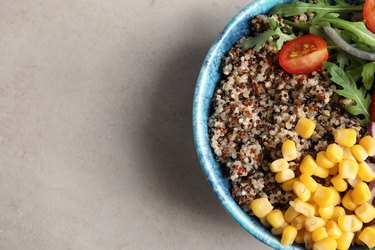
Few foods have as much bona fide health cred as quinoa: It's both whole-grain and gluten-free, low in fat, a good source of protein, and rich in antioxidants; in other words, it's pretty much a nutritional slam dunk.
But quinoa is also high in carbohydrates — which can pose a problem if you're following a low-carb meal plan like Atkins or the keto diet.
Video of the Day
Video of the Day
But before you write off this pseudocereal, as food scientists call it, it's important to understand how the carbs in quinoa differ from those in refined grains and starches. This can help you decide whether or not to incorporate it into your diet and the best ways to do so.
Quinoa Nutrition Facts and Figures
Although it's classified as a whole grain, quinoa is actually the seed of a plant native to the Andes region of South America, related to Swiss chard, spinach and beets. Cooked quinoa makes a nutritious, gluten-free addition to any diet, providing a valuable source of fiber and vegetarian protein.
Read more: The Best Grains for a Low-Carb Diet
There are more than 120 varieties of quinoa, including white (also known as golden), red and black. Nutritionally, they are all similar: A half cup of cooked quinoa contains 111 calories, 4 grams of protein, about 2 grams of fat and almost 20 grams of carbohydrates, according to the USDA. Because nearly 3 grams of the carbs in quinoa are from fiber, it contains 17 "net grams" of carbs. (Some people on low-carb diets count net carbs, which is a measure of total carbohydrates minus fiber and sugar alcohols — both of which have little effect on blood sugar.)
Unlike most plant-based foods, quinoa is considered a "complete protein" because it contains all seven essential amino acids, according to Harvard T.H. Chan School of Public Health. Quinoa also has a higher ratio of protein to carbs than other whole grains.
Quinoa also supplies a variety of other nutrients, including B vitamins (except vitamin B12) and vitamin E, and minerals such as iron. According to the National Institutes of Health, a half cup of quinoa contains 17 percent of a man's daily iron requirement and almost 8 percent of a woman's.
How Quinoa Fits into a Low-Carb Diet
Depending on the specific plan, people on low-carb diets may be advised to limit their carbohydrates to anywhere from 20 to 130 grams a day. For those on the low end — like those in the first phase of the Atkins 20 diet, or any other plan designed to put the body in a ketogenic, fat-burning state — even one serving of quinoa is too many carbs for one meal, says Franziska Spritzler, RD, author of The Low-Carb Dietitian's Guide to Health and Beauty.
Read more: Where Does Quinoa Fall on the Glycemic Index?
"Quinoa is a really great substitute for people who can't have gluten," says Spritzler. "But it's definitely not a keto food: It's high in carbohydrates, and it doesn't have all that much fiber in relation to digestible carbs."
For people on more moderate low-carb diets — who are allowed 50 or more grams of net carbs per day — quinoa can be eaten in small quantities, Spritzler says. On the Atkins 20 diet, for example, small quantities of quinoa are allowed in phases three and four, which are designed for maintaining weight loss after reaching one's goal.
Why Quinoa May Be Worth an Exception
Quinoa is widely hailed as a superfood with numerous health benefits. Its fiber and protein help keep you satiated — an important factor for weight management — while its iron content helps transport oxygen to the body's tissues. As a gluten-free grain, quinoa also boosts the fiber content of diets for people with celiac disease or gluten intolerance.
Quinoa is also high in antioxidants, particularly quercetin, that may have cancer-protective benefits, according to an April 2016 review article published in the Journal of Nutrition & Food Sciences. And in an August 2017 study published in Current Developments in Nutrition, people with obesity who ate 50 grams of quinoa a day saw a reduction in triglycerides (a harmful type of cholesterol) and a reduced prevalence of metabolic syndrome — a major risk factor for type 2 diabetes and heart disease.
One reason quinoa is so nutritious is because the body doesn't react to it the same way it does other types of carbohydrates, says Suzanne Ryman-Parker, RD, founder and CEO of Powerhouse Bakery, a gluten-free bakery and cooking school in San Antonio, Texas. In that sense, she says, the numbers on the nutrition label don't tell the full story.
"Quinoa has fiber and more protein than other grains, so absorption and digestion is slower," she says. "It doesn't elevate blood sugar the way, for example, a serving of white rice with the same number of carbs would — which is exactly what we're trying to avoid on a low-carb diet." (Over time, blood sugar fluctuations can lead to insulin resistance, which triggers the growth of fat cells and fuels weight gain.)
In other words, she says, adding quinoa to your diet can be a healthy choice — even if it delivers more carbs than you'd normally allow yourself. People who are truly focused on getting into or staying in ketosis should skip it, she says, but those who simply want to cut back on carbs shouldn't worry about this healthy source.
How to Enjoy More Quinoa
Quinoa is a versatile food, and it can be enjoyed in many different ways. It has a mild, slightly nutty taste and easily soaks up other flavors, like lemon, spices and olive oil.
Rinse quinoa in water before cooking, advises the Academy of Nutrition and Dietetics; this will remove residual saponins, a natural but bitter coating that keeps insects away while the plant is growing.
The grain cooks quickly, in just 10 to 15 minutes. You can enjoy quinoa hot or cold, as a side dish for your fish or chicken, or as a salad with fruits, nuts and veggies.
Use quinoa as a protein-rich alternative to rice in your recipes, or as a gluten-free substitute for couscous in Middle Eastern dishes like tabbouleh. You can even try making a quinoa porridge for breakfast, or incorporating quinoa flour into gluten-free baked goods.
- USDA Nutrient Database: "Quinoa, Cooked"
- Harvard T.H. Chan School of Public Health: "Quinoa"
- National Institutes of Health: "Iron"
- Atkins.com: "Atkins 20, Phase 1: Induction"
- LowCarbDietitian.com: "About Me"
- Longdom Publishing: "Quinoa (Chenopodium quinoa Willd), from Nutritional Value to Potential Health Benefits: An Integrative Review"
- US National Library of Medicine National Institutes of Health: "Quinoa Seed Lowers Serum Triglycerides in Overweight and Obese Subjects: A Dose-Response Randomized Controlled Clinical Trial"
- Powerhouse Bakery: "About Us"
- Centers for Disease Control and Prevention: "Diabetes: What’s Insulin Resistance Got To Do with It?"
- Academy of Nutrition and Dietetics: "5 Whole Grains to Keep Your Family Healthy"
- ScienceDirect: "Kent's Technology of Cereals (Fifth Edition)"