
What does fact checked mean?
At SportsRec, we strive to deliver objective content that is accurate and up-to-date. Our team periodically reviews articles in order to ensure content quality. The sources cited below consist of evidence from peer-reviewed journals, prominent medical organizations, academic associations, and government data.
- Sports Medicine: Macronutrient considerations for the sport of bodybuilding.
- Sports Medicine: Macronutrient considerations for the sport of bodybuilding.
The information contained on this site is for informational purposes only, and should not be used as a substitute for the advice of a professional health care provider. Please check with the appropriate physician regarding health questions and concerns. Although we strive to deliver accurate and up-to-date information, no guarantee to that effect is made.
The Difference Between Runner and Bodybuilding Abs

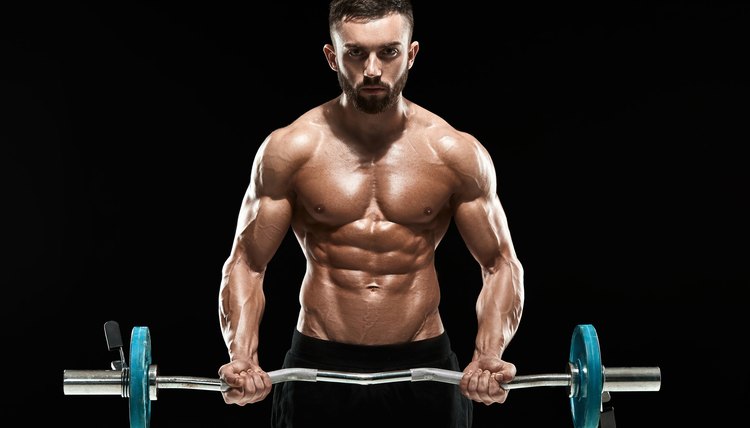
Flat and lean versus thick and muscular: two very different physiques for two very different sports. Runners need lean, light bodies so they can be fast and go the distance. Bodybuilders pack on muscle and burn fat to reveal a chiseled physique. As a result, the abdominal muscles of runners and bodybuilders tend to be very distinct.
The Difference Between Runner and Bodybuilding Abs
Everyone Has Abs, But They Look Different
Even if you don't exercise at all, you still have abdominal muscles. You need them to help you sit and stand, bend down to pick something up or turn to the side.
The more active you are, however, the stronger your abs need to be to support your body in your sport, whether it's playing tennis, hiking, running or pumping iron. The more force you put on your abdominal muscles, the bigger and stronger they will become.
Runners Tend to Be Lean with Less Developed Abs
Running, especially long distances, burns a lot of calories. Runners who pack in a lot of miles each week generally tend to be very lean, with long sinewy muscles. Runners typically want to stay light; they don't want to put on too much muscle because this makes their bodies heavier to carry over distances.
Although strong abdominal muscles are important during running to stabilize the hips and knees and support the spine, they do not need to be super strong, nor do they need to be big. For this reason, runners will primarily focus on functional ab exercises using their own body weight or light resistance, and do higher repetitions of exercises to increase their muscular endurance.
However, many runners don't do any ab exercises at all -- they just run.
Bodybuilders Develop Their Abs
A bodybuilder's main goal is to increase the size of his muscles. Bodybuilders typically train their abs with much heavier weight and lower reps to induce hypertrophy, or muscle growth. The emphasis is on size, definition and strength.
During different phases of a bodybuilder's routine, however, the abs may be less noticeable. During the bulking phase, a bodybuilder is focused on lifting heavy and eating a lot to support muscle growth. He may also put on some fat during this time, which can hide his ab muscles.
Before a competition, a bodybuilder enters a cutting phase. He does more cardio at this point and reduces his calorie intake to lose fat and reveal the rippling abdominal muscles underneath.
Body Type Plays a Role
The differences in muscle size and appearance between runners and bodybuilders depend on training style and diet. They also depend on the body type you're born with. If you're an ectomorph, a person with a naturally thin and delicate build, even as a bodybuilder you may never be able to get big, thick abs. If you're a runner and a mesomorph, a person who puts on muscle easily and is still naturally lean, you may have bigger more defined abs than your ectomorph friend who's a bodybuilder.
References
Writer Bio
Jody Braverman is a professional writer and editor based in Atlanta, GA. She received a Bachelor of Arts in English from the University of Maryland, and she is a certified personal trainer, fitness nutrition specialist, and yoga teacher. She has written for various online and print publications, including Livestrong.com, SFGate, Healthfully, and Chron.com. Visit the writer at www.JodyBraverman.com.