
What does fact checked mean?
At SportsRec, we strive to deliver objective content that is accurate and up-to-date. Our team periodically reviews articles in order to ensure content quality. The sources cited below consist of evidence from peer-reviewed journals, prominent medical organizations, academic associations, and government data.
- Journal of Sports Medicine : Physiological Differences Between Cycling and Running: Lessons From Triathletes
- Journal of Sports Medicine : Physiological Differences Between Cycling and Running: Lessons From Triathletes
The information contained on this site is for informational purposes only, and should not be used as a substitute for the advice of a professional health care provider. Please check with the appropriate physician regarding health questions and concerns. Although we strive to deliver accurate and up-to-date information, no guarantee to that effect is made.
Exercise Bike Sprinting vs. Track Sprinting
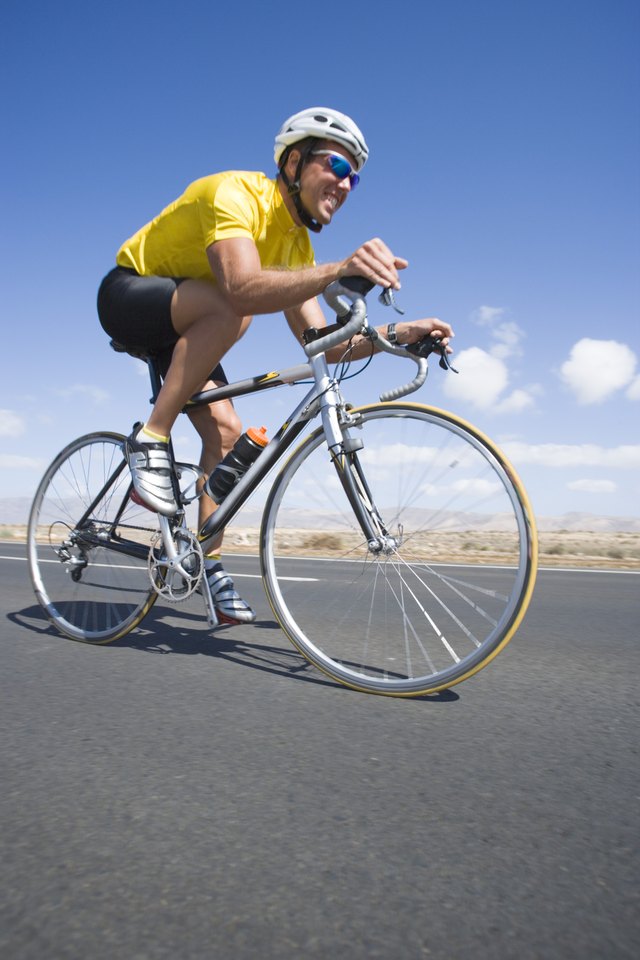
Literally meaning "top speed," a sprint is a way to bring on the heat and put the pedal to the metal when exercising. A sprint is a maximal exertion performed to reach top speed for a short period of time. You can do sprints in a variety of ways, but two popular methods are on an exercise bike and on a running track.
Sprint Definition
Sprints are an anaerobic activity, meaning they are performed without the use of oxygen. Since no oxygen is used, sprints are only 30-seconds long at most and tap into stored fuel in the muscles called glycogen. Using glycogen without oxygen produces lactic acid in your body, responsible for the burning you feel during a hard sprint. You can do sprints as part of any workout session or alternate them one after another with periods of rest -- otherwise known as an interval workout.
Bike Sprints
Performing sprints on a bike is best for you if you have joint problems that won’t tolerate a lot of pounding or if biking is your main form of cardio exercise. Doing sprints on a stationary bicycle allows you to get an intense workout in a small space. Adequate resistance on the pedals is important during bike sprints to maintain control and keep the muscles working at maximum level instead of just going through the motions.
Track Sprints
Sprinting on a track has the advantage of being a very simple activity and requires very little equipment. Running as fast as possible is the oldest form of physical activity to humans and has no learning curve -- just lace up your shoes and go. While sprinting on a track is usually easiest, running sprints can be done anywhere you can find open space or even on a treadmill. Many common sports such as basketball, soccer, football and baseball require athletes to sprint and performing sprints on a track can be an effective form of sport specific training. If you prefer running to other activities or participate in sports that require sprinting, track sprints are the best choice for you.
Personal Preference
VO2 max is the maximum amount of oxygen your body can use at one time for an activity and is used a measurement of fitness level. The higher your V02 max, the more fit you are. According to a study conducted by the University of Laussane in Switzerland, V02 max adapts to exercise type. The test subjects reached their highest V02 max while performing the type of exercise they usually performed. Runners were best at running and bikers were best at biking; neither one was better than the other from a cardiovascular standpoint. Running and bike sprints also use the exact same muscles: quadriceps, calves and hamstrings. The bottom line is that you should pick the style of exercise that you enjoy the most. Your body will adjust and become very efficient at it, making the activity effective for you.
References
Writer Bio
Jilana Dennis is a health and fitness writer based out of San Antonio, Texas. Dennis is a nationally certified personal trainer with the American Council on Exercise and holds a B.S in exercise science from Illinois State University.