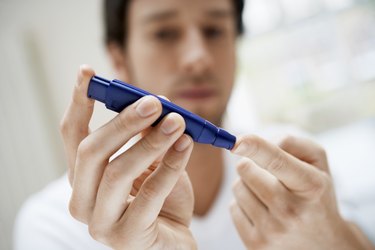
Having a high amount of glucose in the bloodstream can cause various effects. It can make you lose a great deal of water, sodium and potassium, and lead to dehydration. A high level of glucose can also change the hemoglobin in red blood cells. If the level stays high for a considerable period of time, problems in the nerves, kidneys, eyes and heart or damage to the arterial walls can arise, leading to diabetes mellitus.
Diabetes and Glucose
The beta cells of the pancreas normally release insulin to prevent the blood glucose level from becoming too high. In type 1 and type 2 diabetes, an abnormally high amount of glucose circulates in the bloodstream. Type 1 diabetes is an autoimmune disease, in which the immune system attacks and destroys the beta cells instead of only attacking foreign substances. In type 2 diabetes, the tissues are not as sensitive to insulin as they should be. In both types, the blood glucose level is high, as explained in “The Washington Manual of Medical Therapeutics” by Ernesto Bernal-Mizrachi, M.D.
How Food Affects the Glucose Level
The type of food you consume, how much you eat and even the time of day you eat all affect your glucose level, according to the Mayo Clinic. Not having enough food can lower your blood glucose level, while consuming too much can raise it. The amount of glucose in your bloodstream, however, will be at the highest level approximately one to two hours after you have finished eating your meal. The blood glucose level will then start to decrease. This is why one screening test for diabetes mellitus checks the glucose level two hours after you have consumed 75 grams of glucose.
Theory on Effect of Glucose
The high amount of glucose in diabetes can lead to many complications; it affects many organs and the arterial walls as well. One theory about the effects of glucose on the walls of arteries is explained by Robert Murray, M.D., Ph.D., in “Harper’s Illustrated Biochemistry.” When glucose attaches to protein, this leads to the formation of substances called Schiff bases. These Schiff bases are then rearranged to form a different structure. After a series of steps, substances called advanced glycation end products form. This process changes the structure of the arterial wall and causes plasma proteins to accumulate in the wall of the arteries, damaging them.
Glucose and Atherosclerosis
In the January 2000 issue of the “European Heart Journal,” researchers from the University of Auckland wrote that abnormalities in the lining of the arterial wall can lead to atherosclerosis, a disorder in which the arteries harden. According to the authors, studies have demonstrated a high amount of glucose in the bloodstream can interfere with the cells that line the arterial walls. A high level of blood glucose can lead to atherosclerosis, although abnormal lipid levels in the bloodstream and hypertension are also involved. A person with hyperglycemia, or a high blood glucose level, has two times the risk of developing disease in the heart and in the blood vessels.
References
- European Heart Journal; Glucose, Insulin and Coronary Artery Disease; W. Bagg et al.
- Harper’s Illustrated Biochemistry; Robert Murray, M.D., Ph.D., et al.
- Harrison’s Principles of Internal Medicine; Dan Longo, M.D., et al.
- Hurst’s The Heart; Valentin Fuster, M.D., Ph.D., et al.
- Mayo Clinic: Diabetes Management
- The Washington Manual of Medical Therapeutics; Gopa Green, M.D.


