Side Effects of Wheatgrass Juice
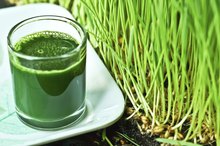
Made from a young grass originating from the wheat family, wheatgrass juice is a dietary supplement. Many health food aficionados praise wheatgrass juice and its purported health benefits, such as boosting your immune system. People drink wheatgrass juice as a single shot of highly concentrated juice or, more commonly, blend it with other fresh fruit or vegetable juices to mask the taste. Fresh wheatgrass juice is strong tasting and for those not used to it, may be too intense in taste and for your digestive system. While generally considered safe, wheatgrass juice can cause a number of unpleasant side effects.
Nausea and Headaches
Some people experience nausea and headaches soon after they drink wheatgrass juice -- often after the first several times they drink the juice. According to Steve Meyerowitz, author of "Wheatgrass, Nature's Finest Medicine," some people attribute the nauseated feeling and headaches to detoxification. The American Cancer Society says it may also be a sign of your body’s general intolerance to wheat grass juice. If you experience nausea or headaches after consuming wheatgrass juice, consider drinking less of the juice or blending it with other juices to mask the taste. If nausea and headaches persist, speak with a medical professional and stop consuming the juice altogether.
- Some people experience nausea and headaches soon after they drink wheatgrass juice -- often after the first several times they drink the juice.
- If you experience nausea or headaches after consuming wheatgrass juice, consider drinking less of the juice or blending it with other juices to mask the taste.
Allergic Reactions
Difference Between Wheat & Wheatgrass
Learn More
Another side effect of wheatgrass juice is an allergic reaction. Meyerowitz states that wheatgrass juice is safe for those who have a wheat or wheat gluten intolerance or allergy. But the American Cancer Society suggests that, to be safe, you consult a medical professional before taking wheatgrass juice if you have a known gluten intolerance. Signs of an allergic reaction to wheatgrass juice include hives and a swollen throat. If you have these symptoms immediately after consuming wheatgrass juice, the allergic reaction may only get worse as time passes, so seek medical treatment immediately.
- Another side effect of wheatgrass juice is an allergic reaction.
- But the American Cancer Society suggests that, to be safe, you consult a medical professional before taking wheatgrass juice if you have a known gluten intolerance.
Mold
Because wheatgrass is a young, sprouted grass grown in moist conditions, improper care may lead to mold developing on the grass and getting in the juice. While you can wash off some mold on wheatgrass, to be safe, throw the wheatgrass away. The most common type of mold to affect wheatgrass is “blue fuzz” mold, a type of nonharmful “slime mold” that you can wash off, because it only grows on the outside of the plant. But other types of mold, including brown and white mold, are signs of spoilage, and you shouldn't consume either. A bitter and musty tasting wheatgrass juice means your wheatgrass is moldy.
- Because wheatgrass is a young, sprouted grass grown in moist conditions, improper care may lead to mold developing on the grass and getting in the juice.
- The most common type of mold to affect wheatgrass is “blue fuzz” mold, a type of nonharmful “slime mold” that you can wash off, because it only grows on the outside of the plant.
Contaminant-Free Environment
Differences Between Wheat Germ & Wheatgrass
Learn More
Because wheatgrass grows in either soil or water and people consume it raw, bacteria or other dangers -- in addition to mold -- may be present and can also contaminate your wheatgrass juice. To avoid contamination, sterilize your trays and keep your soil and water clean. Keep your wheatgrass away from areas of possible cross contamination, uncovering your wheatgrass tray only once the sprouts have set root and are hardy enough to grow well, usually the fourth day and after. To avoid contamination after you harvest your wheatgrass, consume your cut grass within seven to 10 days and store in a clean plastic bag in the fridge.
- Because wheatgrass grows in either soil or water and people consume it raw, bacteria or other dangers -- in addition to mold -- may be present and can also contaminate your wheatgrass juice.
- To avoid contamination after you harvest your wheatgrass, consume your cut grass within seven to 10 days and store in a clean plastic bag in the fridge.
Related Articles
Difference Between Wheat & Wheatgrass
Learn More

Differences Between Wheat Germ & Wheatgrass
Learn More
Wheatgrass & Weight Loss
Learn More

Can You Eat Wheatgrass Raw?
Learn More
Wheatgrass & Vitamin K
Learn More

How to Make Grapefruit Juice Taste Better
Learn More
Wheatgrass & Menstruation
Learn More
Side Effects of Juicing Green Vegetables
Learn More

Wheatgrass for Anemia
Learn More

Mushrooms & Skin Rashes
Learn More
References
- NYU Langone Medical Center: Wheat Grass Juice
- Urban Agriculture Notes: Wheatgrass and Mold
- Wheatgrass Nature's Finest Medicine: The Complete Guide to Using Grasses to Revitalize Your Health; Steve Meyerowitz
- American Cancer Society: Wheatgrass
- Wheat grass powder. FoodData Central. U.S. Department of Agriculture. Published April 1, 2019.
- Renu M, Preeti R. Health benefits of wheat grass — a wonder food. Int J Food Nutr Sci. 2013;2(4):10-13.
- Bar-Sela G, Cohen M, Ben-Arye E, Epelbaum R. The medical use of wheatgrass: Review of the gap between basic and clinical applications. Mini Rev Med Chem. 2015;15(12):1002-10. doi:10.2174/138955751512150731112836
- Wan P, Chen H, Guo Y, Bai AP. Advances in treatment of ulcerative colitis with herbs: From bench to bedside. World J Gastroenterol. 2014;20(39):14099-104. doi:10.3748/wjg.v20.i39.14099
- Bar-Sela G, Tsalic M, Fried G, Goldberg H. Wheat grass juice may improve hematological toxicity related to chemotherapy in breast cancer patients: A pilot study. Nutr Cancer. 2007;58(1):43-8. doi:10.1080/01635580701308083
- Kyada A, Chorai P. Myeloprotective effect of Triticum aestivum Linn. grass against antineoplastic agents induced bone marrow toxicity in mice. Trends in Pharmaceutical Sciences. 2017;3(3):169-180.
- Kothari S, Jain AK, Mehta SC, Tonpay SD. Hypolipidemic effect of fresh Triticum aestivum (wheat) grass juice in hypercholesterolemic rats. Acta Pol Pharm. 2011;68(2):291-4.
- Mutha AS, Shah KU, Kinikar AA, Ghongane BB. Efficacy and safety of wheat grass in thalassemic children on regular blood transfusion. Cureus. 2018;10(3):e2306. doi:10.7759/cureus.2306
- Parit SB, Dawkar VV, Tanpure RS, Pai SR, Chougale AD. Nutritional quality and antioxidant activity of wheatgrass (Triticum aestivum) unwrap by proteome profiling and DPPH and FRAP assays. J Food Sci. 2018;83(8):2127-2139. doi:10.1111/1750-3841.14224
- Wheat grass cold pressed juice. FoodData Central. U.S. Department of Agriculture. Published April 1, 2019.
Writer Bio
Marie Dannie has been a professional journalist since 1991, specializing in nutrition and health topics. She has written for "Woman’s Own," the "Daily Mail," the "Daily Mirror" and the "Telegraph." She is a registered nutritionist and holds a Bachelor of Science degree with honors in food science from the University of Nottingham.