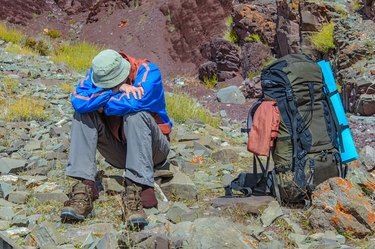
If you've ever traveled from sea level to a high altitude, you may have felt sick for the first few days of your trip. Breathlessness, headache and fatigue are common side effects of high altitude. Blame it on thin air. At high altitude, there's less oxygen in the air, and this can affect your body.
"Symptoms of adjustment to high altitude can feel like a hangover," says Humberto Choi, MD, a pulmonology medicine specialist at the Cleveland Clinic.
Video of the Day
Video of the Day
Oxygen in the air at 10,000 feet is only about 70 percent of the oxygen in the air at sea level, according to the Centers for Disease Control and Prevention (CDC). A traveler above 8,000 feet may experience altitude sickness. It can take about 3 to 5 days to adjust.
Symptoms and Types of Altitude Sickness
The most common type of altitude sickness is a mild form called acute mountain sickness. It affects about 25 percent of visitors who spend an overnight in Colorado, or another high altitude destination, per the CDC.
Common symptoms of altitude sickness, according to the Cleveland Clinic, include:
- Shortness of breath
- Fatigue
- Difficulty sleeping
- Loss of appetite or nausea
You might notice it about 2 to 12 hours after you get to the higher altitude, according to the CDC.
More severe symptoms of high altitudes on the body are much less common, but they can include swelling and fluid in the brain, called high-altitude cerebral edema (HACE), and high-altitude pulmonary edema (HAPE). According to the CDC, HACE symptoms include:
- Drowsiness
- Confusion
- Clumsiness
HAPE symptoms include:
- Increasing shortness of breath
- Chest tightness
- Cough that may produce blood-tinged sputum
"Mild symptoms are caused by your body adapting to low oxygen and low air pressure. You breathe faster and your heart works harder to get blood pumping. Rapid breathing and drier air contribute to dehydration, which adds to the symptoms, but the main dangers are fluid buildup in the lungs or the brain," Dr. Choi says.
Symptoms of HACE or HAPE can become very serious or fatal over about 24 hours. For these conditions, getting to a lower altitude as soon as possible is the most important treatment, according to the CDC.
People who live at high altitudes can have additional risks. They may produce more red blood cells, according to a November 2016 study in the Journal of Experimental Medicine. In fact, about 20 percent of high-altitude dwellers develop a condition called chronic high-altitude sickness. Their blood becomes too thick, putting them at risk of heart attack or stroke. This does not occur in visitors.
Who's Most at Risk?
Anyone can get altitude sickness. However, the risk is mostly associated with how high you go, how fast you get there and how much energy you expend at high altitude, according to the CDC.
"The biggest risk factor is having had altitude sickness in the past," Dr. Choi says. Like seasickness, if you've had it once, you'll probably have it again.
Other risk factors for altitude sickness, according to the CDC, may include:
- Obesity
- Sleep apnea
- Heart disease
- Lung disease
- Seizure disorder
- Sickle cell disease
- Liver disease (cirrhosis)
"Older age does not increase the risk of altitude sickness unless you have a medical condition that affects your heart or lungs," Dr. Choi says. "More older people experience altitude sickness because they are more likely to have these conditions."
Treatment and Prevention
"Nobody ends up at high altitude by accident, so you usually have time to plan ahead," Dr. Choi says. "The best way to prevent altitude sickness is to get to your destination gradually. This allows you time to adapt."
"If you have mild symptoms, the best treatment is to rest, drink twice as much water as usual and avoid drinks that increase dehydration like alcohol or caffeine. An over-the-counter pain medicine usually works for headaches," Dr. Choi says.
In addition, there are medications your doctor can prescribe to prevent or reduce high altitude sickness. If you are at risk and you need to travel to a high altitude, talk to your doctor about a prescription. In addition, many hotels will supply oxygen, so you can call ahead to ask about availability, per the CDC.
- Centers for Disease Control and Prevention: “Travelers Health: High-Altitude Travel & Altitude Illness”
- Humberto Choi, MD, pulmonologist, Department of Pulmonary Medicine, Cleveland Clinic, Cleveland, Ohio
- Cleveland Clinic: “Mountain Vacation? 5 Tips to Cope With Your Altitude Sickness”
- JEM: "Senp1 drives hypoxia-induced polycythemia via GATA1 and Bcl-xL in subjects with Monge’s disease"
Is this an emergency? If you are experiencing serious medical symptoms, please see the National Library of Medicine’s list of signs you need emergency medical attention or call 911.