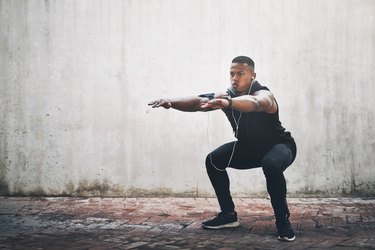
With all the workout trends and new equipment on the market, it's easy to forget about timeless training techniques like body-weight exercises.
But now that many gyms have closed due to the COVID-19 pandemic, many of us have been forced to take a second look at body-weight exercises — and the assumptions we've made about them that are simply untrue.
Video of the Day
Video of the Day
If you're used to lifting heavy weights, you may think body-weight exercises are a waste of time, but using your body in place of free weights and machines is actually a highly effective training method that can help you reach a number of fitness goals. Not to mention, it can save you money and space.
Still not convinced? Here, experts bust five of the most common body-weight workout myths and offer ways to turn up the intensity so you can get stronger — no additional equipment necessary.
Myth 1: Body-Weight Exercises Are Easy
It's common to think that you need heavy barbells or dumbbells in order to have a challenging workout. But those are just tools, says Mike Clancy, a certified strength and conditioning specialist (CSCS) and personal trainer based in New York City.
Resistance training is simply a way of playing with the force from gravity, whether you're holding dumbbells or pushing yourself up and down from the floor. The way you use that force is what makes an exercise easy or hard.
So, if you have to do dozens of body-weight squats or lunges in order to feel the burn, play with gravity to make it challenging. Start by slowing down your tempo, also known as eccentric loading, and making sure you're moving through the full range of motion. Aim to really feel your muscles working as you move through each rep.
In order to do this, you'll have to limit distractions. "If we don't have weights or equipment, we're going to have to make up for that lack of intensity by getting more involved mentally and physically," Clancy says.
Myth 2: Body-Weight Exercises Are Only for Beginners
Body-weight training is a great place to start if you're new to strength training, but that doesn't mean you have to stop once you become more advanced. "[Body-weight exercises] can absolutely work for any fitness level," says Tom Holland, CSCS, exercise physiologist and author of The Micro-Workout Plan.
The key to making body-weight training work as you go from fitness newbie to old-timer is to keep progressing the exercises. If body-weight squats are a snore, try more advanced variations, like squat jacks, pistol squats, skater squats or squat jumps.
"The sky's the limit as far as the number of exercise variations you can do," Holland says. For example, if regular push-ups are a breeze, you can make them more challenging by:
- Elevating your feet on a bench or step
- Lifting one hand or foot off the floor
- Slowing down your tempo
- Adding an explosive element (i.e. plyometric push-ups)
- Bringing your hands closer together, like a diamond push-up, or farther apart to engage your chest more
- Incorporating another exercise to the mix: Do a push-up and then alternate tapping one knee to each elbow, also known as a spiderman push-up, for an added core challenge.
Related Reading
Myth 3: You Don’t Need a Rest Day After a Body-Weight Workout
It doesn't matter if you're doing barbell bench presses or body-weight push-ups, your muscles still need at least 24 hours to recover and repair before hitting them again, according to Holland. That is, so long as you're doing body-weight exercises that challenge you, and you're taking your sets to the point where you can't do another rep with good form.
If not, you may not be working hard enough to create significant muscle damage to incite growth. However, if you're treating your body-weight training like any other form of strength training, you'll only want to work out three or four times per week, Clancy says.
"That being said, you can absolutely take a month and say, 'You know what, I'm going to do a squat or push-up challenge," Holland says. You probably won't want to do hardcore squats and push-ups every single day of the year, but a 30-day body-weight challenge can be a great way to build strength and skill in a specific movement.
Related Reading
Myth 4: Body-Weight Exercises Don’t Build Muscle
If you really think you can't build muscle (and serious strength) without dumbbells and exercise machines, just look at professional gymnasts, Holland says. These athletes manage to pack on tons of muscle with body-weight-focused training sessions.
But in order to build muscle with body-weight exercises, you have to follow the same guidelines as training with weights: work to the point of muscle fatigue, and continue to do more work over time.
To build muscle, the American Council on Exercise (ACE) recommends working within a range of 3 to 6 sets of 6 to 12 reps for a given movement. Start at the lower end of the range and add reps and sets over time. "Then, modify the exercise you're doing, perhaps going from a regular push-up to a spiderman or a plyometric push-up so you're overloading your muscles in a different way," Holland says.
Related Reading
Myth 5: Body-Weight Training Is Boring
Many people think they need an assortment of free weights, machines, medicine balls, resistance bands, suspension trainers and stability balls to keep their workouts fun and fresh.
And while these tools can add challenge and variety to otherwise routine exercises, you can get these effects from body-weight movements, too. That's because there's more to body-weight training than just standard squats and planks.
As you've already learned, there are countless variations of body-weight exercises to choose from. If you're tired of the basic forward and reverse lunge, for example, try a lateral lunge, jump lunge or curtsy lunge. You can also add a knee lift, kick, torso twist or step-up between reps. It's all about moving in different planes of motion and challenging your muscles with new stimuli.
Aside from push-ups, squats, lunges, planks and all their variations, there are many other body-weight exercises you can add to the mix. Try single-leg body-weight deadlifts, side planks and glute bridges to test your unilateral strength. Then, kick things up with pull-ups, supermans, mountain climbers, tuck jumps, bear crawls and wall sits.
Get creative, or hire a personal trainer who can be creative for you: "It's like cooking," Clancy says, "Some people are like, 'I know I need to cook healthy, but I don't know how, so just tell me how to cook.'" If you're overwhelmed by all the body-weight exercise options out there, find a personal trainer who can cut through the clutter and keep body-weight training fun and interesting for you.
Was this article helpful?
150 Characters Max
0/150
Thank you for sharing!
Thank you for your feedback!