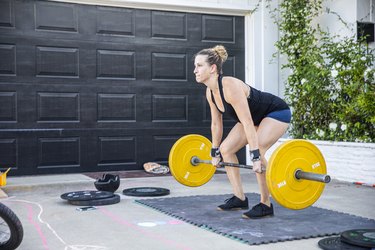
Lifting weights is a great way to increase your strength and build muscle mass. But you may not realize just how much stress it places on your body.
One problem sometimes caused by this stress is pain in the coccyx, which is more commonly known as the tailbone — a small triangular bone at the end of your spine.
Video of the Day
This pain, known as coccydynia, is a symptom of an injury or strain to your coccyx, often due to using improper form or lifting more weight than your body can handle.
Below, we'll further break down why you might be experiencing tailbone pain after lifting weights, how to treat it and how to make sure it won't happen again in the future.
Causes of Tailbone Pain From Weightlifting
If you're wondering, "Why does my tailbone hurt?" there are a few potential reasons. Injuries to your tailbone can occur in a number of ways, including repeated stress or pressure to the bone, regularly having poor posture or form during an exercise and deterioration to the bone over time, according to Arizona Pain.
Other tailbone pain causes include exercises containing sudden motions or requiring significant strain can cause tailbone injuries as well. When lifting weights, injury generally occurs in the form of strains to the ligaments that hold the coccyx in place. This is more common in lifts that require significant leg movement, such as lunges or squats, or in lifts that require you to brace your core, such as deadlifts, snatches or clean and jerks, according to Veritas Health.
Symptoms of a Tailbone Injury From Weightlifting
According to the Cleveland Clinic, symptoms of an injury to your coccyx include:
- Pain in your tailbone that's either dull (achy) or or sharp (piercing).
- Pain in your tailbone that gets worse when you go from sitting to standing.
- Pain in your tailbone when you poop.
- Pain in your tailbone during sex.



Treating Tailbone Pain From Weightlifting
What is the fastest way to relieve tailbone pain? While there's no magical cure that'll have you back in the gym tomorrow, there are a few solves if you're wondering how to heal a sore tailbone generally speaking.
In most cases, all that's required to recover from lifting-related tailbone pain is rest and a few weeks without additional strain. NSAID pain relievers are often recommended by doctors to reduce inflammation and ease the pain that you're experiencing, and a doughnut-shaped pillow may help to relieve pain during recovery, per the Cleveland Clinic.
If pain continues or is severe, your doctor may suggest steroid injections to stabilize your coccyx. In the most serious instances, surgery may be required, though this is fairly unlikely for lifting-related tailbone pain.
There are also a few exercises you can do for tailbone pain relief. If you feel any discomfort when doing them, stop immediately.
1. Cat-Cow Pose
- Begin on your hands and knees.
- Exhale as you round your back, pull your belly button toward your spine and tuck your chin toward your chest.
- Starting at the tailbone, release one segment of your spine at a time, relaxing through the lumbar spine, thoracic spine (mid-back) and finally, your cervical spine as you lift your chin upward into full flexion.
- Then reverse the motion. Be aware of what segments feel stuck. Breathe into these spaces and remember to move slowly.
- Continue to move between cat and cow pose for 15 to 30 seconds, letting your body move with your breath.
2. Child's Pose
- On your mat, begin by kneeling down with your hips approximately hip-width distance apart, feet untucked, and sit your hips back onto your heels.
- Inhale and elongate your spine. As you exhale, bow forward to fold over your knees and rest your forehead down on the mat.
- Stretch your arms forward with your palms facing down, and gently press your hips back and down onto your feet to stretch your lower back and outer hips.
- If this feels restrictive, try widening your knees even farther apart until you feel more comfortable. Alternatively, you can bring your knees closer together, or all the way together, if that position suits you better. A good rule of thumb is to listen to your body and do what feels right!
- Rest here for about 5 cycles of breath.
3. Cobra Pose
- Lie face-down with your legs extended behind you, feet hip-width apart (or slightly wider if your back is sensitive).
- Bring your hands back so that your thumbs are in line with your rib cage.
- Hug your elbows close to the sides of your body and press the tops of your feet down; your knees might lift away from the ground.
- Exhale to engage your abdominal muscles (think: low belly in and up) and lift your chest. Anchor your hips, pubic bone and the tops of your feet into the ground to support the lift.
- Press into your hands gently and engage them toward your body to help encourage your chest forward and your shoulders back.
- Lift and lengthen through the back of your neck and keep your gaze down and out. Keep your neck neutral.
- Breathe here for 3 to 5 breaths or 15 to 30 seconds.
Preventing Tailbone Pain From Weightlifting
The best way to take care of tailbone pain is to prevent it from occurring in the first place. Proper stretching before lifting and using proper form during your lifts will reduce the likelihood of coccyx injury. (If you're unsure of how to do an exercise, chat through the move with a personal trainer and have them watch you to make sure you're doing it right.)
Using any recommended safety equipment when lifting is also important to prevent all types of injury, not just to your tailbone. If you experience any discomfort in your coccyx or pelvis during your lifts, stop lifting immediately to prevent injury.