
You know you want a plant-based oil that's solid at room temperature, but beyond that... well, you're confused because you didn't expect there to be different types of coconut oil on the market.
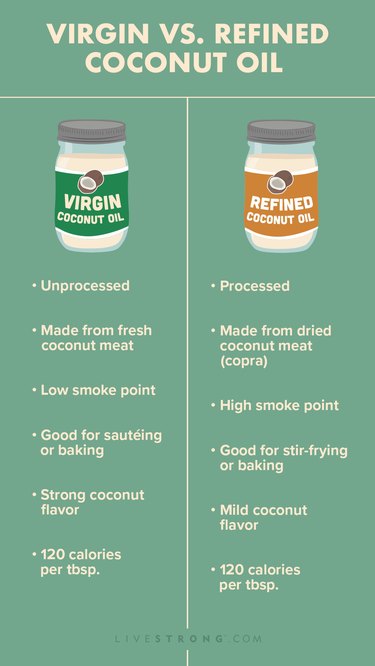
Simply put, refined coconut oil is more processed, resulting in a milder-tasting oil, while unrefined coconut oil endures less processing and has a lower smoke point and deeper coconut flavor.
Video of the Day
Video of the Day
Nutritional Properties of Coconut Oil
Coconut oil in cooking has become a darling of the health food movement, with many recipes advocating the substitution of coconut oil for butter.
Coconut oil is often pushed as heart-healthy because of the suggestion it can raise HDL ("good") cholesterol, and because the type of saturated fats it contains are called "medium-chain triglycerides," according to Harvard Health Publishing.
But coconut oil is high in saturated fat. To add to that, there is still not enough scientific evidence to prove that coconut oil is necessarily healthy.
The Dietary Guidelines for Americans recommends getting less than 10 percent of your calories from saturated fat. Lowering your intake of saturated fat and replacing it with unsaturated fats, especially polyunsaturated fats, is linked to a lower risk of heart disease, per a June 2017 study in Circulation.
Tip
Because coconut oil's nutritional benefits are still being investigated, it should be used sparingly as part of a healthy diet.
What Is Refined Coconut Oil?
When it comes to shopping for coconut oil, you usually have a choice of refined or unrefined.
Refined coconut oil has a high smoke point, making it ideal for stir-frying or baking, per the University of Rochester Medical Center. It also has a less intense coconut flavor, so if you're not a fan of coconut but would still like to incorporate it into cooking, this is the one you'd use.
How Is Refined Coconut Oil Produced?
Coconut oil labeled as "refined oil" takes dried coconut meat, known as copra, and machine presses it to release the oil, explains a September 2016 article in Ghana Medical Journal.
The oil is then steamed or heated to deodorize it and "bleached" by filtering it through clay to remove impurities and any remaining bacteria. Sometimes, chemical solvents such as hexane may be used to extract oil from the copra. The resulting oil is flavorless and odorless.
Refined Coconut Oil Nutritional Facts
- 120 calories
- 14 grams of fat
- 13 grams of saturated fat
- 0 grams of carbohydrates
- 0 grams of fiber
- 0 grams of sugar
- 0 grams of protein
If you take a look at the nutrition label on a jar of refined coconut oil, you'll see that it has about 120 calories per 1-tablespoon serving.
All of those calories come from fat, as coconut oil has no protein or carbohydrates. Of the 14 grams of fat found in coconut oil, 13 of those grams are saturated fat — that's the total daily limit recommended by the American Heart Association, all in that single tablespoon of coconut oil.
It's worth noting that coconut oil does not contain a significant amount of any vitamins or minerals.
What Is Unrefined Coconut Oil?
Unrefined coconut oil has a lower smoke point, making it appropriate for quick sautéing or baking, and it imparts a stronger coconut flavor, per Harvard Health Publishing.
"Virgin" or "extra virgin" are additional terms you may see on jars of unrefined coconut oil, sometimes used in place of "unrefined" — these just mean the oil has not been refined.
Other terms you may find include "expeller pressed," which means that a machine has pressed the oil from the coconut flesh, often with the use of steam or heat. "Cold-pressed" means that the oil has been pressed without heat.
You may also spot "expeller pressed," which means that a machine has pressed the oil from the coconut flesh, often with the use of steam or heat. "Cold-pressed" means that the oil has been pressed without heat.
How Is Unrefined Coconut Oil Made?
Unrefined coconut oil can be made by two different methods, according to a May 2019 article in Food Quality and Safety.
One is a "dry" method, where the fresh coconut meat of mature coconuts is dried quickly with a small amount of heat and then pressed with a machine to remove the oil.
The second is a "wet" method, in which a machine presses fresh coconut meat to yield milk and oil. These are separated through fermentation, enzymes or centrifuge machines.
Unrefined Coconut Oil Nutritional Facts
- 120 calories
- 14 grams of fat
- 13 grams of saturated fat
- 0 grams of carbohydrates
- 0 grams of fiber
- 0 grams of sugar
- 0 grams of protein
Unrefined virgin coconut oil has the same nutritional panel as refined coconut oil, even when you're comparing refined vs. unrefined coconut oil from the same brand (in this case, Wildly Organic).
The unrefined coconut oil has 120 calories per 1-tablespoon serving, all coming from its 14 grams of fat, 13 of which are saturated fat.
For reference, butter has 102 calories per tablespoon and 7.3 grams of saturated fat while canola oil has 124 calories per tablespoon but only 1 gram of saturated fat.
Which One Should You Choose?
Coconut oil for culinary use is best used sparingly as an occasional alternative to other oils in baking and cooking, according to Harvard T.H. Chan School of Public Health.
If you want to reap the potential benefits of coconut oil nutrition by subbing it for some of the other fat in your diet, the choice between refined or unrefined coconut oil comes down to personal preference — any health differences between the two have not yet been substantiated, per a February 2019 article in the Journal of the American College of Nutrition.
- American Journal of Clinical Nutrition: "Effects of Medium-Chain Fatty Acids and Oleic Acid on Blood Lipids, Lipoproteins, Glucose, Insulin, and Lipid Transfer Protein Activities"
- HealthySD.gov: "Coconut Oil – Healthy or Unhealthy?"
- Mayo Clinic: "Is Coconut Oil an Effective Sunscreen?"
- American Heart Association: "Dietary Fats and Cardiovascular Disease: A Presidential Advisory From the American Heart Association"
- Office of Disease Prevention and Health Promotion: "Scientific Report of the 2015 Dietary Guidelines Advisory Committee"
- Harvard Health Publishing: "Ask the Doctor: "Coconut Oil and Health"
- NCBI: Journal of American College of Nutrition: "Health Effects of Coconut Oil-A Narrative Review of Current Evidence"
- Harvard T.H. Chan School of Public Health: "Coconut Oil"
- American Heart Association: "Saturated Fats"
- Ghana Medical Journal: "Coconut Oil and Palm Oil's Role in Nutrition, Health and National Development: A Review"
- Food Quality and Safety, Volume 3, Issue 2, May 2019: "Coconut Oil: What Do We Really Know About It So Far?"
- U.S. National Library of Medicine: "Facts About Saturated Fats"
- Harvard Health Publishing: "Coconut Oil: Heart-Healthy or Just Hype?"
- University of Rochester Medical Center: "Cooking Oils: Which One When, and Why?"
- MyFoodData: "Wildly Organic - Refined Coconut Oil"
- MyFoodData: "Wildly Organic - Virgin Unrefined Coconut Oil"
- MyFoodData: "Salted Butter"
- MyFoodData: "Canola Oil"