
History of Softball and Baseball
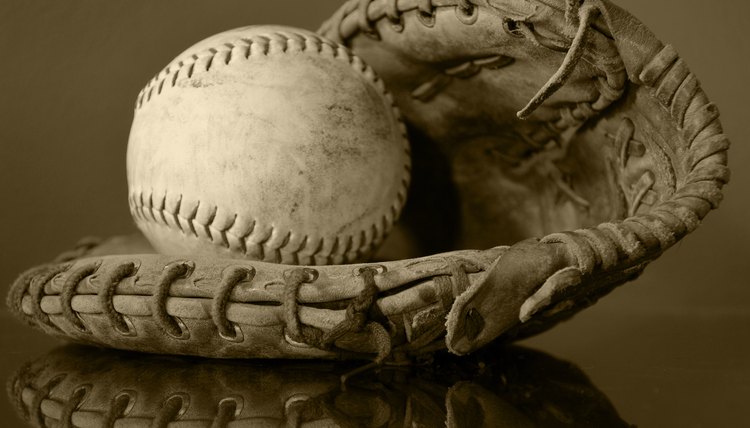
The summertime craving for extra innings and the satisfying crack of ball connecting with bat got its start back in the day when a ball and stick were all you had to play with. Baseball's greatest influence was the 19th century British game called rounders. Softball's invention is more concrete, as the first game can be traced to Chicago's Farragut Boat Club in 1887.
Baseball Origins
Back before there were international and national federations determining the rules for baseball; every town, in every city, played by their own rules. But by the mid-1840s, two distinct versions of baseball had emerged, Knickerbocker Rules, which closely resembles baseball as it is known today, and Town Ball, or The Massachusetts Game, which maintains closer ties to the game of rounder.
Knickerbocker Rules
Alexander Cartwright is credited with establishing Knickerbocker Rules on Sept. 23, 1845. The term Knickerbocker was used as that was the name of Cartwright's baseball team. The original Knickerbocker Rules were a list of 20 items, some of which are still being used. The first-known baseball game to be played using Knickerbocker Rules occurred in 1846, as the New York Baseball Club defeated the Knickerbocker Base Ball Club of New York City.
Massachusetts Game
While baseball played under Knickerbocker Rules was gaining popularity in New York, Town Ball was still being played elsewhere. In 1858, The Massachusetts Association of Base Ball Players formalized a set of rules for Town Ball, which became known as the Massachusetts Game, or Massachusetts Rules. Even though Knickerbocker Rules had been established earlier, not everybody was eager to give up their version of baseball. The first college baseball game was played between Williams College and Amherst College in 1859 using Massachusetts Rules.
Baseball's First League
The first organized baseball league was the National Association of Base Ball Players, which was established in 1858. Although the league was intended to be for amateurs, some players were quietly paid under the table or were hired by the team's sponsors. In 1869, the Cincinnati Red Stockings became the first known professional team and complied a 65-0 record.
Softball Origins
The game of softball was born almost by accident, as it occurred after the traditional Harvard vs. Yale football game on Thanksgiving Day 1887 at Chicago's Farragut Boat Club, where fans of both teams had gathered to hear the score. A Yale supporter tossed a boxing glove at a Harvard fan in good fun, and the Harvard fan hit the glove away with a broom handle and an idea was born. A man named George Hancock witnessed the incident and tied a boxing glove to be used as the ball and the first game took place that day.
Softball's Growing Popularity
The game of softball enjoyed instant popularity in Chicago, as it could be played indoors or outdoors, and the sport gradually expanded to other regions. The game gained acceptance in Minneapolis when fireman Lewis Rober used the game at his station and the sport was adopted by the Minneapolis Park Board in 1913. The Amateur Softball Association was created in 1933 and helped create a standard of rules to be used for the game.
References
Writer Bio
A.G. Moody is a multiple award-winning journalist who has been writing professionally since 2000. He has covered everything from business to health issues. His work has appeared in the "Milwaukee Journal Sentinel" and numerous other newspapers and magazines. Moody earned a Bachelor of Arts in journalism from Eastern Washington University.