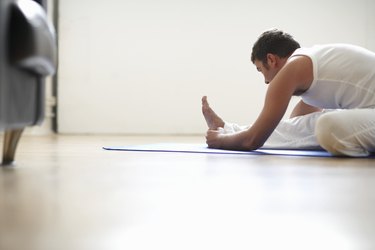
Your muscles typically contract and release as you move them. However, when a muscle spasm occurs, it is due to a muscle contraction that occurs when your muscle tightens without your brain telling it to. Typically, a solution for muscle spasms is stretching, which can help to loosen tight or contracted muscles. However, it is possible to experience muscle spasms after stretching your muscles due to a number of factors in your body that caused the spasms in the first place.
Causes
Video of the Day
Muscle spasms are caused by a number of factors. This includes overuse of your muscles, especially after a long exercise session. If you experience a mineral or chemical imbalance, such as dehydration of your muscles due to calcium or potassium depletion, you are at an increased risk for muscle spasms because your muscle cannot maintain proper fluid levels. In rare instances, muscle spasms can indicate a more serious condition, such as kidney problems, hypothyroidism or a metabolic disorder.
Video of the Day
Considerations
If you experience muscle spasms after stretching, it's important to consider the activities you were performing before you stretched. If you stretched after a long exercise session, the spasms could be due to overuse of your muscles that may not cease even with stretching. If you have been sweating profusely or have not had anything to drink in some time, these can be contributing factors to your muscle spasms, meaning the stretching did not trigger the spasms. However, if your muscle spasms are very severe, do not go away with time or continue for a long time period, you should seek a physician's evaluation.
Technique
Sometimes your stretching technique can contribute to muscle spasms. For example, bouncing while you stretch can increase the muscle contractions instead of soothing them. Holding the stretch too long can have a reverse effect on your muscles, causing them to contract too hard. Try not to hold a stretch for minutes at a time. Typically between 15 and 30 seconds at a time should be sufficient for each stretch. You also should avoid stretching to the point of pain or stretching too quickly. Instead, sink into a stretch slowly.
Prevention
While stretching is one method for relieving muscle spasms, it does not have to be your only method. In addition to stretching, you can increase the amount of fluids you drink to restore fluid imbalances. Sports drinks and water are good examples of drinks that can replace these fluids, which should help to reduce cramping. Applying heat to the area with a hot shower or a heating pad also can help to prevent muscle cramping. Continuing to engage in slow, gentle stretches can help to relieve muscle spasms.
Is this an emergency? If you are experiencing serious medical symptoms, please see the National Library of Medicine’s list of signs you need emergency medical attention or call 911.