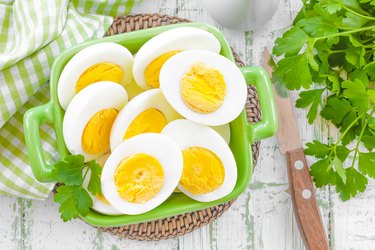
Eggs are a commonly consumed type of food that can be cooked using a variety of different methods. Boiling and frying eggs are two of the most popular ways to eat them, but they involve very different cooking methods. The way you cook your egg can affect its nutrition based on the temperature and duration of the heat applied during the cooking process.
Video of the Day
Video of the Day
Egg Consumption and Portions
Eggs are one of the most commonly eaten foods worldwide. They're a staple food that is often eaten as a snack, prepared as breakfast items or cooked into desserts. Regardless of whether you're consuming quail's eggs, chicken eggs or duck eggs, these protein-rich foods can all be treated and cooked in similar ways. Scrambling, frying and boiling are the most popular ways of cooking eggs in the United States.
According to the American Heart Association, you can eat one large egg a day as part of a healthy diet. The United States Department of Agriculture says that chicken eggs can range between 1.25 ounces (35.5 grams) for peewee eggs to 2.42 ounces (about 68.5 grams) for jumbo eggs. One large whole egg is usually around 1.96 ounces (or 55 grams).
Although eating eggs was once restricted due to their cholesterol content, the cholesterol in eggs (dietary cholesterol) is now considered to be healthy. In fact, one egg a day might even help reduce the risk of heart disease and stroke. A 2018 study in the American Journal of Clinical Nutrition showed that you can eat up to 12 eggs per week without it negatively impacting your health.
Boiled Egg Nutrition Facts
Boiling your eggs can result in two different types of eggs: hard-boiled eggs and soft-boiled eggs. Both types are nutrient-rich foods. Their nutritional differences are minimal, and any differences between them are based on how long they're cooked. Every large boiled egg contains various nutrients, including:
- 13 percent of your daily value (DV) of protein
- 6 percent of your DV for vitamin A
- 15 percent of your DV for vitamin B2 (riboflavin)
- 7 percent of your DV for vitamin B5 (pantothenic acid)
- 5 percent of your DV for vitamin B9 (folate)
- 9 percent of your DV for phosphorus
- 22 percent of your DV for selenium
Each boiled egg's calories total just 77.5 (which is 4 percent of your recommended daily amount of calories if you follow a 2,000-calorie diet). You can also find 1 to 4 percent of other vitamins and minerals in boiled eggs. This includes many of the B vitamins, vitamin E, calcium, iron, magnesium, manganese, sodium and zinc. Each large boiled egg also contains 212 milligrams of cholesterol.
Eggs are also often enriched with healthy fatty acids, like polyunsaturated fatty acids omega-3 and omega-6. They also have other types of beneficial nutrients, like carotenoids and xanthophylls.
Fried Egg Nutrition Facts
Fried eggs and boiled eggs are fairly comparable. For example, boiled egg calories and fried egg calories are about the same. Also, protein and nutrients like phosphorus, selenium and vitamins A, B2, B5 and B9 are similar. The nutritional value is slightly higher in fried eggs but by a tiny amount of just 1 or 2 percent. The only real difference in fried egg nutrition is that it has nearly twice as much iron, with 5 percent of the DV for this mineral.
Of course, fried eggs are cooked in a very different way compared to boiled eggs. Fried eggs are traditionally cooked in some sort of fat, whereas boiled eggs are cooked in water. The nutritional value of eggs can be greatly influenced by what you cook your eggs in. While fried eggs may traditionally be cooked in butter, you may want to opt for healthier fats like olive oil if you choose to consume fried eggs regularly.
The Effect of Cooking Eggs
Eggs are traditionally consumed in some sort of cooked form. While you may find raw eggs in various desserts or smoothies, cooking eggs is usually preferred as it helps eliminate bad bacteria. This includes microbes like Salmonella, which can cause food poisoning. Cooking eggs is also positive in that it can improve digestibility for people who have egg intolerances or allergies.
While cooking eggs is traditionally seen as positive, the heat used to cook eggs can also be bad for them from a nutritional perspective. Heat can denature egg nutrients and reduce the amount of proteins, omega fatty acids and carotenoids in each serving. Generally, low to medium levels of heat are thought to help eggs retain nutrients and reduce the formation of negative by-products.
The way you cook your eggs can also influence the amount of advanced glycation end products (AGEs) that end up in your food. AGEs (also called glycotoxins) are most often found in large amounts in high-heat, high-fat cooking methods. Consuming too many AGEs has been linked to variety of different health issues, like heart disease and diabetes. Out of all the ways you could cook eggs, frying eggs is considered to be the cooking method that results in the most glycotoxins.
Fried Egg vs. Boiled Egg
Comparing a fried egg with a boiled egg doesn't reveal too much difference from a nutritional perspective. However, the way these eggs are cooked can influence more than just their vitamins and minerals. There are xanthophylls in eggs, like lutein and zeaxanthin, that are mainly found in egg yolk. The average egg yolk has about 175 to 400 micrograms of lutein and 200 to 300 micrograms of zeaxanthin.
These nutrients are important as they're good for your eyes. They can actually help prevent eye diseases like age-related macular degeneration. Unfortunately, certain cooking methods can reduce nutrients more than others. Boiling your eggs, which often cooks them all the way through, causes a large reduction in beneficial nutrients like xanthophylls. From this perspective, boiling your eggs is worse than frying them or even microwaving them.
It's easy to identify overcooked eggs. Their discolored yolks are greenish-gray and may smell like sulfur. The color and smell occur when hydrogen sulfide in the egg white and iron in the yolk interact during the heating process and form iron sulfide. Overcooked hard-boiled eggs are typically safe to eat, but may have a peculiar flavor.
Of course, there are different degrees to which you could boil your eggs. Soft-boiled eggs, which don't cook the yolk all the way through, could be considered to be a bit better for you than hard-boiled eggs. Soft-boiled eggs, which involve low amounts of fat and a lightly cooked egg yolk, may actually have the greatest health benefits out of the most popular egg-cooking techniques. If you eat soft-boiled eggs, use pasteurized eggs to reduce the risk of food poisoning.
Read more: The 20 Best Ways to Use Eggs
- Medical History Journal: The Effects of Different Methods of Cooking an Egg on Its Therapeutic Properties From the Perspective of Persian Medicine
- Innovative Food Science & Emerging Technologies: Application of High Pressure Processing for Prevention of Greenish-Gray Yolks and Improvement of Safety and Shelf-Life of Hard-Cooked Peeled Eggs
- Journal of Agricultural and Food Chemistry: Effect of Domestic Cooking Methods on Egg Yolk Xanthophylls
- Journal of the American Dietary Association: Advanced Glycation End Products in Foods and a Practical Guide to Their Reduction in the Diet
- Universiti Putra Malaysia Institutional Repository: Effects of Cooking Methods on the N-3 PUFA Content of PUFA-Enriched Eggs
- The Journal of Nutrition: Digestibility of Cooked and Raw Egg Protein in Humans as Assessed by Stable Isotope Techniques
- Business Insider: This Is The Most Nutritious Way to Prepare an Egg
- Journal of Allergy and Clinical Immunology: Immunologic Changes in Children With Egg Allergy Ingesting Extensively Heated Egg
- American Egg Board: The Incredible Edible Egg: Salmonella
- National Institutes of Health: Omega-3 Fatty Acids Fact Sheet for Health Professionals
- SELFNutritionData: Egg, Whole, Cooked, Hard-Boiled
- American Egg Board: Nutrient Composition Tables
- The American Journal of Clinical Nutrition: Effect of a High-Egg Diet on Cardiometabolic Risk Factors in People With Type 2 Diabetes: The Diabetes and Egg (DIABEGG) Study—Randomized Weight-Loss and Follow-Up Phase
- BMJ Heart: Associations of Egg Consumption With Cardiovascular Disease in a Cohort Study of 0.5 Million Chinese Adults
- University of Illinois Extension: Incubation and Embryology: Structure of the Egg
- USDA: United States Standards, Grades, and Weight Classes for Shell Eggs
- American Heart Association: Are Eggs Good for You or Not?
- Journal of the American College of Nutrition: Nutritional Contribution of Eggs to American Diets
- Centers for Disease Control and Prevention: Salmonella and Eggs
- SELFNutritionData: Egg, Whole, Cooked, Fried