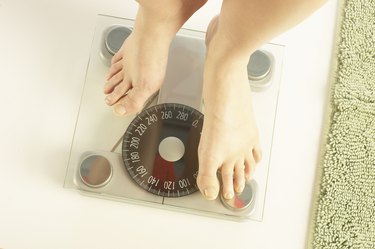
You're down to the last 15 pounds of weight loss, but the scale will not to budge. It can be incredibly frustrating when you hit a plateau in your weight loss, especially when you're so close to reaching your goals. Once you understand what's causing your plateau, you'll be able to make the adjustments necessary to finish strong.
Muscle Loss
Video of the Day
When you lose weight, your body draws on both fat and muscle tissue for energy. The more muscle mass you lose, the slower your metabolism becomes, as muscle burns more calories than fat. If you are not strength training already, add at least two sessions to your routine each week to preserve and build metabolism-boosting muscle tissue.
Video of the Day
Metabolism Changes
Your daily calorie needs are determined by your age, gender, height, weight and activity level. As you drop those excess pounds, your metabolism adjusts your body's energy needs to accommodate the lower weight and alterations in body composition. Furman University suggests this quick method for estimating daily calories requirements based on activity level. If you are inactive, multiply your weight by 11; moderately active, multiply weight by 13; very active, multiply your weight by 15. Using this method, if you are a 160-pound, moderately active female you need 2,080 calories per day to maintain your weight. At 130 pounds, your daily requirement drops to 1,690 calories. To lose additional weight, safely reduce your daily intake by 200 or more calories, but not below 1,200 calories per day for women or 1,500 daily calories for men.
Too Much Too Fast
If you began your weight-loss program with significant changes to your diet and exercise routine, the last bit of weight may be difficult to lose because you left yourself little room for improvement. For example, if you reduced your caloric intake to 1,200 right off the bat, you'll be unable to safely reduce your calories further when your rate of weight loss slows. Similarly, starting with too much exercise early on can make it difficult to add time or intensity to your workout to burn off those final 15 lbs.
Motivation
Motivation is typically higher when you're just starting out and seeing the quick results that come during early weight loss. While most of the weight you lose early on is water weight and not fat, seeing the pounds drop may be all the push you need to continue exercising and eating right. As your weight loss slows, your motivation may suffer, making it seem more difficult to hit the gym or pass up the fatty snacks or fast food.
Breaking Through a Plateau
Evaluate your fitness program to identify where you can make changes to help power you through the last few pounds. A body weighing 160 pounds uses more energy with each movement than a body weighing 120 pounds. As you lose weight, your 30-minute walk will burn fewer calories than it did before your weight loss. To become a more efficient fuel burner at your current weight, increase the pace, intensity or amount of time spent in performing your exercise regimen.