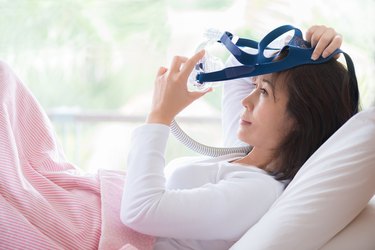
CPAP, or continuous positive airway pressure, is a relatively safe and effective treatment for sleep apnea and certain other breathing problems, according to the National Heart Lung and Blood Institute. A CPAP machine blows a steady stream of air into a mask that the patient wears over the mouth and nose. Because the air is under a small amount of pressure it prevents the airway from collapsing or blocking airflow to the lungs. While the complications of CPAP are rarely serious, they can be annoying.
Irritation
Video of the Day
Sometimes the mask can irritate the skin, cause an allergic reaction, create sores on the nose or irritate the eyes, according to the National Heart Lung and Blood Institute. This can be an indication that the mask needs to be adjusted for a better fit. Because CPAP masks vary quite a bit and are made of different materials, some may be less irritating to patients than others. Some have fewer straps or are designed to have less contact with the face to prevent discomfort. Patients should try different masks to find one they can wear comfortably.
Video of the Day
Dry Mouth
Sometimes the flow of air into the mouth can cause dry mouth, or this problem can be caused simply because the patient is breathing all night through the mouth, according to the National Heart Lung and Blood Institute. Some CPAP machines have heated humidifiers than can help to relieve this problem. Patients can also use a mask with a chinstrap that keeps the mouth closed, or one that fits over the full face and covers both the mouth and nose. Sometimes dry mouth is an indication that the mask is leaking air and needs to be replaced.
Nasal And Sinus Problems
Sometimes a CPAP machine can cause symptoms similar to those of a cold, such as nasal congestion, a runny nose, sneezing, sinusitis or even nosebleeds, according to the National Heart Lung and Blood Institute. A heated humidifier can help. Sometimes patients need to change their mask, because an improperly fitted mask can cause the problem. Also, a saline nasal spray used at bedtime can alleviate these symptoms. If nothing else works, doctors sometimes prescribe a steroid nasal spray to reduce symptoms.
Stomach Problems
Sometimes a CPAP machine can cause stomach bloating and pain, according to the National Heart Lung and Blood Institute. This is usually because the air pressure setting on the machine is causing it to pump too much air into the mask. This can be corrected by having a sleep specialist adjust the settings.
Is this an emergency? If you are experiencing serious medical symptoms, please see the National Library of Medicine’s list of signs you need emergency medical attention or call 911.