What does fact checked mean?
At Healthfully, we strive to deliver objective content that is accurate and up-to-date. Our team periodically reviews articles in order to ensure content quality. The sources cited below consist of evidence from peer-reviewed journals, prominent medical organizations, academic associations, and government data.
- National Institute of Health: National Heart, Lung and Blood Institute: Inhaled Corticosteroids
- National Institute of Health: National Heart, Lung and Blood Institute: Inhaled Corticosteroids
- Cleveland Clinic: Diseases and Conditions: Asthma Treatments
- National Institute of Health: Managing Asthma Long Term
- National Institute of Health: Managing Asthma Long Term
The information contained on this site is for informational purposes only, and should not be used as a substitute for the advice of a professional health care provider. Please check with the appropriate physician regarding health questions and concerns. Although we strive to deliver accurate and up-to-date information, no guarantee to that effect is made.
How Do Asthma Inhalers Work?
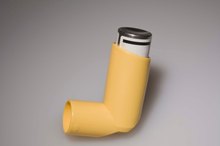
Asthma is a chronic lung disease that involves swelling of the airways, constriction of the muscles that surround them and increased mucus production, all of which make it hard to breathe. Asthma symptoms range from mild cough and wheezing to severe difficulty breathing, which can be life-threatening. To treat these symptoms, people often use a metered dose inhaler, a handheld device that delivers medication to the lungs. Inhalers dispense a variety of medications that act upon the lungs in different ways to help people breathe more easily. They can be a lifesaving measure during an acute asthma attack or used for control of daily symptoms.
If you are experiencing serious medical symptoms, seek emergency treatment immediately.
Rescue Inhalers
Albuterol (Proventil, Proair, Ventolin) is a medication called a bronchodilator, commonly found in rescue inhalers for acute asthma attacks. After it is inhaled and reaches the lungs, it relaxes the constricted smooth muscles around the airway within minutes. The airways become larger, which allows air to pass more easily in and out of the lungs. Albuterol can be used every 4 to 6 hours to treat acute symptoms, with the guidance of a health care provider. It occasionally causes side effects such as tremor or a feeling of heart racing, but these may resolve over time.
- Albuterol (Proventil, Proair, Ventolin) is a medication called a bronchodilator, commonly found in rescue inhalers for acute asthma attacks.
Control Inhalers - Corticosteroids
Ingredients in an Asthma Inhaler
Learn More
Inhaled corticosteroids (Budesonide, Flovent, Asmanex, Alvesco, Beclovent, Qvar) are medications that decrease the swelling within the airways and make it easier to take a deep breath. Sometimes they are used in combination with rescue inhalers for acute symptoms. More often corticosteroids are used for prevention of daily asthma symptoms and acute attacks. Because they take time to work, they need to be taken every day to be effective. Inhaled corticosteroids' side effects may include sore throat, hoarseness and oral thrush, a fungal infection of the mouth 3. Washing the mouth out after using an inhaled corticosteroid may help prevent this from occurring.
- Inhaled corticosteroids (Budesonide, Flovent, Asmanex, Alvesco, Beclovent, Qvar) are medications that decrease the swelling within the airways and make it easier to take a deep breath.
- Washing the mouth out after using an inhaled corticosteroid may help prevent this from occurring.
Control Inhalers - Other Medications
Like corticosteroids, other inhaled medications act over a long period of time to control asthma symptoms. They must be taken every day to be effective. Some inhalers contain a longer-acting form of a medication related to albuterol -- for example, salmeterol (Serevent). This works similarly -- by relaxing the smooth muscle around the airways -- but lasts much longer, from 12 to 24 hours. Drugs like salmeterol are given in combination with inhaled steroids in people whose asthma is not well controlled.
- Like corticosteroids, other inhaled medications act over a long period of time to control asthma symptoms.
- Some inhalers contain a longer-acting form of a medication related to albuterol -- for example, salmeterol (Serevent).
When to Seek Medical Help
List of Nebulizer Medications and Ingredients
Learn More
Inhaler medications can be extremely beneficial in managing symptoms during an asthma attack and decrease the number of asthma attacks that occur. If severe shortness of breath and wheezing cannot be controlled with rescue inhalers, you should seek emergency medical care. In addition, notify your doctor if your asthma symptoms are not controlled with your current daily regimen. You should also contact a medical professional if you experience side effects from your inhaled medications that are not resolving, such as feeling your heart racing, tremor or white spots in your mouth, which could be a sign of oral thrush.
- Inhaler medications can be extremely beneficial in managing symptoms during an asthma attack and decrease the number of asthma attacks that occur.
- If severe shortness of breath and wheezing cannot be controlled with rescue inhalers, you should seek emergency medical care.
Related Articles

Ingredients in an Asthma Inhaler
Learn More

List of Nebulizer Medications and Ingredients
Learn More

List of Asthma Inhalers, Ingredients and How They Work
Learn More

Singulair & Weight Loss
Learn More
List of Drugs Prescribed for Breathing Problems
Learn More

Long-Term Effects of Overuse of an Inhaler for Asthma
Learn More

Treatment for Asthmatic Bronchitis
Learn More
How Often Can a Nebulizer Be Used?
Learn More

Nebulizer Alternatives
Learn More

Antihistamines for Asthma
Learn More
References
- The Merck Manual Professional Edition: Asthma
- American Academy of Allergy Asthma and Immunology: Attaining Optimal Asthma Control: A Practice Parameter
- National Institute of Health: National Heart, Lung and Blood Institute: Inhaled Corticosteroids
- Cleveland Clinic: Diseases and Conditions: Asthma Treatments
- National Institute of Health: Managing Asthma Long Term
- Barnes PJ. Inhaled corticosteroids. Pharmaceuticals (Basel). 2010;3(3):514-540. doi:10.3390/ph3030514
- National Jewish Health. FAQs on inhaled steroids for asthma. December 2012.
- American Academy of Allergy Asthma & Immunology. AAAAI Allergy & Asthma Medication Guide. July 2019.
- U.S. Food & Drug Administration. Transition from CFC propelled albuterol inhalers to HFA propelled albuterol inhalers: questions and answers. February 2018.
- Galván CA, Guarderas JC. Practical considerations for dysphonia caused by inhaled corticosteroids. Mayo Clin Proc. 2012;87(9):901-4. doi:10.1016/j.mayocp.2012.06.022
- Pandya D, Puttanna A, Balagopal V. Systemic effects of inhaled corticosteroids: an overview. Open Respir Med J. 2014;8:59-65. doi:10.2174/1874306401408010059
- National Osteoporosis Foundation. The how’s and why’s of osteoporosis medications. September 2018.
- Shroff S, Thomas RK, D'souza G, Nithyanandan S. The effect of inhaled steroids on the intraocular pressure. Digit J Ophthalmol. 2018;24(3):6-9. doi:10.5693/djo.01.2018.04.001
- Food and Drug Administration (FDA). Transition from CFC propelled Albuterol inhalers to HFA propelled Albuterol inhalers: questions and answers.
- National Heart, Lung, and Blood Institute. Expert panel report 3 (EPR3): guidelines for the diagnosis and management of asthma. 2007.
Writer Bio
As a Physician Assistant, Amy Stumpf is passionate about patient care and preventive medicine. Stumpf has a master's in public health, and was inaugural graduate program faculty for Nova Southeastern University, developing a PA training program. She has vast clinical experience in areas such as neurosurgery, oncology, and pulmonary medicine.