What Do the Parts of the Brain Control?
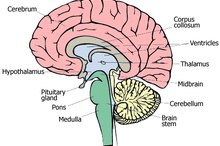
The brain is the most complex part of the body. It controls our movements, communication, decisions and emotions, as well as our organs. Neuroscientists from Duke University write that the human brain is composed of six basic parts: the medulla oblongata, the pons, the midbrain, the cerebellum, the diencephalon and the cerebrum.
If you are experiencing serious medical symptoms, seek emergency treatment immediately.
Different brain parts often work together to control the body's actions. Large areas are devoted to complex functions, such as the ability to have thoughts and feelings, to express them using language and to store them in memory. Neuroscientists are still working on deciphering which parts of the brain work together to accomplish such functions.
Medulla Oblongata
The medulla oblongata controls the lungs, the heart and blood pressure and contains reflex centers involved in vomiting, coughing, sneezing and swallowing.
Pons
Four Main Parts of the Brain
Learn More
"Pons" means "bridge" in Latin, and the pons functions as a bridge between different parts of the brain 23.
Midbrain
The midbrain, together with the pons and the medulla, builds the brainstem, and contains several parts. The tectum controls eye movement, auditory and visual reflexes and processing. The tegmentum controls reflexes. The cerebral peduncles influence voluntary motor functions.
- The midbrain, together with the pons and the medulla, builds the brainstem, and contains several parts.
- The tegmentum controls reflexes.
Cerebellum
Left Frontoparietal Functions in the Brain
Learn More
Diencephalon
Two important structures of the diencephalon are the thalamus and the hypothalamus. The thalamus serves as a relay between the cerebral cortex and other parts of the brain. All sensory signals except smell enter the thalamus, and its neurons send them further to the cerebral cortex for processing.
It also regulates the autonomic nervous system that controls the inner organs. The hypothalamus controls the pituitary gland, which produces hormones that influence other hormone-producing glands.
- Two important structures of the diencephalon are the thalamus and the hypothalamus.
- The hypothalamus controls the pituitary gland, which produces hormones that influence other hormone-producing glands.
Cerebrum
The cortex is divided into four sections or lobes. The frontal lobe is associated with reasoning, planning, problem solving, language and higher emotions, such as:
- empathy
- altruism
The parietal lobe controls movement, orientation, visual attention and perception of pain and touch. The occipital lobe controls visual sensation and processing, and the temporal lobe is associated with hearing, speech, memory and emotion.
- The cortex is divided into four sections or lobes.
- The frontal lobe is associated with reasoning, planning, problem solving, language and higher emotions, such as: * empathy
* altruism The parietal lobe controls movement, orientation, visual attention and perception of pain and touch.
Related Articles
Four Main Parts of the Brain
Learn More
Left Frontoparietal Functions in the Brain
Learn More
What Parts of the Brain Control the Parts of Your Body?
Learn More
Parts of the Brain That Control Primitive Reflexes
Learn More
Parts of the Brain Involved With Hearing
Learn More

Parts of the Brain Used While Driving
Learn More
What the Different Parts of the Brain Do?
Learn More
The Difference Between L-Glucose & D-Glucose
Learn More

Parts of the Brain That Control Sight
Learn More

How Are the Muscular & Nervous Systems Connected?
Learn More
References
- “Neuroscience”; Dale Purves, George J. Augustine, , David Fitzpatrick, , Lawrence C. Katz, , Anthony-Samuel LaMantia, James O. McNamara and S. Mark Williams; 2001
- Center for Neuroskills: Brain Functions and Map
- Boly M, Massimini M, Tsuchiya N, Postle BR, Koch C, Tononi G. Are the Neural Correlates of Consciousness in the Front or in the Back of the Cerebral Cortex? Clinical and Neuroimaging Evidence. J Neurosci. 2017;37(40):9603-9613.
- Jawabri KH.Physiology, Cerebral Cortex Functions.StatPearls [Internet]. Treasure Island (FL): StatPearls Publishing; 2019-. Accessed June 22, 2019
- Hurley RA, Flashman LA, Chow TW, Taber KH. The brainstem: anatomy, assessment, and clinical syndromes. J Neuropsychiatry Clin Neurosci. 2010;22(1):iv, 1-7. doi: 10.1176/jnp.2010.22.1.iv
- Wagner MJ, Kim TH, Savall J, Schnitzer MJ, Luo L. Cerebellar granule cells encode the expectation of reward. Nature. 2017;544(7648):96-100. doi: 10.1038/nature21726
- Fama R, Sullivan EV. Thalamic structures and associated cognitive functions: Relations with age and aging. Neurosci Biobehav Rev. 2015;54:29-37. doi: 10.1016/j.neubiorev.2015.03.008
- Biran J, Tahor M, Wircer E, Levkowitz G. Role of developmental factors in hypothalamic function. Front Neuroanat. 2015;9:47. doi: 10.3389/fnana.2015.00047
- Anand KS, Dhikav V. Hippocampus in health and disease: An overview. Ann Indian Acad Neurol. 2012;15(4):239-46. doi: 10.4103/0972-2327.104323
- Lanciego JL, Luquin N, Obeso JA. Functional neuroanatomy of the basal ganglia. Cold Spring Harb Perspect Med. 2012;2(12):a009621. doi: 10.1101/cshperspect.a009621
- Carter, R. The Human Brain Book. New York: Penguin; 2014.
- Kalat, JW. Biological Psychology. Boston, MA: Cengage Learning; 2016.
Writer Bio
Maja Fiket has been writing about medicine and science since 2002, first as graduate student and then as a medical and science freelance writer. She has written for the news website of the University of Chicago Medical Center. Fiket received her Ph.D. in molecular biology in Berlin, Germany/