Should Babies Sleep in Playpens?
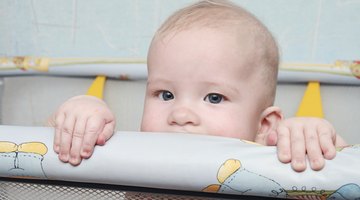
Playpens and play yards are convenient enclosed places for parents to place a baby while taking care of household tasks, but experts warn that you should only put your baby to sleep in a playpen while you are nearby and after you have taken precautions to ensure your baby’s safety in order to help prevent injuries or possible death.
History of Harm
According to the Consumer Product Safety Commission, approximately 1,960 children were injured each year between 2000 and 2006, and 47 babies died from strangulation, entrapment or suffocation between 1999 and 2004, in play yards. The American Academy of Pediatrics found that most injuries are to the head and neck due to a fall from the playpen. In some cases, injuries and deaths were due to product failure; product misuse by consumers, such as assembling the play yard incorrectly or altering it in some way; using a separate, ill-fitting mattress; adding soft bedding in the playpen; or placing the playpen too close to a window blind cord or other strangulation hazard.
Safe Playpen Basics
Are Moses Baskets Safe for Babies?
Learn More
Beginning in 2013, play yards started to undergo more rigorous testing, so, if possible, choose a new playpen. KidsHealth recommends finding one certified by the Juvenile Products Manufacturers Association to ensure it meets safety standards set by the CPSC. The playpen should feature mesh sides of at least 20 inches above its floor and holes smaller than 1/4 inch or wooden slats with no more than 2 3/8 inches of space between them, padding on rail tops, a 1-inch-thick, firm mattress, covered hinges and supports and automatically-locking side rails that are out of your baby’s reach. If you choose a used playpen, look for the JPMA certification and check it carefully for wear and tear, such as broken hinges.
Playpen Sleeping Precautions
When putting your baby to sleep in a playpen, always follow safety guidelines. "Consumer Reports" recommends keeping your baby in view and never adding a second mattress, comforter, pillows or toys to the playpen. Use only a sheet designed specifically for your playpen’s mattress, if any at all. The CPSC suggests you dress your baby in footed pajamas for warmth, and KidsHealth advises you never leave your baby in a mesh playpen with the side lowered to prevent possible suffocation and to always put your baby to sleep on his back as recommended by the AAP in its Back to Sleep campaign, which was designed to help reduce sudden infant death syndrome.
Additional Cautions and Concerns
Cradle Vs. Bassinet
Learn More
Put your playpen in a safe place -- never put it near a stove or other source of heat or near window blinds. Don’t try to move the playpen when your baby is in it. Don’t tie toys across the top or onto a corner of the playpen with strings or cords. According to KidsHealth, you should stop using the playpen for play or sleep when your child is tall enough to crawl out, usually at 30 pounds and 34 inches tall.
Related Articles
Are Moses Baskets Safe for Babies?
Learn More
Cradle Vs. Bassinet
Learn More
Instructions for the Graco Pack 'n Play Bassinet
Learn More

When Should a Baby Be Moved From a Bassinet to a Crib?
Learn More

Things You Should Buy New for a Second Baby
Learn More
The Safety of Baby Bunting Bags
Learn More
Safety When Using a Mosquito Net With a Toddler
Learn More

When Can You Stop Using Baby Gates?
Learn More

How Long Can a Baby Sleep in a Cradle?
Learn More

Rules in Ohio on Kids Riding in the Front Seat
Learn More

Based in Bloomington, Ind., Tanya Konerman is a writer/editor with more than 20 years of experience. Her work has appeared in "At-Home Mother," "Parents," "Career Woman," "Employment News," "Bloomington Business Network," "Bloomington Monthly" and the "Herald-Times." She also worked in advertising and public relations for 10 years. Konerman holds a Bachelor of Arts in journalism and psychology from Indiana University.
