
What does fact checked mean?
At SportsRec, we strive to deliver objective content that is accurate and up-to-date. Our team periodically reviews articles in order to ensure content quality. The sources cited below consist of evidence from peer-reviewed journals, prominent medical organizations, academic associations, and government data.
The information contained on this site is for informational purposes only, and should not be used as a substitute for the advice of a professional health care provider. Please check with the appropriate physician regarding health questions and concerns. Although we strive to deliver accurate and up-to-date information, no guarantee to that effect is made.
Stretches for the Waist
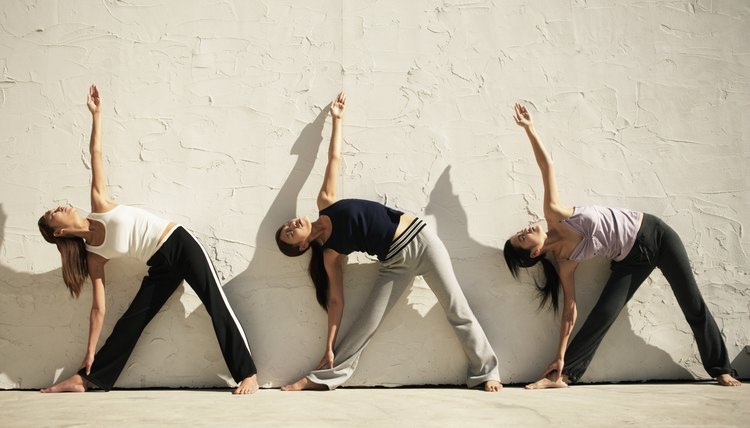
Stretching can help relieve pain from muscle stiffness, increase range of motion, promote flexibility and can even improve strength and endurance. However, many people only focus on stretching their arms and legs, neglecting to stretch their spine and muscles in their waist. But there are many stretches that target the torso and lower back that can be done before or after a workout, or anytime to help you feel more relaxed.
Reach for the Sky
The torso stretch promotes flexibility in your lower back and stretches the obliques to help loosen up your waist. This stretch can be done standing or seated. Begin with your feet flat on the floor, shoulder-width apart. Reach up as high as you can by extending your arms over your head and locking your hands together. Lean to the left by bending at the waist. Keep your head facing forward, hold for a moment and then return to the starting position. Switch sides. Repeat six to eight times on each side.
Do the Twist
The torso twist helps loosen your lower back to stretch your waist. This stretch can be done both standing up or sitting in a chair. Sit or stand tall with your feet flat on the floor, shoulder-width apart. You can either put your hands behind your head, cross your arms in front of your chest or leave your arms loose at your sides. Twist your body to the right by twisting at the waist. Allow your head to follow your body. Hold for a moment before returning to the starting position. Repeat on the other side. Perform this stretch six to eight times on each side.
Meow Then Moo
The cat cow stretch is a combination of two great yoga moves designed to stretch your waist and hips while warming up your spine for physical activity or every day functionality. Begin on your hands and knees with your hands positioned under your shoulders and your knees positioned under your hips. Inhale as you arch your back and lift your head and tailbone. This is the cow position. Exhale as you round your spine like a cat while you tuck both your chin and your tailbone. This is the cat position. Flow slowly back and forth between these two moves for about a minute to get a good stretch.
Not All Snakes Bite
The cobra pose is a yoga move that stretches your waist by targeting the spine for increased flexibility. Begin by laying flat on the floor on your stomach with your legs extended and the tops of your feet touching the ground. Place your hands on the floor underneath your shoulders. Inhale and straighten your arms to raise up your chest and torso. Lift your chin up by looking towards the sky and arch your back. Do not push the front ribs forward, as this will harden the lower back. Evenly distribute the back bend throughout your spine. Hold for 15 to 30 seconds while breathing naturally. Exhale as you return to the starting position.
References
- NBC News: Stretching May Offer Extended Benefits
- American Heart Association: Stretching and Flexibility Exercises
- Yoga Journal: Cobra Pose
- Lurati AR. Health issues and injury risks associated with prolonged sitting and sedentary lifestyles. Workplace Health Saf. 2018;66(6):285-290. doi:10.1177/2165079917737558
- Nakphet N, Chaikumarn M, Janwantanakul P. Effect of different types of rest-break interventions on neck and shoulder muscle activity, perceived discomfort and productivity in symptomatic VDU operators: A randomized controlled trial. Int J Occup Saf Ergon. 2014;20(2):339-53. doi:10.1080/10803548.2014.11077048
- Cooley D, Pedersen S. A pilot study of increasing nonpurposeful movement breaks at work as a means of reducing prolonged sitting. J Environ Public Health. 2013;2013:128376. doi:10.1155/2013/128376
- Daneshmandi H, Choobineh A, Ghaem H, Karimi M. Adverse effects of prolonged sitting behavior on the general health of office workers. J Lifestyle Med. 2017;7(2):69-75. doi:10.15280/jlm.2017.7.2.69
- Henning RA, Jacques P, Kissel GV, Sullivan AB, Alteras-Webb SM. Frequent short rest breaks from computer work: Effects on productivity and well-being at two field sites. Ergonomics. 1997;40(1):78-91. doi:10.1080/001401397188396
- Ylinen J, Kautiainen H, Wirén K, Häkkinen A. Stretching exercises vs manual therapy in treatment of chronic neck pain: A randomized, controlled cross-over trial. J Rehabil Med. 2007;39(2):126-32. doi:10.2340/16501977-0015
Writer Bio
Based in the Los Angeles area, Brandi Junious specializes in health-related articles. Her writing reflects her expertise in fitness and education. Junious is the author of children's book "A World Without Trees" and her work has appeared on Modern Mom, The Nest Woman, Chron Healthy Living and at Loseweightandlivehealthy.blogspot.com. Junious holds a bachelor's degree in psychology from the University of Southern California and a master's degree in Education.