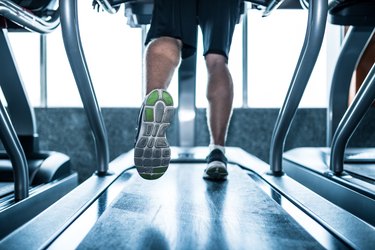
To be successful in many sports, you need to be able to generate great amounts of lower-body speed and power during short bursts of all-out effort. This is known as anaerobic fitness, and it's an essential component of every sport. For example, think of a soccer player sprinting down the field for a final goal or a power lifter picking up as much weight as possible off the floor.
But if you only pay attention to developing lower-body speed and power, you may find you're able to sprint a few bouts, yet fizzle out after only 20 minutes. If you want your strength to last throughout the entire game or competition, you need to build lower-body stamina.
Video of the Day
Video of the Day
You can develop lower-body stamina through cardio or strength training. But for best results, do both.
Read more: Why Is Muscle Endurance Important?
How to Build Leg Stamina with Cardio
To develop endurance, perform at least 30 minutes of low- to moderate-intensity cardio three times per week, but if you're just starting out, even 15 minutes may be enough to improve your stamina in the beginning. On an effort scale of zero-to-10, where zero equals doing nothing at all and 10 refers to an all-out effort, aim to stay around a four.
In addition to your low- to moderate-intensity cardio sessions, you'll also want to perform high-intensity interval training (HIIT) sessions. For 20 to 30 minutes, alternate high-intensity intervals lasting 60 to 90 seconds with recovery periods lasting one to two minutes. Keep your interval pace challenging, yet sustainable. To prevent injury, limit HIIT sessions to one or two per week, and build up both intensity and duration as you gain fitness.
Keep in mind, the activity you perform during these endurance sessions will depend on your sport of choice. If you're a runner or you play a team sport (i.e. basketball, softball, soccer), running will be your best choice. If you're a swimmer, swim. And if you're a cyclist, cycle.
Read more: How to Test Muscular Endurance
How to Build Leg Stamina with Weights
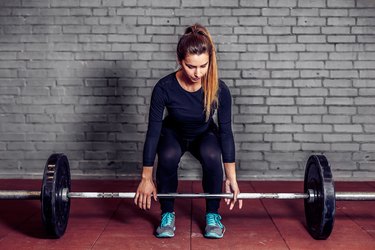
Hit your lower body two times per week, making sure to perform exercises that work your quads, glutes and hamstrings. Examples of effective moves include: squats, deadlifts, lunges, leg presses, hamstring curls, step-ups and split squats.
When strength training for muscular endurance, higher reps are ideal, says the American College of Sports Medicine. Stick with two to four sets of 15 or more reps, and use a light to moderate weight. ACSM advises using weights that correspond to 40 to 60 percent of your one-repetition maximum (1RM).
For example, if the most you can squat for a single rep is 200 pounds, go for 80 to 120 pounds. However, continue increasing the weight as your strength increases. Limit your rest in between sets to 60 seconds or less.
If you can work directly with a coach to plan a training schedule that ensures your stamina improves without adversely affecting your in-competition performance. Include upper-body training if your sport calls for it.