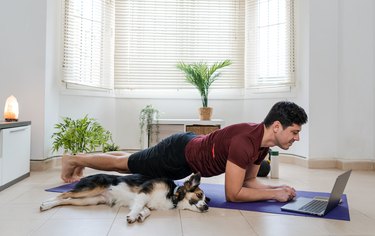
Between 60 and 70 percent of adults in industrialized countries will deal with low-back pain, according to the World Health Organization.
Thankfully, the majority of cases are acute and last just a few days to a few weeks and usually respond well to at-home treatment, according to the National Institute of Neurological Disorders and Stroke. Lower-back pain that doesn't go away after 12 weeks, however, is classified as chronic.
Video of the Day
Chronic low-back pain usually starts as a minor, dull ache; acute pain or injury can feel sharp and come on quickly.
The Best Lower-Back Exercises
Since lower-back pain is so common, there are a number of known treatment options to try. For starters, here's a list of exercises that may relieve some discomfort — and could even help prevent injuries, too.
1. Forearm Plank
- Lie on your stomach with your forearms tucked under your chest.
- Keep your body in a straight line from head to feet as you push up, balancing on your toes and forearms.
- Keep your core engaged and don't allow your lower back to sag.
- Hold for 20 to 30 seconds and repeat twice more.
Tip
If the full forearm plank feels too challenging, you can drop down to your knees to modify the exercise.
2. Trunk Extension Stretch
- Lie on your stomach with your hands beside your shoulders.
- Press your chest off the floor, arch your upper back as much as you can comfortably and look up to the ceiling.
- Hold for 5 seconds.
- Perform 2 sets of 10 repetitions.
3. Supine Marching
- Lie on your back, knees bent, feet flat on the floor.
- Allow your elbows to rest by your sides and place your hands on the front of your pelvis.
- Contract your deep core muscles and lift one foot off the ground so that your leg forms a 90-degree angle and your shin is parallel to the floor.
- Hold for 5 seconds before returning your foot to the starting position.
- Perform 2 sets of 10 repetitions on each leg.
Tip
If you're having trouble getting up off the floor, you can do this exercise next to a couch or sturdy chair for some extra assistance.
4. Side-Lying Hip Abduction
- Lie on your left side, with your right leg straight and your left leg bent so your foot is behind you.
- Bend your left arm to support your head.
- Raise your right leg, keeping it straight, and don't let your back arch.
- Hold for 5 seconds.
- Perform 2 sets of 10 reps on each side.
5. Pelvic Tilt
- Lie on your back with your arms folded across your chest.
- Bend your knees so that your feet are flat on the floor and the small of your back is in a natural curve.
- Rock your hips toward your head to press the small of your back to the floor and hold for 5 seconds.
- Relax and return the small of your back to a neutral position.
- Perform 2 sets of 10 reps.
6. Prone Cobra
- Lie on your stomach with your arms to your side, hands facing down.
- Lift your head and chest several inches off the floor, keeping your chin slightly tucked and your elbows bent.
- Hold for 5 seconds.
- Perform 2 sets of 10 reps.
The Importance of Lower-Back Exercises for Men
Back-strengthening exercises can benefit just about anyone. As you age, you may start to accumulate weight around your core. This can put you at higher risk for lower-back pain.
Risk Factors for Low-Back Pain
In order to help alleviate low-back pain, it's important to understand where and how it originates. According to Katherine Rush, DPT, physical therapist and owner of The Perfect Pelvis, the most common causes can include age-related muscle loss, abdominal weakness, pregnancy, weight gain and underlying health conditions.
While some of these factors, like age and genetics, are outside of your control, others, like muscle strength, are not. That's why it's important to practice back-strengthening exercises during your workouts.
Weakness in your core may be another cause of lower-back pain. Your core muscles help stabilize your pelvis and spine but when they're weak, you may experience back sensitivity. Practicing some core stability exercises (like planks or dead bugs) can help build abdominal strength.



- Katy Rush: "The Perfect Pelvis"
- Theresa Marko: "Marko Physical Therapy"
- The Journal of Clinical Endocrinology & Metabolism: "Abdominal and Gynoid Fat Mass Are Associated with Cardiovascular Risk Factors in Men and Women"
- Liza Janda: "Yoga Janda"
- WHO: "Low Back Pain"
- National Institute of Neurological Disorders and Stroke: "Low Back Pain Fact Sheet"
Is this an emergency? If you are experiencing serious medical symptoms, please see the National Library of Medicine’s list of signs you need emergency medical attention or call 911.