
How to Guard a Bigger Player in Basketball
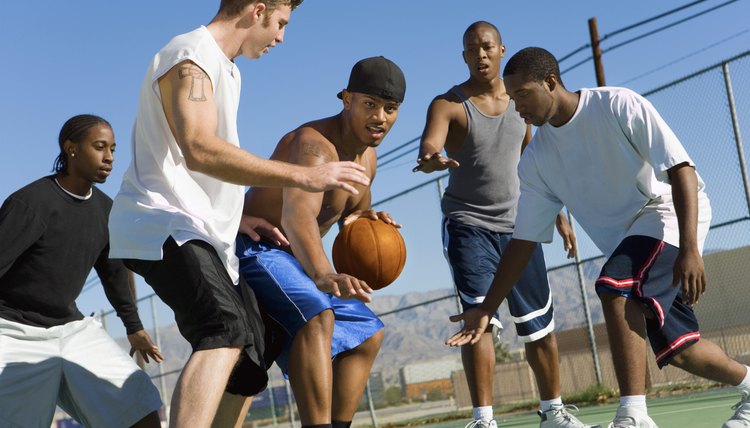
The key phrase to remember when guarding a bigger player in basketball is "ball-you-man," which means you must keep yourself between your opponent and the ball, wherever it is on the court. However, you should also remember to stick close to your man and prevent him from getting uncontested shots or too much space to drive to the basket. You can overcome a mismatch in height frequently by tenacious defense and lots of movement.
Stay on Your Man
Try to keep within an arm's length of your opponent at all times, unless he drifts far from the basket. If your man has the ball, be within touching distance.
Move your feet so you're always between the ball and your man. If he gets a better position on you, at least try to get an arm out in front of him to deny him a pass. The arm you use should be the one closest to the ball, with your hand turned toward the passer, not your man.
Hold your ground. If your man has the ball and his driving to the basket, plant your feet before he jumps or makes his last move to the hoop and try to draw a charging foul on him.
Force your opponent to the outside, toward the sideline, to keep him away from the lane.
Anticipate
Pay attention to the offensive plays your opponents are running. If you see players lining up in the same positions and going through the same rotations, get out in front of those players and cut off their passing lanes or force them to take unwanted angles as they run their offense.
Get up in his face and harass him if your opponent picks up his dribble and must pass or shoot. Move your hands, anticipating where he may want to pass the ball. Contest every pass and shot.
Block out your opponent as soon as a shot goes up and try to anticipate where the rebound will go. If you back into your opponent while blocking him out and stay close to him, his only way to get a rebound will be going over your back and committing a foul.
Prepare to deny a pass to your opponent if he passes the ball and breaks toward the basket. He may be looking for a quick pass back to him as part of a give-and-go play, so if he cuts hard to the hoop, remember the ball-you-man concept.
Tips
Greater size makes more of a difference the closer you get to the basket, so the more you can keep your bigger opponent out of the lane, the better.
If you're guarding a bigger player, chances are you may be the quicker of the two. Use your quickness to reach for steals or to stay close to him as he tries to get some open space to make his move.
Warnings
Be careful when leaving your opponent to help out if a teammate gets beat or a player is penetrating the lane unguarded. Guards like to drive inside and then pass the ball to a teammate, often a big man who can get an easy score if left alone near the basket.
Writer Bio
James Roland started writing professionally in 1987. A former reporter and editor with the "Sarasota Herald-Tribune," he currently oversees such publications as the "Cleveland Clinic Heart Advisor" and UCLA's "Healthy Years." Roland earned his Bachelor of Science in journalism from the University of Oregon.