Have Heel Spurs? How to Strap Your Foot
A heel spur is the result of an abnormal growth of the heel bone. When the plantar fascia pulls away from the heel bone, calcium deposits form and a bony protrusion develops, resulting in pain. Heel spur pain can be extreme especially when standing or walking. Women suffer from heel spurs more frequently than men due to the difference in footwear 2. The treatment of a heel spur includes nonsteroidal anti-inflammatory drugs, such as ibuprofen, naproxen and aspirin; ice; stretching exercises; and foot taping 2.
If you are experiencing serious medical symptoms, seek emergency treatment immediately.
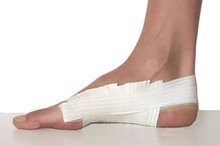
Apply a strip of tape just below the pinky toe on the outside portion of the foot. Wrap that portion of tape around the heel, then across the arch and join it with the first piece of tape.
How to Tape a Heel Spur
Learn More
Apply another strip of tape just below the big toe on the inside portion of the foot. Wrap that portion of tape around the heel across the arch and join it with the piece of tap under the big toe.
Repeat Steps 1 and 2 until again until two pieces of tape are applied in each direction, starting at the big toe and the pinky toe.
Sciatica and the Big Toe
Learn More
Apply short strips of tape along the middle portion of the foot and down to the heel to secure the criss-cross patterns of tape 2.
Wrap one final piece of tape across the foot from the pinky to the big toe to secure the tape into place.
Tips
Prevent blisters by not wrapping the tape too tightly or leaving wrinkles.
Related Articles
How to Tape a Heel Spur
Learn More

Sciatica and the Big Toe
Learn More

Symptoms of Bone Spur in the Foot
Learn More
How to Use an Athletic Wrap for Foot Arches
Learn More
Why Does My Achilles Tendon Hurt?
Learn More
What Causes Foot Pain on the Sole?
Learn More
Causes of Bilateral Hip Pain in Women
Learn More
How to Stretch the Foot Arch
Learn More
My Heel Hurts & I Have Sharp Pain When I Walk
Learn More
Foot Pain in the Heel From Playing Soccer
Learn More
References
- “Arnheim’s Principles of Athletic Training 12th edition”; William Prentice; 2008
- Foot.com: Heel Spurs
- American Academy of Orthopaedic Surgeons. "Plantar Fasciitis and Bone Spurs." https://orthoinfo.aaos.org/en/diseases--conditions/plantar-fasciitis-and-bone-spurs.
- Cleveland Clinic. “Think You Have a Heel Spur? It’s Probably Plantar Fasciitis.” https://health.clevelandclinic.org/think-heel-spur-probably-plantar-fasciitis.
- Johal KS, Milner SA. "Plantar Fasciitis and the Calcaneal Spur: Fact or Fiction?" Foot and Ankle Surgery. 2012;18(1):39-41. doi: 10.1016/j.fas.2011.03.003.
- Ahmad J, Karim A, Daniel JN. Relationship and Classification of Plantar Heel Spurs in Patients With Plantar Fasciitis. Foot Ankle Int. 2016;37(9):994-1000. doi:10.1177/1071100716649925
- Krukowska J, Wrona J, Sienkiewicz M, Czernicki J. A comparative analysis of analgesic efficacy of ultrasound and shock wave therapy in the treatment of patients with inflammation of the attachment of the plantar fascia in the course of calcaneal spurs. Arch Orthop Trauma Surg. 2016;136(9):1289-1296. doi:10.1007/s00402-016-2503-z
- Kirkpatrick J, Yassaie O, Mirjalili SA. The plantar calcaneal spur: a review of anatomy, histology, etiology and key associations. J Anat. 2017;230(6):743-751. doi:10.1111/joa.12607
- Alatassi R, Alajlan A, Almalki T. Bizarre calcaneal spur: A case report. Int J Surg Case Rep. 2018;49:37-39. doi:10.1016/j.ijscr.2018.06.006
- Boules M, Batayyah E, Froylich D, et al. Effect of Surgical Weight Loss on Plantar Fasciitis and Health-Care Use. J Am Podiatr Med Assoc. 2018;108(6):442-448. doi:10.7547/15-169
- Agyekum EK, Ma K. Heel pain: A systematic review. Chin J Traumatol. 2015;18(3):164-9. doi:10.1016/j.cjtee.2015.03.002
- American Academy of Orthopaedic Surgeons. "Plantar Fasciitis and Bone Spurs."
- Cleveland Clinic. “Think You Have a Heel Spur? It’s Probably Plantar Fasciitis.”
- Johal KS, Milner SA. "Plantar Fasciitis and the Calcaneal Spur: Fact or Fiction?" Foot and Ankle Surgery. 2012;18(1):39-41. doi: 10.1016/j.fas.2011.03.003.
Resources
Writer Bio
Sha Buckines is a freelance writer, fitness and nutrition expert based in Atlanta. She has trained celebrity clients as well as business professionals since 2001. She obtained her B.S. in exercise science from Georgia State University, is American College of Sports Medicine certified and teaches group fitness classes.