
What does fact checked mean?
At SportsRec, we strive to deliver objective content that is accurate and up-to-date. Our team periodically reviews articles in order to ensure content quality. The sources cited below consist of evidence from peer-reviewed journals, prominent medical organizations, academic associations, and government data.
The information contained on this site is for informational purposes only, and should not be used as a substitute for the advice of a professional health care provider. Please check with the appropriate physician regarding health questions and concerns. Although we strive to deliver accurate and up-to-date information, no guarantee to that effect is made.
Weight Training on a Powerhouse Home Exercise Machine
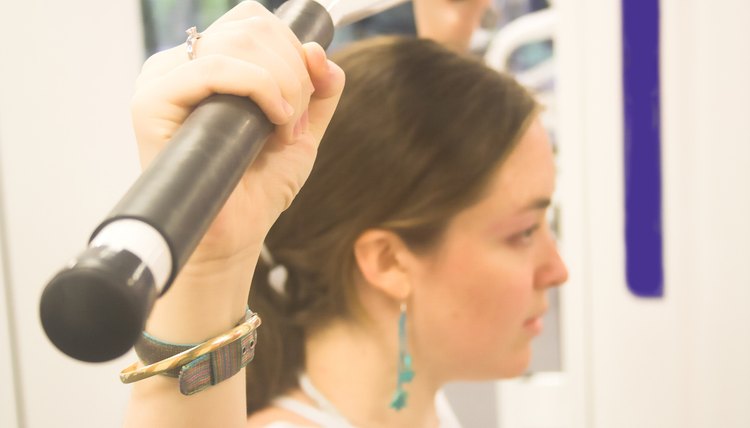
The Powerhouse Home Gym provides a convenient way to work all the major muscles of the body. Impex Inc. manufactures the home gym under the brand name Marcy, a company founded in 1959 by strength-training specialist Walter Marcyan. The home exercise machine allows you to create a complete strength-training program. Select eight to 10 exercises and perform eight to 12 repetitions of each exercise at least twice a week to meet the American College of Sports Medicine’s basic strength-training recommendations.
Features
The Powerhouse Home Gym features a weighted pulley system with components such as a lat pulldown bar, a preacher curl pad, and a leg extension and curl station. High and low pulley stations make it possible to attach accessories and work various muscles in the upper and lower body. The accessories include an ankle strap and a straight bar, providing methods for working the inner and outer thighs, as well as the large muscles of the back.
Exercises
Use the Powerhouse Home Gym to perform at least eight exercises that work different parts of the body on at least two nonconsecutive days of the week. Try the front chest press for the chest, the seated row using the straight bar for the back and the preacher curl pad for the biceps. Move to the triceps push-down for the back of the arms, the leg curl for the hamstrings, the leg extension for the quadriceps and shoulder front raises using the lower pulley station. The manufacturer includes guidelines for proper procedures and exercise demonstrations.
Resistance
Plates on the Powerhouse Home Gym weigh 10 pounds each. Because of the pulley mechanism, each exercise provides varying degrees of resistance. When you use one plate, for example, the exercise machine will provide 30 pounds of resistance for the front press, 15 pounds for the butterfly, 30 for the lat pulldown, and 30 for the leg developer and low pulley, according to Impex-Fitness. Select a weight that you’re comfortable with, and gradually progress to heavier loads in your fitness regimen.
Benefits
A home gym provides many benefits, including cost effectiveness and exercise convenience, according to CNN Money. Incorporating strength training into your lifestyle helps you manage body weight, boost your energy levels, reduce your risk of injury and manage chronic health conditions. Regular exercise will also sharpen your mental focus and reduce fatigue, enhancing the quality of life.
Considerations
The Powerhouse Home Gym cannot accommodate extra weight or resistance. Only the provided plates may be used on the machine. Add aerobic exercise to your regimen at least five days a week to maintain cardiovascular health.
Explore In Depth
References
Writer Bio
Sunny Griffis, a certified performance technologist, is a fitness coach who has been a professional writer since 1998. Her work can be seen in online and print publications such as "Family Fun," "Cappers," "Rutherford Woman Magazine" and "Healthy Family Magazine." She holds a Bachelor of Arts in metaphysics from AIHT, and a CPT certification from NFPT.