Anyone that sits in a chair or desk throughout the day is no stranger to hip tightness. Even driving in the car for an hour or two can make these small muscles stiffen up.
Although it's not the only surefire cure to all your hip tension problems, dynamic stretching is one way you can help alleviate the ache. Whereas static stretches involve holding a position for 30 seconds or so, dynamic stretches are movement-based and get blood flowing to ease your tight muscles.
Video of the Day
Before your next training session (or during your lunch break), take charge of your tight hip flexors and try these eight dynamic hip stretches to realign your hips, boost mobility and rotate, open and extend the joint.
Move 1: Half-Kneeling Hip Flexor Stretch With Rotation
At some point, you've probably tried a half-kneeling hip flexor stretch. But this rotated variation helps you get even deeper into your hip joints, according to New York-based physical therapist Sam Chan, DPT.
You should feel this dynamic hip stretch in the front of your hip as it gets into your hip flexor tension points.
Try It:
- Get in a half-kneeling position with your right foot on the floor, knee bent at 90 degrees, kneeling on your left knee.
- Holding your legs in place, extend your left arm across your body and twist through your core, rotating toward your right leg.
- Return to the starting position.
- Repeat on the opposite side.
Tip
Make sure to squeeze your glutes and tighten your abdominals to get the full effect of this motion.
Move 2: Half-Kneeling Hamstring Rocker
This dynamic hip stretch targets the small muscles in your hips and inner thighs. This helps with motions like hip abduction (opening the hips) and hip adduction (closing the hips). These muscles also keep your hips stable and aligned.
You should feel this stretch in the back of your legs, almost between your thighs.
Try It:
- Get on your knees with your back flat.
- Keeping your right knee in place, extend your left leg out to the left and place your foot flat on the floor with your knee straight.
- With your left foot in place, push your hips back and let them sink toward your right heel.
- Pause here for a moment until you feel a stretch along your left inner thigh.
- Reverse the motion and return to kneeling.
- Repeat on the opposite side.
Move 3: 90/90 Switch
Imagine opening and closing your knees while sitting in a chair. Those movements are called external and internal hip rotations. Those two movements are huge for loosening tight muscles and improving hip mobility, Chan says. After all, how often do hip internal rotations in everyday life? Your hip stretching routine is your opportunity to change that.
To do so, he suggest trying this dynamic hip rotator stretch, called the 90/90 hip stretch. You'll feel this one in the tension points of your inner and outer parts of your hips. When doing this hip external and hip internal rotators stretch, focus on keeping your torso up as tall as possible and squeezing your glutes.
Try It:
- Sit on the ground with one knee bent in front of you at 90 degrees and one knee bent behind you at 90 degrees.
- Lift both knees up and turn to face the leg behind you, keeping your heels planted on the ground.
- Keep switching back and forth.
Move 4: Dynamic Frogger
This is one of the best hip internal rotator stretches ever. It builds mobility and relieves tension muscles deep in your hip joint and groin, according to Chan. These include your internal rotator muscles.
You'll feel this one across the front of your hips as well as your inner thigh muscles.
Try It:
- Get on the floor on your hands and knees.
- Slowly spread your knees apart as far as is comfortable.
- Allow the entire inner side of your feet to rest on the floor.
- Exhale and press your hips back toward your heels.
- Inhale and return to the starting position.
- Continue this motion with each breath.
Tip
This can feel like a pretty intense stretch so ease into it slowly, Chan says. To make this move more comfortable, you can also place a pillow under each knee.
Move 5: Hamstring Scoop
When the muscles behind your legs are tight, your hips tend to tilt backward, also known as a posterior pelvic tilt, Chan says. This stretch releases your hamstrings, helping you tuck your tailbone to align with your spine.
You'll feel this stretch in your glutes and hamstrings.
Try It:
- Stand tall with your feet together.
- Step one the heel of one foot on the floor in front of you with your toes pointed toward the ceiling.
- Keeping your knee straight, slowly push your hips behind you and let your torso fall forward. At the same time, scoop your arms down toward the floor in front of you.
- Raise back up to stand.
- Switch sides.
Move 6: Eccentric Split Squat
When your hip flexor muscles are tight, they can cause your pelvis to tilt down and throw your back out of alignment, also known as an anterior pelvic tilt, according to Chan. This stretch helps readjust the tilt, correcting your posture.
Weak glutes often cause a tilt, too, Chan says. Eccentric split squats are a slow motion, so they'll stretch your hips while building strength in your glutes, quads and hamstrings.
You'll feel this stretch in the quads of your rear leg and the front of the hip joint.
Try It:
- Stand with your right foot about two or three feet in front of your left with your legs straight and arms at your sides.
- Simultaneously bend your right knee to 90 degrees and lower your left knee toward the floor.
- Lower down slowly for about a 4-second count.
- Return to standing and repeat on the other side.
Tip
Avoid leaning forward or backward as you move through this stretch. Keep your head, torso and pelvis in line as best as you can, Chan says.
Move 7: Cat-Cow
A common yoga hip opener, the cat-cow helps you build control of your hips. Over time, developing more control of these muscles helps fix pelvic tilting, according to Chan.
You should feel this anterior pelvic tilt stretch in your front hips.
Try It:
- Get on your hands and knees.
- Exhale as you round your back, pull the belly button toward your spine and tuck your chin toward your chest.
- Starting at the tailbone, release one part of your back at a time, relaxing from the bottom of your back to the top as you lift your chin up to the ceiling.
- Continue to move between cat-cow pose, letting your body move with your breath.
Move 8: Glute Bridge
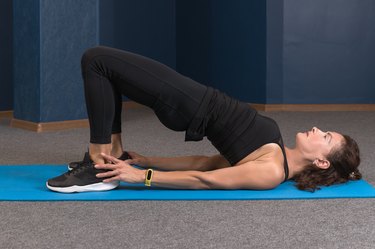
A hip flexor strengthening exercise as well as a dynamic stretch, the glute bridge build muscle in your glutes, hamstrings, hips and core. "You also get the added benefit of a gentle hip flexor stretch at the top of the movement," Chan says.
You should feel this pelvic lift in your glutes, the top of your hips and your hamstrings.
Try It:
- Lie on your back with your arms at your sides, feet flat on the floor and knees bent.
- On an exhale, squeeze your glutes, press into your heels and drive your hips up toward the ceiling.
- Raise your hips until you form a diagonal line from knees to hips to chest.
- Pause here for a moment.
- Reverse the motion and return to the starting position.