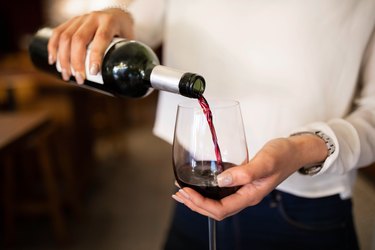
With most beverages, finding out the calories is easy: Rotate the bottle and review the nutritional label.
That's not the case for wine or other alcoholic beverages, which aren't required to carry nutrition facts. This can make figuring out the calories in that glass of wine you had with dinner a bit of a struggle.
Video of the Day
Video of the Day
Why Don't Wine Bottles Have Nutrition Labels?
Alcohol isn't regulated by the U.S. Food & Drug Administration (FDA) — instead, it's regulated by the Alcohol and Tobacco Tax and Trade Bureau (TTB). Unlike the FDA, the TTB doesn't require wine, beer and liquor brands to disclose nutritional information.
But given the rise in consumer awareness and more people demanding transparency, many alcohol brands now voluntarily publish nutrition facts on their labels or on their websites.
Where Do the Calories in Wine Come From?
The calories in wine come from sugar and alcohol. Sugar has 4 calories per gram while alcohol contains 7 calories per gram.
Plus, the caloric content of wine varies depending on the type of grape used, how long the wine is fermented and the amount of sugar added to the product.
How to Calculate Calories in Wine
Typically, an ounce of wine has about 24 to 25 calories. Multiply the number of ounces you're drinking by 24 to 25 to calculate the calories in your wine.
Will Wine Make You Gain Weight?
It could — wine contains about 125 calories per glass, so adding an extra 125 calories to your daily menu frequently could result in weight gain.
For comparison, one shot of liquor has around 97 calories while a 12-ounce beer has around 150 calories.
Wine, and other types of alcohol, contain empty calories — that means that their calories don't come from nutrients that help fill you up. Also, your body metabolizes alcohol before it does food, according to the Cleveland Clinic.
What's more, drinking alcohol (including wine) can cloud your judgment and cause you to make poor food choices, which could lead to weight gain in the long run.
How Much Sugar Is There in a Glass of Red Wine?
One 5-ounce glass of red wine has 0.9 grams of sugar, per the USDA.
Does White Wine Have More Sugar Than Red Wine?
In general, white wine has a bit more sugar than red wine — a glass of white wine has 1.4 grams of sugar whereas a glass of red wine has 0.9 grams of sugar.
What Are the Benefits of Drinking Wine?
Experts agree that if you don't drink alcohol, there's no reason to start. But if you already do drink wine, here are some of the beverage's health perks, according to the Mayo Clinic:
- It contains antioxidants
- It's good for your heart (in moderation)
- It might help lower cholesterol
Why Is Red Wine Healthier Than White?
It all boils down to the manufacturing process: White wine is mainly made with white grapes, and their skins are removed before the fermentation process; meanwhile, red wine is made with red or black grapes, and the skins remain on the grapes during fermentation, according to Piedmont.
So red wine contains more antioxidants because those compounds are mainly found in the grapes' skin. These antioxidants include resveratrol, which is thought to contribute to heart health.
Calories in Red Wine
Varieties of red wine include shiraz, cabernet, merlot, malbec, tempranillo, Sangiovese and Chianti. Many wines mix more than one grape variety, which can affect the calorie count. Even the same wine variety has different nutritional information when made by two different winemakers.
Take a look at the calories for different red wine varietals:
Calories in 1 bottle | Calories in a half bottle | Calories in 1 glass | |
|---|---|---|---|
610 | 305 | 121 | |
610 | 305 | 122 | |
610 | 305 | 122 | |
610 | 305 | 122 | |
660 | 330 | 129 |
The Calories in Half a Bottle of Wine
A bottle of red or white wine is 750 milliliters, making half a wine bottle 375 milliliters, or about 12 ounces. Put another way, a standard pour for a wine glass is 5 ounces. Half a bottle of wine, therefore, is a little more than two glasses of wine.
The calories in half a bottle of wine will depend on the type — red or white — and the variety of wine, along with other factors.
A box of wine typically contains 5 liters of wine, or 34 five-ounce glasses of wine. So, the total calories in a box of wine will amount to roughly 4,100 calories (the amount will vary depending on the variety of wine).
Pinot Noir
The grape in this wine originally hails from the Burgundy region of France, according to Plant Grape. Now, it's grown elsewhere, including the United States, per the USDA Cooperative Extension. It's known to be hard to grow, per the Wine International Association.
Pinot noir is a very popular red wine — and it only got more attractive to wine lovers after the movie Sideways, featuring a road trip through wine country in California, per the Wine Institute. In 2004, when the movie came out, supermarket sales of the wine grew by 18 percent, according to the Wine Institute.
A typical 5-ounce pour of pinot noir wine has 121 calories, per the USDA. About 11 percent of these calories come from carbohydrates, and the remaining 89 percent of the calories come from alcohol.
Just as taste will vary from one winery's bottle of pinot noir to another, so too will the nutritional information. Calories in a glass of pinot noir will vary slightly depending on the brand's specific sugar and alcohol content.
Shiraz
Whether this wine is referred to as shiraz, sirah or syrah, it comes from the same grape, per the Wine Institute. Typically, in the U.S., you'll hear it referred to as syrah. Australia and South Africa refer to it as shiraz.
This varietal produces full-bodied wines — you may hear them described as tasting like berries, bacon, black pepper and smoke, per the Wine Institute.
A 5-ounce pour of a typical shiraz wine has 122 calories, per the USDA, with 12 percent of the calories coming from carbohydrates and the rest from alcohol. The caloric makeup is quite similar to pinot noir (121 calories in a glass) and other red wines, such as merlot and cabernet sauvignon.
Merlot
Merlot is a full-bodied, soft varietal of red wine. It's been grown in the Bordeaux region of France for centuries and is often blended together with cabernet sauvignon, per the USDA Cooperative Extension. Merlot is one of the most popular types of red wine.
A 5-ounce glass of merlot contains 122 calories, with most of them (88 percent) coming from alcohol, and 12 percent from carbohydrates, per the USDA.
Cabernet Sauvignon
Cabernet sauvignon is the second most sold wine in the U.S. and the "king of red wine grapes," per the Wine Institute. Expect your glass of cabernet sauvignon to be dry and full-bodied.
As with shiraz and merlot, a 5-ounce glass of cabernet sauvignon nets out at 122 calories, per the USDA.
Zinfandel
You'll sometimes hear zinfandel referred to as zin. And while this wine is made from a red grape, it's also used to make white zinfandel, a rosé wine (so no, white zinfandel is not red wine). This grape most likely arrived in the U.S. in the 1800s, although zinfandel's path here remains somewhat mysterious, per the University of California, Davis.
Zinfandel is slightly higher in calories than other red wines: A 5-ounce glass has 129 calories, with most coming from carbs, per the USDA. Just like with other alcoholic drinks, red zinfandel isn't good for you.
Do White Wine and Red Wine Have the Same Calories?
The calories in red and white wine do not differ much.
In general, white wine has slightly fewer calories than red wine — emphasis on "slightly." A 5-ounce glass of everyday red table wine has 125 calories per the USDA, while a glass of white table wine has 121 calories, per the USDA.
A typical red wine pour is 5 ounces, but watch the size of your glass as well as your pour: In England, wine glasses have ballooned seven times larger from the 1700s to current times, per a December 2017 article in The BMJ. And, with a larger glass, people may be more likely to do a heavy pour, resulting in a larger serving, per a December 2015 study in PLOS One.
A larger pour, of course, means that you'll be taking in more calories. For instance, an 8-ounce glass of merlot has 192 calories (compared to 120 calories in a 5-ounce glass), per the USDA. And 8 ounces of zinfandel tops 200 calories (208, to be precise), compared to 130 calories in a 5-ounce glass, per the USDA.
Calories in White Wine
White wine has a paler hue than red wine both because of the grapes (white versus red) and because it's fermented without the skin on. Unlike red wine, which is typically served at room temperature, white wine is often served chilled.
Calories in 1 bottle | Calories in a half bottle | Calories in 1 glass | |
635 | 318 | 123 | |
635 | 318 | 123 | |
610 | 305 | 119 | |
610 | 305 | 122 |
Chardonnay
Hands-down, chardonnay is the most popular wine overall in the United States, according to the Wine Institute. This wine is sometimes described as "buttery" or "oaky" — that oak taste may be due to aging in barrels, which chardonnay is well-suited for, per Plant Grape. Chardonnays are also often described as having fruit notes, such as apple or dried fruit.
A 5-ounce glass of this popular wine contains 123 calories (with 89 percent of them coming from alcohol), per the USDA. Here are more details on the nutrition facts for a glass of chardonnay, via the USDA:
- Sodium: 7.4 mg, 0% Daily Value (DV)
- Total Carbohydrate: 3.2 g, 1% DV
- Total Sugars: 1.4 g, 3% DV
- Protein: 0.1 g, 0% DV
- Iron: 0.4 mg, 2% DV
- Calcium: 13.2 mg, 1% DV
- Potassium: 104.4 mg, 2% DV
- Phosphorus: 26.5 mg, 2% DV
Moscato
If you prefer a sweeter, less dry white wine, Moscato is a good choice. The wine is made from the Muscat grape (and sometimes referred to as Muscat), per the Wine Institute.
A typical Moscato wine contains 123 calories per 5-ounce serving, according to the USDA. The calories come from the alcohol and carbohydrates in the wine. Moscato is also available in red varieties, which have more calories. For instance, a 5-ounce glass of Sutter Home Red Moscato has 138 calories.
While Moscato wines are often served chilled and paired with fruit, mild cheeses or a light dessert, they're far lower in calories than other sweet wines, which have 236 calories per 5-ounce glass, per the USDA. Muscat grapes can be used to make either still or sparkling wines; sparkling varieties are lower in alcohol, per the Wine Institute.
Calories in Rosé or Blush Wine
Rosé and blush wines, which come in delicate shades of pink, are particularly popular when the temperatures outside are steamy.
Rosé wines can be produced from just about any red wine grape, per the Wine Institute. The pale color comes from only allowing the red or black grape skins brief contact with the clear juice during production.
A standard 5-ounce glass of rosé wine contains 126 calories, per the USDA. This sweet wine has 5.8 grams of sugar, which is far more than other wines (chardonnay, for instance, has 1.4 grams of sugar, while merlot has under 1 gram of sugar).
Recommended Servings
There are some health benefits to drinking wine. However, moderation is key: For people assigned male at birth, drinking in moderation amounts to 2 drinks or less per day, and for people assigned female at birth, it's 1 drink or less, per the 2020-2025 Dietary Guidelines for Americans.
And keep the size of your pour in mind: For wine, the National Institutes of Health defines a serving as 5 ounces. If you're not measuring out ounces, it's easy to exceed that amount.
Calories in Dessert Wine
Sweet and dessert wines have more calories than other wines. Dessert wines are typically served in smaller glasses — and smaller amounts — than white or red wine, due to their sweetness and potency.
A wine is classified as a dessert wine when it has between 14 and 24 percent alcohol by volume. Typically, people sip on these beverages alongside their dessert, or sometimes, as a solo end to a meal.
A 3.5-ounce glass of sweet dessert wine has 165 calories, per the USDA. There are slightly fewer calories — 157 — in the same size glass of dry dessert wine, according to the USDA.
Sherry Wine
Sherry wine come from the Sherry Triangle, a region in southwest Spain, according to the Institute of Culinary Education.
Because it has a high alcohol content, people tend to drink a small serving of Sherry, as with other dessert wines. A 2-ounce serving of Sherry has 75 calories, per the National Institute on Alcohol Abuse and Alcoholism (NIAAA).
Port Wine
Port wine is a dark, sweet red wine typically enjoyed for dessert. This type of wine is fortified with additional alcohol (typically brandy). This leads to a high-alcohol beverage, which is usually enjoyed in small servings alongside dessert.
Port ranges from very sweet to extra dry, according to the Association of Port Wine Companies.
A 2-ounce serving of port has 90 calories, per the NIAAA.
Calories in Sparkling Wine
These fizzy beverages are ideal for celebrations, which is why it's so common to toast with sparkling wine at weddings. Examples of sparkling wines include Champagne, prosecco, Lambrusco, cava and vinho verde (a fizzy white wine hailing from Portugal).
Sparkling wine is classified in terms of its dryness or sweetness. If the label says "natural" it's very dry, while a brut is dry, per the Wine Institute. Sec and demi-sec sparkling wines are sweet, according to the Wine Institute.
Sparkling wine is sometimes used in cocktails. Mix orange juice with prosecco or Champagne for a mimosa, for instance.
Champagne
A 4-ounce glass of Champagne has 84 calories, per the NIAAA.
One of the most famous names in Champagne is Moët & Chandon, which sells lines including Imperial, Rose Imperial, Nectar Imperial and Grand Vintage. A 6-ounce glass of Moët & Chandon Brut Champagne has 140 calories, per the MyFitnessPal calorie-tracking app.
Lambrusco
Lambrusco is an Italian sparkling wine not quite as well-known as others produced within the country, like Prosecco or Spumante, and certainly less pricey than Champagne.
Its color is ruby red, and it can be made in various levels of sweetness. Like other sparkling wines, Lambrusco, which is the most popular wine sold by Italian winemaker Riunite, should be served chilled. It is made from grapes grown within the three provinces of Emilia, Italy.
A 4-ounce glass of Lambrusco wine has 100 calories. Lambrusco calories come from alcohol and sugar.
Calories in Sake
Although sake resembles wine, no fruit is involved in this beverage. Instead, it's made from fermenting rice, and even though many people (incorrectly) call sake "rice wine," the beverage that results from this process is distinct from both beer and wine, per the Japan Sake and Sochu Makers Association.
Regardless, a 100-gram serving of sake (about 3.5 ounces) contains 134 calories, with 84 percent from alcohol, 15 percent from carbs and just 1 percent from protein, per the USDA.
Sake has a 13 to 17 percent alcohol content (a bit higher than wine's), per the Japan Sake and Sochu Makers Association. Sake can be served warm or slightly chilled.
Calories in Sangria
Sangria is a wine-based mixed drink that is made with either white or red wine, fruit, a sweetener and sometimes liquor or liqueur.
The calories in sangria depend on the specific ingredients used, but generally, red sangria has 144 calories per 5-ounce glass while white sangria has 141 calories per glass.
Calories in Mulled Wine
Mulled wine is a popular holiday drink that's made by heating red wine with spices such as cinnamon as well as a sweetener, liqueur and sometimes raisins, and it's served hot.
One glass has around 172 calories, according to this recipe that's made with maple syrup.
Calories in Fruit Wine
Most wines are made from grapes, but you can use many different kinds of fruit to make wine as well. Elderberries, blueberries, plums and strawberries, among other fruits, can be used to produce different kinds of wine once they ferment.
The calories of these wines vary, depending on the fruit base and preparation. Some fruit wines can be made at home, as well as being purchased.
Plum Wine
A glass of Benihana Plum Wine has 240 calories per glass. Expect the calories to vary from one brand to another.
Japanese Plum Wine
Japanese plum wine, or umeshu, is made by soaking Japanese plums in a liquor such as shochu (a Japanese distilled spirit), brandy or sake, per Takara Sake.
It is almost syrupy in its sweetness and is often consumed with soda or on the rocks.
Strawberry Wine
Strawberry wine is often a vibrant red color. Calories will vary, depending on the maker and how its prepared. Boone's Farm Strawberry Daiquiri Flavored Citrus Wine contains 150 calories per 8-ounce serving.
Blueberry Wine
Stella Rosa Blueberry is a low-alcohol wine, with 90 calories per 5-ounce serving.
Elderberry Wine
As with all fruit wines, the calories can vary depending on how elderberry wine is prepared. A 5-ounce glass of Manischewitz Elderberry Kosher Red Wine contains 130 calories. (More on kosher wines below.)
Calories in Wine Coolers and Spritzers
Canned and bottled wine coolers, spritzers and alcopop are convenient, easy-to-drink beverages sold at supermarkets, gas stations and just about anywhere you can purchase beer.
Smirnoff Wine Coolers
The Smirnoff version of a wine cooler is Smirnoff Ice, a line of ready-to-drink malt beverages. These malt beverages are often called malternatives because they are similar to beer in preparation. The taste is far sweeter than beer, however.
Smirnoff Ice comes in 18 flavors, including strawberry, hurricane punch, mango, raspberry and lemon-lime. While you may associate the brand Smirnoff with vodka, there is no hard alcohol of any kind, including vodka, within this beverage when sold in the U.S. Instead, Smirnoff Ice is made from malt, which is barley that's been in water, allowing the grain to sprout, per the Michigan State University Extension.
A 12-ounce container of an alcoholic malted beverage contains 245 calories, per the USDA. These beverages also have a significant amount of sugar (35 grams per can).
Smirnoff Ice Original Zero Sugar has under 100 calories per bottle.
Seagram Wine Coolers
Back in the 1980s, Bruce Willis sang and danced his way through a series of memorable commercials for Seagram's Wine Coolers.
A lot's changed since the '80s: Bruce Willis no longer has a full head of hair, for one thing, and the popularity of wine coolers has shifted to malt-based beverages. But people still like sweetness when it comes to alcoholic drinks: These days, Seagram offers Seagram's Escapes in place of Seagram's Wine Coolers.
Like Smirnoff Ice, these beverages have a malt base; a 12-ounce container of alcoholic malted beverage has 245 calories.
Bartles & Jaymes Wine Coolers
The Bartles & Jaymes or B&J original wine cooler first hit the marketplace in 1984, according to the Bartles & Jaymes website. Unlike other wine coolers, B&J is made with white wine, along with fruit and other flavors.
Bartles & Jaymes used to come in a distinctively shaped bottle, but is now available in a 12-ounce can. The company has churned out many flavors since its launch, such as blue Hawaiian, fuzzy navel, mojito, kiwi strawberry and mango.
The calories vary from one flavor to the next. For example, there are 120 calories in a watermelon mint wine color, according to the nutrition label.
Wine Spritzers
A wine spritzer is a refreshing drink usually made with white wine and club soda or lemonade. It's a particularly common choice on hot days.
A basic white wine spritzer is made with about 2 ounces of club soda and 4 ounces of white table wine. These proportions can change, depending on your preferences and the recipe you follow.
Club soda, also known as seltzer, has 0 calories, per the USDA. That helps make a wine spritzer a lower-calorie alternative to a glass of wine. Where a 5-ounce glass of white table wine has 121 calories, a 6-ounce white wine spritzer has only 96 calories, per the USDA.
If you use 2 ounces of lemonade in place of seltzer, you'll add 26 calories to the beverage, per the USDA, resulting in 122 calories total. (Now you're back to about the same calories as a glass of white wine.)
Wine Calories by Brand
Around the world, there are tons of wine producers, from pricey upscale options to budget-friendly brands that are available at the grocery store. Take a look at the calorie counts for some wine brands.
Ernest & Julio Gallo Winery
E. & J. Gallo Winery — previously known as the Ernest & Julio Gallo Winery — is one of the best-known wineries in the United States, for both white and red wines. This family-owned winery was founded in 1937 and is located in Napa Valley, California, per the E. & J. Gallo Winery website. Since the 1930s, they've acquired many brands and wineries.
Expect Gallo's white wines (such as sauvignon blanc, chablis and chenin blanc) to contain roughly 119 to 123 calories per 5-ounce glass. Gallo's red wines (including a hearty burgundy and cabernet sauvignon) have approximately 121 to 129 calories per glass.
Gallo Café Zinfandel
One of Gallo's popular wines is its vividly pink Gallo Café Zinfandel. It's a refreshing option, per the Gallo website. A 5-ounce glass of red zinfandel has 129 calories, per the USDA.
Duplin Winery
Duplin Winery has two locations — one in South Carolina and one in North Carolina. The winery offers more than 30 varieties, including red, white, blush and alcohol-free wines. The company also makes muscadine wine (with alcohol-free options available).
Many of its wines have won awards, such as the Hatteras Red, which has won more than 20 awards, per the brand's website.
Calories in a glass of Duplin wines are likely to range between roughly 119 and 129 calories.
Relax Wine
Relax offers several kinds of wine: a riesling, pink rosé, pinot grigio, pinot noir, a cool red and two types of sparkling wine.
The calories in a 5-ounce glass of Relax will vary, but are likely between 119 and 129 calories. As with all wines, the calories come from alcohol and carbohydrates — not fat.
Barefoot
Barefoot Wines is a California winery that makes white, red and bubbly (aka sparkling) wine, as well as canned spritzers.
The calories vary by grape. For example, a 5-ounce glass of Barefoot Pinot Grigio, Moscato or Red Moscato each has 120 calories, per the MyFitnessPal calorie-tracking app. Barefoot Merlot has 150 calories per 5-ounce glass.
The company was created in 1965 by owner Davis Bynum, per the Barefoot website, out of his garage. In 1986, Michael Houlihan and Bonnie Harvey purchased the brand.
Stella Rosa Wine
Stella Rosa wines are imported from Italy, and made by the Riboli family, which founded San Antonio Winery (which is located in Los Angeles). The flagship wine from Stella Rosa is Stella Rosa Rossi, but the line offers more than 20 types of wine.
Wines from Stella Rosa, like all wines, typically range between around 119 to 129 calories per 5-ounce glass. An 8-ounce glass of Stella Rosa Black contains 160 calories per the MyFitnessPal calorie-tracking app.
Franzia
Franzia wines are different than most other wines on the market because they come in boxes rather than bottles. In addition to blush and white wines, Franzia offers a variety of red wines.
There are 107 calories in Franzia chillable red wine, according to the brand's website. Franzia wine's nutritional information also shows that one glass has 8 grams of sugar.
Calories in Kosher Wines
What makes wines kosher isn't the grape — it's the preparation process, per Royal Wine Corp., a kosher winemaker. Certain ingredients are off-limits, and kosher wine must be handled solely by Sabbath-observant Jews during production, according to Royal Wine Corp.
Manischewitz Wine
Manischewitz is a kosher red wine traditionally associated with meals served during Jewish high holidays. Manischewitz wines are produced in New York, under the supervision of the Union of Orthodox Jewish Congregations of America.
They're available in several flavors, including cherry, elderberry and blackberry. Some — but not all — of the wines are kosher for Passover. During this holiday, certain types of foods are avoided, including corn syrup, which is present in some of Manischewitz's kosher wines.
A 5-ounce glass of Manischewitz Blackberry wine contains 130 calories, per the nutrition label.
Along with wine, Manischewitz also makes other kosher products, including noodles, gefilte fish, matzoh and macaroons.
Mogen David Concord Grape Wine
Another certified kosher winemaker is Mogen David, which is also based in New York state. The company makes three wines: concord, blackberry and pomegranate. The estimated calories in a 5-ounce glass are likely between 119 to 129 calories.
What Type of Wine Is Lowest in Calories?
The white wine Sauvignon Blanc is lowest in calories, with 119 calories per 5-ounce glass. But it doesn't take the cake by much: Most wines — red or white — have about 125 calories per glass.
But if you want an even lower-calorie wine, you'll have to skimp on the alcohol content. Low-ABV wines (like Skinnygirl wine) contain around 80 calories per glass because they have less alcohol (and therefore fewer calories coming from alcohol).
- USDA: "Pinot Noir"
- USDA: "Syrah"
- USDA: "Merlot"
- USDA: "Cabernet Sauvignon"
- USDA: "Zinfandel"
- Plant Grape: "Pinot Noir"
- USDA Cooperative Extension: "Growing Pinot Noir Wine Grapes"
- Wine International Association: "Pinot Noir"
- Wine Institute: "California Syrah"
- USDA Cooperative Extension: "Growing Merlot Wine Grapes"
- UC Davis: "Zinfandel: Croatia to California"
- USDA: "Red Wine"
- USDA: "White Wine"
- BMJ: "Wine glass size in England from 1700 to 2017: a measure of our time"
- PLOS One: "Does Glass Size and Shape Influence Judgements of the Volume of Wine?"
- USDA: "Chardonnay"
- USDA: "Moscato"
- USDA: "Sauvignon Blanc"
- USDA: "Pinot Gris"
- Planet Grape: "Chardonnay"
- Wine Institute: "California Muscato/Muscat"
- Sutter Home: "Nutrition Information"
- Wine Institute: "California Rose"
- USDA: "Rose Wine"
- USDA: "Sweet Dessert Wine"
- USDA: "Dry Dessert Wine"
- National Institute on Alcohol Abuse and Alcoholism: "Alcohol Calorie Calculator"
- Association of Port Wine Companies: "Port Wine"
- Benihana Plum Wine: "Wine Menu"
- Michigan State University Extension: "Malting"
- USDA: "Alcoholic malt beverage, sweetened"
- Smirnoff Ice Original Zero Sugar
- Bartles & Jaymes
- USDA: "Best Choice - Seltzer Water"
- USDA: "Lemonade Frozen Concentrate Pink Prepared With Water"
- E. & J. Gallo Winery
- Gallo: "Cafe Zinfandel"
- Duplin Winery
- Barefoot
- Stella Rosa
- Royal Wine Corp.: "About Us"
- Mogen David: "Our Wines"
- Wine Institute: "California Chardonnay"
- Manishewitz: "Products"
- Manischewitz: "Products"
- Relax: "Our Wines"
- Wine Institute: "California Sparkling Wine/Champagne"
- Moët & Chandon: "Our Champagnes"
- 2020-2025 Dietary Guidelines for Americans
- Alcoholic Beverage Rice (Sake)
- Japan Sake and Sochu Makers Association: "A Comprehensive Guide to Japanese Sake"
- Takara Sake: "Plum"
- Boone's Farm Strawberry Daiquiri Flavored Citrus Wine
- Instacart: "Manischewitz Elderberry Kosher Red Wine"
- Seagram's Escapes
- Publix: "Stella Rosa Wine, Blueberry"
- ICE: "A Beginner’s Guide to Spanish Wines"
- Franzia: "NUTRITION INFORMATION"