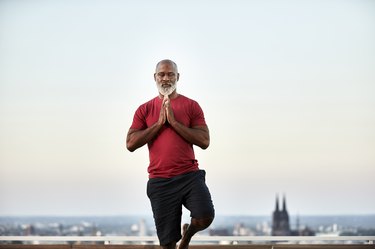
Balance is an essential skill for exercisers of all ages and fitness levels, but it becomes increasingly important as you get older. Older adults are more susceptible to falls and related injuries due to a decrease in both muscle mass and bone density, as well as vision loss and other age-related health conditions.
According to the Centers for Disease Control and Prevention, falls are the most common cause of injuries in older adults, with more than 1 in 4 seniors falling every year. Of those falls, 1 in 5 results in serious injuries like broken bones or head trauma.
Video of the Day
But there's good news: You can maintain and improve balance by implementing stability-focused exercises, of which there are plenty. Laura Endres, CPT, a certified personal trainer who specializes in training older adults, put together this guide on how to improve balance.
The 10 Best Balance Exercises for Older Adults
These balance exercises for older adults range from beginner to advanced, and each one can be modified for different fitness levels.
Before trying any of these balance exercises, perform a brief warm-up to prepare your body. To warm up for balance exercises, march in place for 1 to 2 minutes, perform some dynamic ankle and wrist circles and gently stretch your arms and legs.
Warning
If you feel unsteady, dizzy or short of breath at any point, stop the exercise, move carefully to a chair and sit down. If you suspect there might be an underlying medical reason for your balance issues, talk to your doctor.
1. Single-Leg Hinge to Knee Raise
This is a great balance exercise for older adults because it challenges you to keep your body stable in multiple planes of motion and throughout a full joint range of motion in your hips. You'll need a chair or another piece of knee-height furniture.
- Place a chair 6 to 8 inches in front of your toes. Stand with your feet about shoulder-width apart and squarely face the chair.
- Plant your right foot firmly into the ground and lift your left foot up.
- Extend your arms in front of you as you hinge your hips back, bending until your fingertips graze the chair. Make sure to keep your back flat and core braced.
- Return to the starting position.
Modification
Instead of using a chair, you can perform this move in front of a wall to modify the depth to a level that is comfortable for you. Follow the same steps, but stop once your fingertips graze the wall.
2. Float Up to Knee Raise Hold
This exercise challenges your balance even more by adding a brief isometric hold at the top of the move.
- Stand in a narrow stance with your feet close together.
- Step your right foot to the side and, at the same time, lift your left knee toward your chest and raise your arms up to your sides.
- Hold the single-leg balance on your right leg for 1 to 2 seconds, and then lower your left foot to the ground.
- Repeat on the other side and continue to alternate.
Modification
If you feel a bit too unstable when trying this movement, keep your arms extended to your sides. As you get stronger and improve your balance, you can gradually lower your arms.
3. Knee Raise to Side Lift
The knee raise to side lift is an exceptional way to improve single-leg balance. Not only does it require you to stand on one foot for a period of time, but you'll move through a defined range of motion to further challenge your single-leg balance.
- Stand with your feet about shoulder-width apart.
- Lift your arms up and out to the sides.
- Lift your right leg up and bring your knee toward your chest, as high as you can.
- After reaching your full range of motion, lower your leg about halfway back to the ground, then extend it to the side.
- Bring your leg back to the knee-to-chest position and continue alternating between knee-to-chest and side extension for your target number of reps.
- Repeat on the other leg.
Modification
If you feel a bit too unstable when trying this movement, place your foot down on the ground between the knee raise and side lift.
4. Star Balance Hold
The star balance hold is a good way to increase the duration for which you can balance on one leg.
- Stand tall with your feet together.
- Take a step to the right with your right foot, then shift your body weight onto your right leg and raise your arms up to shoulder height or higher.
- Extend your left leg out to your side.
- Hold this position for 10 to 30 seconds, then switch sides and step with your left foot.
Modification
Shift your weight in small increments, rather than immediately attempting to fully shift your weight to one foot.
5. Star Balance With Weight Pass
This exercise builds upon the skills you'll learn in the star balance hold. With this movement, you'll learn how to balance on one leg while counterbalancing a weighted object.
- Stand tall with your feet about shoulder-width apart. Hold a small weight in one hand.
- Shift your body weight onto your right leg and raise your arms up to shoulder height or higher. Extend your left leg out to your side.
- Hold this position and pass the weight back and forth between your hands while keeping your elbows extended.
- After 8 to 10 passes, switch legs.
Modification
Try this exercise without any weight, so you can get comfortable with the arm movement. You can use an item such as a plastic ball to replicate the hand weight. Once you’re comfortable with the movement pattern, gradually increase the weight.
6. Knee Raise With Weight Pass
Similar to the star balance with weight pass, this exercise challenges you to maintain single-leg balance while moving a weight from hand to hand.
- Stand tall with your feet about shoulder-width apart. Hold a small weight in one hand.
- Shift your body weight onto your right leg and raise your arms up to shoulder height.
- Lift your left knee toward your chest, making a right angle with your leg.
- Hold this position and pass the weight back and forth between your hands while keeping your elbows extended.
- After 8 to 10 passes, switch legs.
Modification
Try it without any weight until you're familiar with the movement pattern.
7. Half Squat Hop
Endres loves this exercise because it incorporates strength training and balance training at the same time: You start in a half squat and land on one foot. It's a challenging one, so make sure to take it slow and practice the modified version below if needed.
- Start in your usual squat stance. For most people, this means feet shoulder- to hip-width apart.
- Descend into a half-squat.
- At the bottom of your half-squat, drive through your heels to stand and hop.
- Land on your right foot only with a soft bend in your knee.
- Descend into a half-squat again, hop and land on your left foot.
- Continue alternating.
Modification
If you find this movement too challenging, eliminate the hop. Instead, as you stand from your squat, simply shift your weight to one leg and practice a single-leg stand in between squats.
8. Side Hop Balance
A much more advanced exercise, this move will challenge you to retain balance under motion and improve your body awareness.
- Stand up straight with your feet shoulder-width apart. Make sure you have about three feet of space to one side.
- Raise your arms up to your sides to assist with balance. Lift your right foot off the ground and use your left foot to hop to the right.
- Land on your right foot and take a second to stabilize your body in the single-leg position.
- Repeat in the other direction.
Modification
If hopping is too challenging, side-step instead of hopping to reduce the amount of momentum and impact.
9. 3-Count Tightrope Heel-to-Toe Walk
Intermediate-to-advanced exercisers can improve further with this move, which challenges your balance in all planes while in a forward motion.
- Stand in a neutral stance. Lift your arms up to your sides to make a ‘T’ with your body.
- Take one step forward as if you’re on a tightrope: Place one foot directly in front of the other, with your heel less than an inch from the toes on your back foot.
- After each step, come up onto your toes and hold this position for 3 seconds.
- Continue walking and holding the tip-toe position after each step.
Modification
Reduce the 3-second count to 1 or 2 seconds if you find that balancing in this position is too challenging. The more you practice, the longer you’ll be able to hold the count.
10. Tightrope Heel-to-Toe Walk With Head Turn
This exercise is similar to the 3-count tightrope heel-to-toe walk above, but it includes an additional balance challenge. During this movement, you'll practice maintaining balance in a forward motion while looking to the side.
- Stand in your neutral stance. Lift your arms up to your sides to make a ‘T’ with your body.
- Take one step forward as if you’re on a tightrope: Place one foot directly in front of the other, with your heel less than an inch from the toes on your back foot.
- After each step, come up onto your toes and hold this position for 3 seconds.
- During the tip-toe hold, rotate your head to the right.
- On your next step, rotate your head to the left.
- Continue walking and alternating head rotations.
Modification
To make this move easier, eliminate the tip-toe hold and practice the head rotations standing flat on the floor.
Was this article helpful?
150 Characters Max
0/150
Thank you for sharing!
Thank you for your feedback!