What does fact checked mean?
At Healthfully, we strive to deliver objective content that is accurate and up-to-date. Our team periodically reviews articles in order to ensure content quality. The sources cited below consist of evidence from peer-reviewed journals, prominent medical organizations, academic associations, and government data.
- Phytotherapy Research: Analgesic and Anti-inflammatory Activity of Morinda Citrifolia L. (Noni) Fruit
- Phytotherapy Research: Analgesic and Anti-inflammatory Activity of Morinda Citrifolia L. (Noni) Fruit
The information contained on this site is for informational purposes only, and should not be used as a substitute for the advice of a professional health care provider. Please check with the appropriate physician regarding health questions and concerns. Although we strive to deliver accurate and up-to-date information, no guarantee to that effect is made.
Acne, a chronic inflammatory skin condition, occurs when pores become blocked with sebum, or natural skin oil. Although not medically serious, acne can be unsightly, affecting appearance, mood and self-esteem. A dermatologist may recommend topical creams and antibiotics to combat acne. Some people turn to herbal remedies, including noni extracts, to alleviate acne symptoms. Consult your doctor or dermatologist before using noni for acne.
Acne Features
The primary trigger for acne flareups is changing hormone levels, which cause excessive amounts of sebum to be produced. Skin Care Physicians notes that bacteria don't cause acne, but they exacerbate it by causing inflammation and infection 1. Acne can appear as comedones, also called whiteheads and blackheads. Inflammation resulting from the presence of bacteria may lead to the formation of papules -- small, raised reddish pimples with white centers -- and even cysts, which are pus-filled lumps that develop under skin. Although acne usually afflicts teens, women in their 40s and 50s are not exempt; fluctuating hormones due to menopause can trigger breakouts. The use of oily cosmetics, certain medications and family history can contribute to acne.
- The primary trigger for acne flareups is changing hormone levels, which cause excessive amounts of sebum to be produced.
Noni History and Traditional Uses
What Is Noni Seed Oil Good For?
Learn More
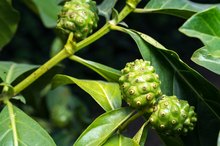
The noni plant -- botanically known as Morinda citrifolia and also called Indian mulberry, morinda and wild pine -- is an evergreen shrub native to Asia, Australia and Tahiti. The bumpy, yellow-white fruits -- which are edible in spite of their unpleasant taste and smell -- have been used by Polynesian healers since antiquity to treat diabetes, high blood pressure and arthritis; noni has also been utilized as a tonic to prolong life.
Constituents and Effects
Noni fruit contains essential oils with anthraquinones, as well as substances called morindone and alizarin. Drugs.com, which provides peer-reviewed medical information to consumers, says that an alkaloid called xeronine has been isolated for medical, culinary and industrial use 2. Xeronine may work at a molecular level to repair damaged cells, including those in skin. Blue Shield's Complementary and Alternative Health credits the fruit with immune-enhancing effects, saying that noni may cause the release of compounds that activate white blood cells 3.
Research
What Are the Benefits of XanGo Juice?
Learn More
Herbalists and naturopaths advise noni as an acne remedy due to its perceived antibacterial and anti-inflammatory properties. There is some scientific laboratory and animal research supporting these beliefs, but human clinical trials are lacking. In a clinical study conducted by R. Usha and colleagues and published in the 2010 issue of "Ethnobotanical Leaflets," researchers found that morinda -- or noni -- extracts had inhibitory effects against E. coli, S. aureus, C. albicans and other common pathogens. In another clinical study, conducted by Simla Basar and colleagues and published in the January, 2010 issue of "Phytotherapy Research," a noni fruit puree worked as well as hydrocortisone in reducing inflammation in arthritic mice.
- Herbalists and naturopaths advise noni as an acne remedy due to its perceived antibacterial and anti-inflammatory properties.
- In a clinical study conducted by R. Usha and colleagues and published in the 2010 issue of "Ethnobotanical Leaflets," researchers found that morinda -- or noni -- extracts had inhibitory effects against E. coli, S. aureus, C. albicans and other common pathogens.
Dosage and Safety Considerations
To take noni for acne, you can drink it as a juice. Many commercial products have reduced the objectionable odor and taste of noni. Blue Shield recommends 4 ounces of juice a day, 30 minutes before breakfast. Noni is also available in a powdered concentrate form; it is generally safe to take 500 to 1,000 mg a day. Consult your doctor before taking noni. Don't take noni if you are pregnant or breastfeeding.
- To take noni for acne, you can drink it as a juice.
Related Articles
What Is Noni Seed Oil Good For?
Learn More
What Are the Benefits of XanGo Juice?
Learn More
Natural Alternatives to Larazapam
Learn More

Pomegranates and Blood Sugar
Learn More
Lapacho Tea Benefits
Learn More
Garcinia Cambogia Extract Side Effects
Learn More
What Are the Health Benefits of Fenugreek & Thyme?
Learn More
Toxicity and Berberine HCL Supplements
Learn More
Chaste Tree Berry for Acne
Learn More
Side Effects of Barberry
Learn More
References
- Skin Care Physicians: What Causes Acne?
- Drugs.com: Complete Noni Information
- Blue Shield Complementary and Alternative Health: Noni
- Phytotherapy Research: Analgesic and Anti-inflammatory Activity of Morinda Citrifolia L. (Noni) Fruit
- Ethnobotanical Leaflets: Antimicrobial Activity of a Rarely Known Species, Morinda Citrifolia L.
- American Academy of Dermatology: Acne
- Gupta RK, Patel AK. Do the health claims made for morinda citrifolia (noni) harmonize with current scientific knowledge and evaluation of its biological effects?. Asian Pac J Cancer Prev. 2013;14(8):4495-4499. doi:10.7314/apjcp.2013.14.8.4495
- West BJ, Deng S, Isami F, Uwaya A, Jensen CJ. The potential health benefits of noni juice: A review of human intervention studies. Foods. 2018;7(4):58. doi:10.3390/foods7040058
- Wang MY, Peng L, Weidenbacher-Hoper V, Deng S, Anderson G, West BJ. Noni juice improves serum lipid profiles and other risk markers in cigarette smokers. ScientificWorldJournal. 2012;2012:594657. doi:10.1100/2012/594657
- Panditrao MM, Panditrao MM, Edghill F, Lockhart HF. Can chronic consumption of noni (Morinda citrifolia) juice lead to changes in the coagulation profile, deranged liver function and excessive intraoperative haemorrhage?. West Indian Med J. 2014;63(7):814-815. doi:10.7727/wimj.2013.109
- National Center for Complementary and Integrative Health. Noni. Updated September 2016.
- Kang YC, Chen MH, Lai SL. Potentially unsafe herb-drug interactions between a commercial product of noni juice and phenytoin- a case report. Acta Neurol Taiwan. 2015;24(2):43-46.
- West BJ, White LD, Jensen CJ, Palu AK. A double-blind clinical safety study of noni fruit juice. Pac Health Dialog. 2009;15(2):21-32.
Writer Bio
Carol Sarao is an entertainment and lifestyle writer whose articles have appeared in Atlantic City Weekly, The Women's Newspaper of Princeton, and New Millennium Writings. She has interviewed and reviewed many national recording acts, among them Everclear, Live, and Alice Cooper, and received her Master of Fine Arts degree in writing from Warren Wilson College.