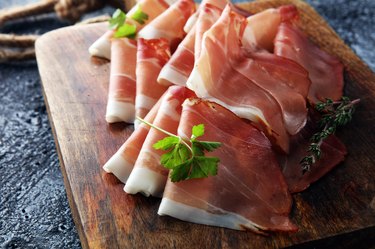
Prosciutto might look like thinly sliced deli ham, but it has a much bolder flavor that's part smoky, part tangy and part salty.
The meat is often added to pizza or wrapped around fruits or vegetables. It's best to eat prosciutto in moderation because it's high in sodium and is considered processed red meat, but it can supply some beneficial nutrients when added to your plate.
Video of the Day
Video of the Day
Rich in protein and relatively low in saturated fats compared to many other processed meats, prosciutto adds a burst of flavor for a small number of calories. This may even help you eat more nutritious foods because prosciutto is often added to things like asparagus and fresh salads.
Prosciutto Nutrition Facts
One serving of prosciutto is 1 ounce (about two slices). Although one serving of meat or seafood is generally 3 ounces, processed meats typically have a smaller serving size.
An ounce of prosciutto crudo contains:
- Calories: 60
- Total fat: 3.5 g
- Saturated fat: 1.5 g
- Cholesterol: 19.9 mg
- Sodium: 520 mg
- Total carbs: 0 g
- Dietary fiber: 0 g
- Sugar: 0 g
- Protein: 7 g
Prosciutto Macros
- Total fat: One ounce of prosciutto has 3.5 grams of total fat, which includes 0.2 grams of polyunsaturated fat, 1.08 grams of monounsaturated fat, 1.5 grams of saturated fat and 0 grams of trans fat.
- Carbohydrates: One ounce of prosciutto contains no carbs, fiber or sugars.
- Protein: One ounce of prosciutto has 7 grams of protein.
Vitamins, Minerals and Other Micronutrients
- Riboflavin (B2): 12% DV
- Vitamin B12: 10% DV
- Phosphorus: 7% DV
- Niacin (B3): 7% DV
- Zinc: 7% DV
- Vitamin B6: 7% DV
- Choline: 5% DV
Health Benefits of Prosciutto
Prosciutto is a savory way to add protein, vitamins, minerals and flavor to your plate. Although you should eat it in moderation, there are several health benefits prosciutto provides.
1. Prosciutto Is High in Protein
Although you'll likely need another source of protein in your meal, prosciutto can act as a powerful "booster" as only two slices of this savory meat add 7 grams of protein to your plate.
What's more, it's easy to eat at any meal in which you need more protein — think: on your whole-grain breakfast sandwich, wrapped around cantaloupe for lunch or added to a cold pasta salad with vegetables at dinner.
"What I love about prosciutto is that you don't need a lot to get the job done, so it's a great way to get flavor and protein without it being a big slab of meat," says Joan Salge Blake, EdD, RDN, a clinical professor at Boston University.
It's important to eat protein regularly throughout the day so that it can properly produce and repair your cells, per the Academy of Nutrition and Dietetics. This essential macronutrient also helps to clot blood, fight infection, keep body fluids balanced, build and contract muscles and carry fats, vitamins, minerals and oxygen throughout the body.
The daily recommended protein intake for adults is about 10 to 35 percent of total calories (though your needs will vary based on activity level, age and sex). One gram of protein contains 4 calories. Prosciutto is higher in protein per ounce than other processed meats such as Italian sausage, pastrami or pepperoni.
2. Prosciutto Provides Vitamins and Minerals
Prosciutto provides various B vitamins, including riboflavin (B2), vitamin B12, niacin (B3), vitamin B6 and thiamin (B1). Your body uses B vitamins to form red blood cells and create energy from the food you eat, per the U.S. National Library of Medicine (NLM).
A lack of vitamin B12 can result in megaloblastic anemia, which causes symptoms such as weakness and fatigue. Vitamin B12 deficiency is also linked to low cognitive function and dementia, according to the Mayo Clinic. Just 1 ounce of prosciutto provides 10 percent of your daily value of vitamin B12.
You'll also get 7 percent of your daily value of zinc, which plays a role in protein synthesis and immune function, per the National Institutes of Health (NIH) and phosphorus, a component of bones, teeth and DNA, per the NIH.
Although prosciutto has vitamins and minerals itself, you can boost its nutritional value even further by pairing it with nutritious produce.
3. Prosciutto Can Add Flavor to Nutritious Foods
Prosciutto is distinguishably savory and can add even more flavor to vegetable-rich dishes, which may help promote a balanced diet.
"It does have a fair amount of sodium, but prosciutto also provides protein and other nutrients along with that great flavor," Blake says. "On the other hand, if you just add table salt to a dish, that's all you're getting."
While you should limit the amount of processed meat you eat, using its savoriness as a vehicle to eat an overall healthier diet with plenty of produce might be helpful. Fruits and vegetables are linked to a lower risk of several chronic diseases and even some types of cancer, per the Academy of Nutrition and Dietetics. Still, most people don't eat enough produce.
Try sliding pieces of prosciutto onto a skewer with a mix of crunchy vegetables, or add it to your favorite fresh salad. You may find that, as a result of using prosciutto, you don't need to add any additional seasonings, particularly salt.
Prosciutto Health Risks
Cancer Risk
Processed meat like prosciutto is classified as a carcinogen — aka something that causes cancer — by the International Agency for Research on Cancer (part of the World Health Organization). What's more, the agency considers red meat a probable carcinogen, or something that probably causes cancer.
Any meat that has been treated through processes like salting, curing, smoking and fermenting for flavor and preservation is considered processed meat, per the American Cancer Society.
It's important to eat prosciutto in moderation: The American Institute for Cancer Research (AICR) recommends eating little (if any) processed meat for cancer prevention. In other words, it isn't a treat to enjoy every day.
In fact, people who ate red and processed meat four or more times weekly were observed to have a 20 percent higher risk of colorectal cancer than those who ate it less than twice weekly in an April 2019 study in the International Journal of Epidemiology. For every additional daily 25-gram serving of processed meat (equal to about two slices of prosciutto), the risk of colon cancer rose by 19 percent.
Saturated Fat
Prosciutto isn't very high in saturated fat per serving, but it can add up quickly if you overeat it. Saturated fat is known for raising LDL (bad) cholesterol, which in turn heightens your risk of heart disease and stroke and leads to weight gain, per the NLM.
Many other types of meat contain more than prosciutto's 1.5 grams of saturated fat per ounce: Take, for instance, salami (3.7 grams of saturated fat) pan-fried bacon (3.4 grams) or pork bratwurst (2.8 grams).
"Ham is pretty lean to begin with," Blake says. "If you don't want prosciutto, you can get lean ham and ask your deli to shave it as thin as possible."
Sodium
One serving of prosciutto contains 520 milligrams of sodium. The daily limit for sodium is no more than 2,300 milligrams, with an ideal limit of no more than 1,500 milligrams daily for most adults (especially those with high blood pressure), per the American Heart Association (AHA).
That means with two slices of prosciutto, you'll reach over a third of your ideal daily limit of sodium. Most Americans already eat too much sodium, which can elevate blood pressure, per the Centers for Disease Control and Prevention (CDC). That, in turn, is a major risk factor for heart disease and stroke.
Stomach cancer risk may also rise with a higher intake of sodium. Foods preserved through a salting process, like prosciutto, are a "probable cause of stomach cancer," per the AICR. That's because salt-preserved foods like meat and fish irritate the stomach lining — over time, this can make the development of cancer more likely.
If you eat prosciutto at a meal or for a snack, be mindful of how much sodium you're eating throughout the rest of the day — and be particularly mindful of packaged, processed foods, as these provide most of the sodium in our diets, per the AHA. When you do eat prosciutto, try to use it as a flavorful replacement for salt in a dish.
Allergies
Any type of meat, including prosciutto, can cause an allergic reaction, per the American College of Allergy, Asthma & Immunology. A meat allergy is uncommon, but more cases have been reported in recent years because the diagnosis is becoming increasingly recognized.
A meat allergy can cause symptoms such as:
- Vomiting
- Wheezing
- Shortness of breath
- Repetitive cough
- Hives
- Swelling
- Dizziness
- Confusion
Because a meat allergy may also cause anaphylaxis, a severe and potentially life-threatening allergic reaction, it's important to speak to an allergist if you think you may be allergic to meat.
You may need to carry epinephrine with you at all times in the case of anaphylaxis. Even if you've previously only experienced mild allergy symptoms, you might suddenly have a more severe reaction such as anaphylaxis at any time.
Prosciutto Recipes
Prosciutto Preparation and Helpful Tips
It's important to store prosciutto correctly, but there's no need to cook it before eating. Follow these helpful tips to safely enjoy it.
Eat it out of the package: Prosciutto is meant to be eaten raw because its low water content prevents bacterial growth, per the USDA. The usual color for prosciutto ranges from a pink to mahogany hue.
Store it properly: Prosciutto will stay fresh for two to three months in the refrigerator, and up to one month in the freezer, per the USDA.
Also, follow these best practices for storing meat recommended by the University of Illinois Extension to prevent disease-causing bacteria:
- Keep your refrigerator between 34 degrees and 40 degrees Fahrenheit as most bacteria grow very slowly (if at all) in this range.
- Use meat stored in the refrigerator quickly, and don't rely on its maximum storage time.
- Store raw meat, poultry and seafood on the bottom shelf of the refrigerator — below your prosciutto — so juices don't cross-contaminate it.
- Avoid opening the refrigerator frequently, especially on warm and humid days, so you can keep its temperature cool.
Alternatives to Prosciutto
To make sure your diet is balanced with nutritious sources of protein, regularly replace processed red meat with skinless poultry, non-fried fish and beans.
You can also aim for lean cuts of meat (look for the words "round," "loin" or "sirloin") and trim off as much fat as possible before cooking.
- My Food Data: "Prosciutto Crudo"
- U.S. Department of Agriculture: "Ham, prosciutto"
- Academy of Nutrition and Dietetics: "How Much Protein Should I Eat?"
- My Food Data: "Italian Sausage"
- My Food Data: "Lowfat Pastrami"
- My Food Data: "Pepperoni"
- U.S. National Library of Medicine: "Facts about saturated fats"
- Harvard T.H. Chan School of Public Health: "Protein"
- U.S. National Library of Medicine: "B Vitamins"
- Mayo Clinic: "Vitamin B-12"
- National Institutes of Health: "Zinc"
- National Institutes of Health: "Phosphorus"
- Academy of Nutrition and Dietetics: "Discover the Health Benefits of Produce"
- International Agency for Research on Cancer: "IARC Monographs evaluate consumption of red meat and processed meat"
- American Cancer Society: "What’s Wrong with Hot Dogs, Hamburgers, and Bacon?"
- American Institute for Cancer Research: "Limit red and processed meat"
- International Journal of Epidemiology: "Diet and colorectal cancer in UK Biobank: a prospective study"
- My Food Data: "Salami"
- My Food Data: "Bacon (Pan-Fried)"
- My Food Data: "Pork Bratwurst"
- American Heart Association: "Why Should I Limit Salt?"
- Centers for Disease Control and Prevention: "Sodium"
- American Institute for Cancer Research: "Stomach Cancer"
- United States Department of Agriculture: "Ham and Food Safety"
- University of Illinois Extension: "Storing Meat in Your Refrigerator"
- American College of Allergy, Asthma & Immunology: "Meat Allergy"