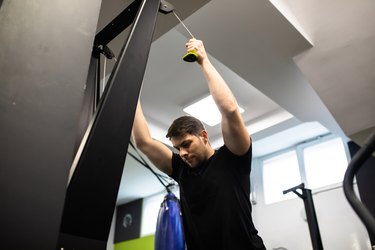
The ski machine is well known and beloved by CrossFit athletes and cross-country skiers. But less popular in gyms than other cardiovascular machines, the ski erg is underutilized by most of the general population — likely because most people don't know how to use the machine, or the many (many!) benefits of using it regularly.
Ahead, fitness trainers breakdown the benefits of the ski erg — no, you don't have to be a CrossFitter or skier to use one! — plus offer tips on using it with good form.
Video of the Day
What Is a Ski Erg Machine?
At its most distilled, a ski erg — sometimes called a ski exercise machine, ski machine or skier machine — is a piece of gym equipment that simulates the movement patterns of alpine or Nordic skiing, according to Jake Harcoff, CSCS, head coach and owner of AIM Athletic.
"It's a lower-impact piece of cardiovascular equipment, and it can be used to improve cardiovascular capacity, full-body strength and power," he tells LIVESTRONG.com.
Visually, this machine looks like a rowing machine that was flipped on its head. Used from a standing position, the ski erg involves moving your upper and lower body the way you might while using poles to gain speed while skiing down a mountain.
How to Use the Ski Erg Properly
The ski erg isn't necessarily harder to use than other gym machines, however using it with good form does require a little savvy. That's why we asked CrossFit Level 1 coach Kyle Baughman, CF-L1, founder and head coach of Golden Goose CrossFit in Rocky Hill, Connecticut, to explain how to use the ski erg.
- Start standing on the platform with your feet hip-width apart.
- Reach overhead to grip the handles with your palms facing in.
- Soften your knees, then simultaneously drive your butt back as if you're closing a door behind you while pulling your arms straight down past your hips until your hands pass by the side of your knees.
- Next, bring your arms back overhead while thrusting your hips forward until you're standing with your arms fully extended.
- Repeat.
Whether you're skiing for short bursts of time or for a long distance, Baughman says you should primarily feel the burn in your posterior chain muscles — specifically, your hamstrings and glutes.
"If you only feel fatigue in your upper body, you're probably rounding your back when you pull down or forgetting to use your legs altogether," he says.
Watch a Full Tutorial
The Benefits of a Ski Exercise Machine
1. It’s a Full-Body Exercise
When you use the ski erg properly, all your muscles from head to toes get in on the action.
"Each time you pull the handles down from overhead to down by your hips, you're using all the muscles between your shoulders and elbows, as well as your lats, rear deltoids, triceps and grip muscles," Harcoff says.
And, when you hinge at your hips for extra power and leverage, you target all your trunk and lower-body muscles, which include your abdominals, hip flexors, hamstrings, calves and glutes, he says.
2. It Can Improve Your Cardiovascular Capacity
Another ski machine benefit? It's an aerobically demanding machine, according to Harcoff, which means using it requires a lot of oxygen.
Because the skier machine is a full-body exercise, your heart has to pump oxygen, which your body uses as fuel, to every single muscle, Harcoff explains. The result? Your heart beats fast. "Just a few minutes on the machine will get your heart ticking," he says.
Regularly using the machine in this way can improve your cardiovascular capacity, says Baughman, which means you'll be able to go harder and for longer periods of time. "Your heart is a muscle, so the more you exercise it, the stronger it becomes," he explains.
3. It's a Low-Impact Workout
If your knees, hips or ankles can't handle the impact of walking on the treadmill or pounding the pavement, consider switching to the ski workout machine.
"The ski erg is a low-impact form of cardiovascular training that is a great substitute for any individual with lower-body injuries that prevent them from running effectively," Harcoff says.
When you ski, your feet almost never leave the ground, so there is little impact placed on your lower-body joints, Harcoff explains.
"Of course, you can incorporate small jumps or presses onto the toes to generate more momentum or power when skiing, but neither one of these are necessary," he says.
4. It Helps You Nail the Hinge Movement Pattern
Most exercisers are familiar with hinge-based exercises (like the deadlift), but few people realized that they utilize that same movement pattern in the real world, too. Every time you pick up a box from your front stoop or haul groceries onto the kitchen counter, you're mimicking that movement.
What does this have to do with the ski erg, exactly?
"The hinge pattern is fundamental to using the ski machine properly," Harcoff says. "If you can use the ski erg to learn how to hinge effectively, you'll be able to avoid unnecessary lower back involvement that could lead to injury, tightness or less mechanical work created by the target muscles when you hinge in the real world," he says.
Ski Machines We Love
- WOLFMATE Ski Indoor Exercise Machine ($999, Amazon.com)
- Concept2 Ski Erg With Garmin Heart Rate Monitor ($1,169.99, Amazon.com)
How to Incorporate the Ski Erg Into Your Exercise Routine
Really, there is no wrong way to use the ski erg. As such, you should let your specific fitness goals dictate how you use it. If you want to improve your cardiovascular capacity, Harcoff suggests doing a ski machine workout for a set period of time. You could also do interval sprints on the erg, alternating between intense bursts and rest (or very low-intensity movement).
If you want to get stronger, it's best to use the ski erg in your warm-up.
"The ski erg is a wonderful piece of equipment to use before an upper- or lower-body strength session," Harcoff says.
The ski erg raises your body temperature while working your upper body, which makes it a better option for warming up for back, chest and shoulder day as opposed to a treadmill, stationary bike or elliptical machine, he explains. However, because the machine forces you to extend your body fully, Harcoff says you can also use it to warm-up for exercises like deadlifts, lunges and squats.
Related Reading