First Outbreak Symptoms of Mouth Herpes
According to the National Institutes of Health (NIH), most people in the United States are infected with the mouth herpes virus by the age of 20. Not all patients show symptoms. In those who do, symptoms of mouth herpes usually manifest one to three weeks after exposure. The first outbreak symptoms of mouth herpes are characteristically much more severe than the symptoms of subsequent outbreaks.
If you are experiencing serious medical symptoms, seek emergency treatment immediately.
Prodrome
The term prodrome refers to early or initial symptoms that often precede a full breakout. For mouth herpes, notes Dr. Lawrence Corey of the University of Washington, prodromal symptoms may include tingling, itching, redness, hypersensitivity or soreness in the location where lesions later appear. During the first outbreak, people are usually unaware that they have been infected with mouth herpes and often fail to recognize prodrome as such.
Flu-Like Symptoms
How to Heal an Internal Mouth Burn
Learn More
Arduino and S.R Porter; February 2008'). Unlike true flu, respiratory symptoms such as cough and cold are not present. Flu-like symptoms of mouth herpes usually last between three days to two weeks and are usually most severe during the first outbreak.
Mouth Lesions
Lesions of the tongue, the lining of the cheeks and the gums may appear at the same time or somewhat later.
The lips may be almost completely covered with crops of blisters. After about two days, the blisters rupture, revealing red, ulcerated tissue that eventually becomes grayish. Two to three days later, ulcerations are replaced by a yellowish “crust” that is often itchy as well as painful.
Compared to the lesions in recurrent outbreaks of mouth herpes, first-outbreak lesions are more numerous, widely distributed and take longer to heal (two to three weeks versus seven to 10 days). Recurrent outbreak lesions are usually confined to the lips and face; lesions in the mouth may signal an immunocompromised state.
- Lesions of the tongue, the lining of the cheeks and the gums may appear at the same time or somewhat later.
- Two to three days later, ulcerations are replaced by a yellowish “crust” that is often itchy as well as painful.
Related Articles
How to Heal an Internal Mouth Burn
Learn More

Facial Herpes Symptoms
Learn More

Symptoms of Type 1 Genital Herpes
Learn More
Causes of Cold Sores Other Than Herpes
Learn More

Early Signs of Squamous Cell Mouth Cancer
Learn More

Herpes Symptoms on the Labia Minora
Learn More
What Causes Small White Bumps on Lips?
Learn More
What are the causes of pale gray and swollen gums?
Learn More
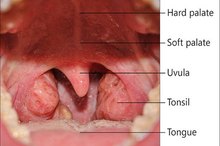
How Long Does Tonsillitis Last?
Learn More

Common Things Mistaken for Herpes
Learn More
References
- National Library of Medicine: Medline Plus – Herpes Labialis
- Herpes Simplex Viruses (Chapter); L. Corey; In: Harrison’s Principles of Internal Medicine, 17th edition; A.S. Fauci, E. Braunwald, D.L. Kasper, S.L. Hauser, D.L. Longer, J.L. Jameson, and J. Loscalzo (Eds); 2008
- Journal of Oral Pathology and Medicine; Herpes Simplex Virus Type 1 Infection: Overview on Relevant Clinico-Pathological Features; P.G. Arduino and S.R Porter; February 2008
- Centers for Disease Control and Prevention. Genital Herpes Treatment and Care
- Centers for Disease Control and Prevention. Genital Herpes - CDC Fact Sheet
- Magaret AS, Mujugira A, Hughes JP, et al. Effect of Condom Use on Per-act HSV-2 Transmission Risk in HIV-1, HSV-2-discordant Couples. Clin Infect Dis. 2016;62(4):456-61. doi:10.1093/cid/civ908
- American College of Obstetricians and Gynecologists. Genital Herpes
- Mayo Clinic. Cold Sore
- Centers for Disease Control and Prevention. Genital HSV Infections
- Carvalho CG, Medeiros-Filho JB, Ferreira MC. Guide for health professionals addressing oral care for individuals in oncological treatment based on scientific evidence. Support Care Cancer. 2018 Feb 22. doi: 10.1007/s00520-018-4111-7. [Epub ahead of print]
- Sénat MV, Anselem O, Picone O, et al. Prevention and management of genital herpes simplex infection during pregnancy and delivery: Guidelines from the French College of Gynaecologists and Obstetricians (CNGOF). Eur J Obstet Gynecol Reprod Biol. 2018 May;224:93-101. doi: 10.1016/j.ejogrb.2018.03.011. Epub 2018 Mar 9.
Resources
Writer Bio
Heather Gloria began writing professionally in 1990. Her work has appeared in several professional and peer-reviewed publications including "Nutrition in Clinical Practice." Gloria earned both a Bachelor of Science in food science and human nutrition from the University of Illinois. She also maintains the "registered dietitian" credential and her professional interests include therapeutic nutrition, preventive medicine and women's health.