
What does fact checked mean?
At SportsRec, we strive to deliver objective content that is accurate and up-to-date. Our team periodically reviews articles in order to ensure content quality. The sources cited below consist of evidence from peer-reviewed journals, prominent medical organizations, academic associations, and government data.
The information contained on this site is for informational purposes only, and should not be used as a substitute for the advice of a professional health care provider. Please check with the appropriate physician regarding health questions and concerns. Although we strive to deliver accurate and up-to-date information, no guarantee to that effect is made.
How to Apply Heat to Your Muscles Before Stretching
You won't always get injured if you stretch a cold muscle, but it's not worth the risk. A proper warm-up consists of five to 10 minutes of full-body movements designed to increase blood and muscle temperature. A warm muscle stretches easier than a cold muscle, and you will feel and see the flexibility improvements. When you are unable to complete a dynamic warm-up, you can use heat applied directly to the muscles prior to stretching in the way of heat packs or moist heat from a bath or shower.
Stand underneath a hot shower for 10 to 20 minutes to warm your muscles for stretching. Set the water temperature high, but not to scalding. Let the water blast on individual muscle groups such as your lower back, hips, chest, hamstrings and calves.
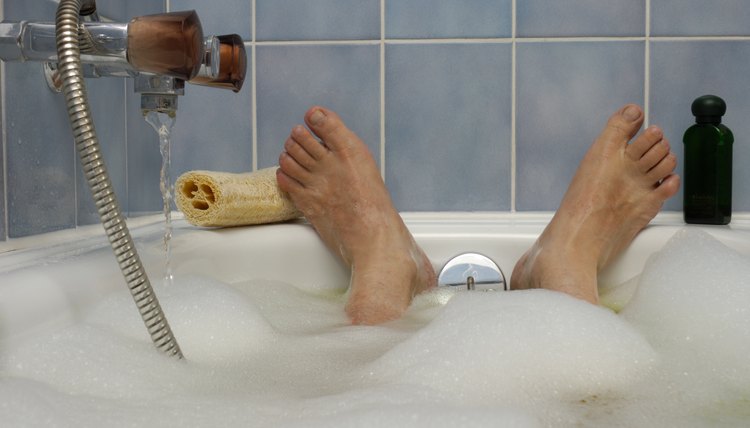
Soak in a hot bath of a temperature that is comfortable, but not painfully high. Rest in the bath for 10 to 20 minutes and perform a few stretches in the tub such as a seated forward fold, which stretches your hamstrings.
Apply a heating pad, or a moist heating pad, to the muscle you wish to stretch. Keep the heating pad on the muscle for 10 to 20 minutes. Stretch, and then move the pad to the next muscle group.
Make a heating pack by using rice or buckwheat and a sock. Fill the sock halfway with rice or buckwheat. Hand sew the top of the sock closed. Place the sock in the microwave for 30 to 60 seconds. Rest the sock for 10 to 20 minutes on the muscle you wish to stretch.
Warnings
Relax and stretch only to the point you feel a mild pull on the muscle. Try not to hurry or overstretch your muscles.
References
Writer Bio
A mother of two and passionate fitness presenter, Lisa M. Wolfe had her first fitness article published in 2001. She is the author of six fitness books and holds an Associate of Arts in exercise science from Oakland Community College. When not writing, Wolfe is hula-hooping, kayaking, walking or cycling.