
What does fact checked mean?
At SportsRec, we strive to deliver objective content that is accurate and up-to-date. Our team periodically reviews articles in order to ensure content quality. The sources cited below consist of evidence from peer-reviewed journals, prominent medical organizations, academic associations, and government data.
The information contained on this site is for informational purposes only, and should not be used as a substitute for the advice of a professional health care provider. Please check with the appropriate physician regarding health questions and concerns. Although we strive to deliver accurate and up-to-date information, no guarantee to that effect is made.
Difference Between a Stability Ball and an Exercise Ball
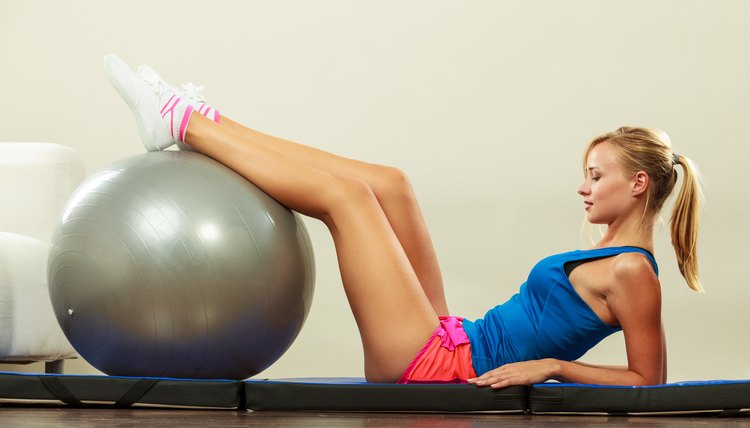
Stability and exercise balls -- which are essentially the same thing --are also called Swiss balls, yoga balls, Pilates balls, balance balls and physio balls. Originally developed for physical therapy purposes, today exercise balls can be found in most commercial and home gyms and fitness centers, as the balls are used for different exercises.
About Stability Balls
Stability balls can make functional exercises more challenging, which will make your muscles work harder and become more effectively fatigued. This can result in a greater amount of muscle mass, which can help your metabolism to run more efficiently. In addition, stability balls target your core and can improve your sense of balance and agility, which will benefit you in numerous types of movement, including activities such as running, soccer, tennis, dancing and yoga.
Lower Body
Exercise, or stability, balls can add a twist to many traditional lower-body strength-training moves. While doing squats, place the exercise ball between your lower back and a wall and then squat as normal; the ball will force you to engage your core and glutes to remain stable as you lower into a squat. Likewise, placing the top of your back foot on a stability ball during lunges will put a greater demand on your core, glutes, hamstrings and quadriceps, allowing them to fatigue faster and increase your muscle mass.
Upper Body
A stability ball can be used while working out every muscle group in your upper body. The ball will turn a traditional pushup or plank pose into a challenging move that can build strength in your back, shoulders, chest and arms all at the same time; this is done by placing the ball under your hands in a pushup or beneath your forearms in plank pose. In addition, sitting on the ball while performing bicep curls and triceps extensions can make the exercises more difficult. And lying your back on the ball during chest presses or placing your chest and stomach on it during rows will also increase the intensity of your workout.
Abs
Probably the one body part that exercise balls are most known for is your abs, as almost every move done on or with a stability ball requires and builds core strength. You can make traditional crunches more difficult by placing your lower back on an exercise ball or employ a more creative move, such as the stability ball knee tuck. In this exercise you place the stability ball under your shins while your hands are flat on the floor, directly under your shoulders. Your body should be in a straight line or plank position. Engage your abdominals and pull your knees toward your chest; the ball will roll forward with your legs. Reverse the movement to return to starting position.
References
- American Council on Exercise: Stability Ball Knee Tucks
- Fitness: Olympic Skier Lindsey Vonn's Lower-Body Workout
- Fitness: 3 Squats to a Strong, Firm Butt
- Sukalinggam CL, Sukalinggam GL, Kasim F, Yusof A. Stability Ball Training on Lower Back Strength has Greater Effect in Untrained Female Compared to Male. J Hum Kinet. 2012;33:133-41. doi:10.2478/v10078-012-0052-2
- Yu W, Cha S, Seo S. The effect of ball exercise on the balance ability of young adults. J Phys Ther Sci. 2017;29(12):2087-2089. doi:10.1589/jpts.29.2087
- Saeterbakken AH, Andersen V, Behm DG, Krohn-hansen EK, Smaamo M, Fimland MS. Resistance-training exercises with different stability requirements: time course of task specificity. Eur J Appl Physiol. 2016;116(11-12):2247-2256. doi:10.1007/s00421-016-3470-3
- Jakobsen MD, Sundstrup E, Brandt M, Andersen LL. Psychosocial benefits of workplace physical exercise: cluster randomized controlled trial. BMC Public Health. 2017;17(1):798. doi:10.1186/s12889-017-4728-3
- Kim SG, Yong MS, Na SS. The effect of trunk stabilization exercises with a swiss ball on core muscle activation in the elderly. J Phys Ther Sci. 2014;26(9):1473-4. doi:10.1589/jpts.26.1473
Writer Bio
Beth Rifkin has been writing health- and fitness-related articles since 2005. Her bylines include "Tennis Life," "Ms. Fitness," "Triathlon Magazine," "Inside Tennis" and others. She holds a Bachelor of Business Administration from Temple University.