
Outrigger Canoe Exercises
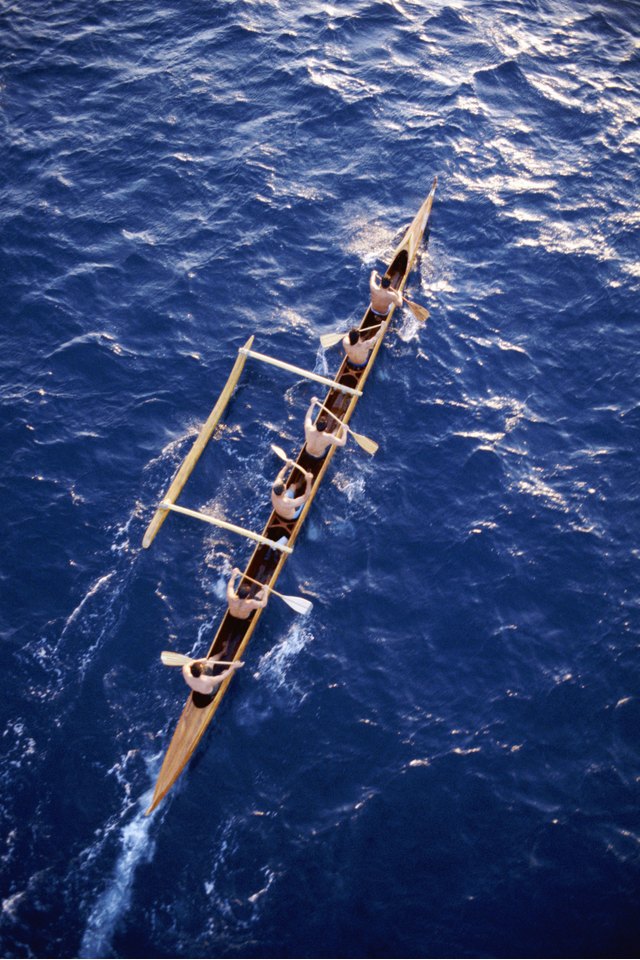
Though its origins are in ancient Polynesia, the outrigger canoe has garnered worldwide devotion as a racing boat for both single and team racers. Doing exercises outside of the canoe can help you keep your edge through the offseason and improve your performance on the water. Though much of paddling focuses on the arms, the abdominals and legs also have major supportive roles to play and should not be neglected.
Save Your Shoulders
Shoulder and rotator cuff injuries are a serious risk for paddlers of all stripes. Strengthening the deltoids, the large triangular muscles that cover the front, top and back of the shoulder joints, can help protect against injury and help increase your paddling power. Shoulder presses are an excellent way to target the deltoids. They are done by placing your hands shoulder-width apart on a bar-shaped object and pressing the weight up through the shoulders over the head. If you're a seasoned weightlifter, use a barbell. Newcomers may want to start with something light, like a broom.
Armed and Dangerous
Strong arms are critical to paddling. In an interview with the Sierra Club, Olympic whitewater slalom canoeist Casey Eichfeld recommends pullups as one of his favorite arm-strengthening exercises. Pullups exercise three of the major muscles of the arms, the biceps on the top of the upper arms, the triceps on the undersides of the upper arms and the latissimus dorsi, the broad muscle of the mid-back. Pullups are simple but challenging, as they require you to lift your entire body weight. Aim for a steady, fluid motion, holding the pullup bar with your hands shoulder-width apart.
Core Power
The abdominal muscles stabilize the torso, providing the foundation from which the arms can wield their paddling power. Abdominal crunches can help develop these muscles. Crunches should be done lying flat on the floor, knees bent at a 90-degree angle with the hands supporting the head, elbows pointing directly out to the sides. Attempt at least 30 crunches, rolling your upper body up toward your knees. Another core-strengthening exercise is plank pose, or the top of a pushup. "River Sports Magazine" recommends hovering in plank for 15 seconds and gradually working your way up to 45 seconds or longer.
Lower-Body Lowdown
Though they get little recognition, the legs have their role to play in paddling, helping the paddler to maintain balance and connecting the paddler to the boat. Outdoor cardiovascular exercise such as running, cycling, skating or skiing all strengthen major muscles of the legs such as the calves and quadriceps. Running is also an excellent way to improve your stamina and burn calories. You don't have to become a marathon runner: a speedy 20-minute run will get your heart rate up.
References
Writer Bio
Michelle Wishhart is a writer based in Portland, Ore. She has been writing professionally since 2005, starting with her position as a staff arts writer for City on a Hill Press, an alternative weekly newspaper in Santa Cruz, Calif. An avid gardener, Wishhart worked as a Wholesale Nursery Grower at Encinal Nursery for two years. Wishhart holds a Bachelor of Arts in fine arts and English literature from the University of California, Santa Cruz.