
My Toes Hurt When Running on a Treadmill
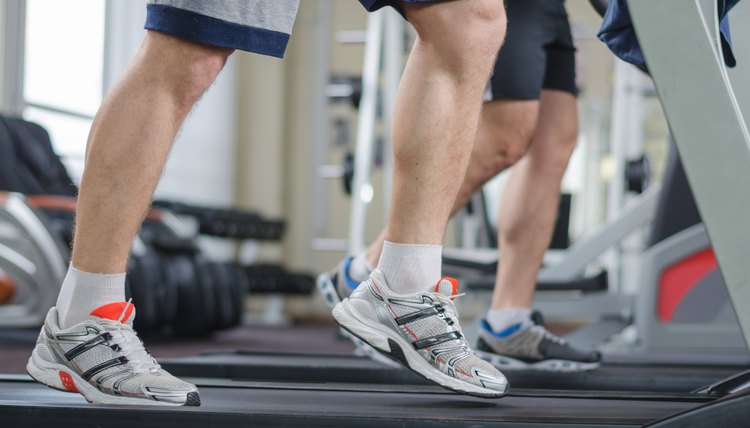
Toe pain while running on a treadmill may not fade away as you become accustomed to a new exercise program. Pain often results from ill-fitting shoes or the wrong shoe style for the treadmill workout. Other chronic problems you might ignore in your usual daily routine show up plainly on the machine because of the repetitive stress of treadmill exercise. Any foot problem that doesn't quickly respond to common sense treatments needs a physician's attention.
Friction Injuries
On natural terrain, each step you take produces a slightly different set of stresses on your foot. Treadmills don't offer the same natural variation, and problems repeat with each step. The most common injury, a blister, forms after repetitive friction separates skin layers. If you wear shoes that fit properly, wear athletic socks and add athletic insoles, you can avoid most blister injuries. Dabbing petroleum jelly on a sore spot before it blisters sometimes prevents more damage. If toes bump against the front of the shoes, the repeated pressure could cause "black toe." Black toe happens when friction separates the toenail from the nail bed and causes bleeding under the nail. Untrimmed toenails might cause the problem even in properly fitted running shoes. Corns -- yellowed bumps of thick skin on the tops of toes -- form because of friction injuries caused by the upper part of the shoe. Better shoes eliminate the cause of corns and the pain.
Constriction Injuries
If you lace your shoes too tight or choose shoes smaller than your actual foot size, you may experience nerve damage, joint problems or bone deformations. Shoes too short for your foot or shoes with a poorly shaped toe box -- the section for the ball of the foot and the toes -- compress toes into an unnatural buckled position. Ignoring the pain might cause a permanent deformation called hammertoe. Constriction across the width of the foot causes bones to rub together, sometimes triggering Morton's neuroma. A mass of tissue forms between toe bones and constricts nerves, causing pain, numbness or burning. A bunion begins when shoe shape forces the big toe out of line, inflaming the first joint. Bunions and many other constriction injuries heal naturally when given rest and better footwear, but some injuries of this type require a doctor's attention.
Sprains
Spraining the joint of the big toe causes a painful condition called "turf toe." Running on the treadmill may aggravate rather than cause this problem. Making a sudden twisting step puts unnatural stress on the big toe and overextends the joint. Turf toe happens indoors during workouts as well as outdoors on athletic fields. Turf toe could take three weeks to heal, according to Dr. Martha A. Simpson, of the Ohio University College of Osteopathic Medicine. Repeated injury to the joint might tear tissues and cause more serious problems, including arthritis.
Toe Care
If you don't take proper care of your feet, small problems could blossom into large, painful problems on the treadmill. Ingrown toenails form when shoes rub against the side of the nail, or when you trim your toenails too short and round the corners. Cutting toenails square to the toe keeps corners of the nails from digging into the flesh beneath. Fungal problems cause trouble between the toes and around nails. As feet swell from exercise, inflammation makes these small injuries hot and painful. Applying anti-fungal foot powder prevents most fungal troubles and cures many small infections.
References
- LeHigh University: Medical Aspects of Running and Running-Related Injuries
- Ohio State University Medical Center: Foot Pain and Problems
- Buldt, AK, Menz, HB. Incorrectly fitted footwear, foot pain and foot disorders: a systematic search and narrative review of the literature. J Foot Ankle Res. 2018;11:43. doi:10.1186/s13047-018-0284-z
- Palomo-López P, Becerro-De-Bengoa-Vallejo R, Losa-Iglesias M, Rodríguez-Sanz D, Calvo-Lobo C, López-López D. Footwear used by older people and a history of hyperkeratotic lesions on the foot. Medicine. 2017. 96(15):e6623. doi:10.1097/md.0000000000006623
- Formosa C, Gatt A, Chockalingam N. A critical evaluation of existing diabetic foot screening guidelines. Rev Diabet Stud. 2016;13(2-3):158-186. doi:10.1900/RDS.2016.13.158
- López-lópez D, Becerro-de-bengoa-vallejo R, Losa-iglesias ME, et al. Evaluation of foot health related quality of life in individuals with foot problems by gender: a cross-sectional comparative analysis study. BMJ Open. 2018;8(10):e023980. doi:10.1136/bmjopen-2018-023980
- U.S. News and World Report Health. 5 ways to cope with changes your feet undergo with age. Updated October 5, 2016.
- American Academy of Orthopaedic Surgeons - OrthoInfo. Tight shoes and foot problems. Updated August 2012.
Writer Bio
James Young began writing in 1969 as a military journalist combat correspondent in Vietnam. Young's articles have been published in "Tai Chi Magazine," "Seattle Post-Intelligencer," Sonar 4 ezine, "Stars & Stripes" and "Fine Woodworking." He has worked as a foundryman, woodturner, electronics technician, herb farmer and woodcarver. Young graduated from North Seattle Community College with an associate degree in applied science and electronic technology.