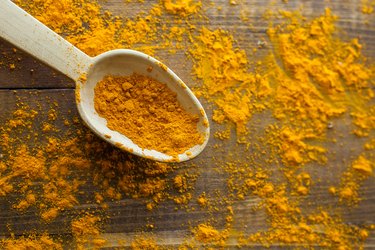
Honey and turmeric milk, sometimes known as golden milk, is reputed to have many health benefits. Each ingredient has health-promoting qualities of its own. In combination, this trio of biologically active foods may have posit...
Although prevalent in Chinese and Ayurvedic medicine, in the West turmeric is largely known as an ingredient in Indian curries. However, in parts of India the yellow-hued spice is also used as a beauty product. When applied to ...
A spicy culinary herb grown mostly in India, turmeric offers a variety of health and healing benefits. Frequently used in Ayurvedic medicine, turmeric's existence has been known for thousands of years and was originally utilize...
Black pepper and turmeric are aromatic spices that not only add unique flavors to food but also have a variety of health benefits. Turmeric, Curcuma Ionga, is a member of the ginger family and one of the main spices in curry, w...
It is used in South Asian cooking as well as traditional Chinese and ayurvedic medicine. The active component of turmeric is curcumin, which is believed to have antioxidant activity, anti-inflammatory properties and weight-loss...
Turmeric (Curcuma longa) has been used for 4,000 years to treat a plethora of diseases and conditions ranging from inflammation to indigestion to infections. Curcumin, a substance found in turmeric, is a potent antioxidant, acc...
Turmeric's bulbous underground stem, or rhizome, is the most prized part of the plant. Although best known in the West for the spice it yields in ground-up form, the turmeric rhizome offers a variety of health benefits when eat...
Turmeric is a spice that has been used medicinally for over 4,000 years to treat many different conditions, including digestive problems, osteoarthritis and cardiovascular disease, according to the University of Maryland Medica...
Turmeric is a spice that features prominently in curries and other Indian dishes and has also been used for purported medicinal effects in traditional herbalism. Turmeric's potential health benefits are due largely to one of it...
Tumeric is a spice used in curry and other dishes. It is a perennial plant belonging to the same family as ginger. Scientific studies show that turmeric tablets may provide a variety of health benefits. However, consult with yo...
More than 1,000 years ago, descriptions of the health benefits of turmeric appeared in traditional Chinese and Indian medicine. Throughout Asia, the American Cancer Society notes that people used, and continue to use, turmeric...
According to the National Center for Complementary and Alternative Medicine, or NCCAM, turmeric has long been used as a flavoring agent in food, colorant in fabrics, and as a medicinal herb in Asian medicine for a wide variety ...
The turmeric leaf is derived from a plant that grows extensively in India, other parts of Southern Asia and Africa. Turmeric is used as a fabric dye and is a common ingredient in Indian cooking. It is also purported to have som...
Turmeric is a shrub grown in Asia, mainly India, and parts of Africa. Turmeric has long been used in Chinese and Ayurvedic medicine. The dried underground stems, known as rhizomes, are crushed into a powder to be taken orally o...
Turmeric is a spice derived from the stems of the Curcuma longa shrub. In addition to being a flavorful food additive and coloring agent, turmeric may also impart health benefits when used as a medicinal supplement. If you have...
Until recently, most people knew turmeric as the plant that gave Indian curries a strong, bitter flavor and their trademark mustard yellow appearance. However, as of 2010, researchers are testing turmeric, and its active ingred...
Turmeric is a spice best known for its distinct flavoring in Indian cuisine. According to the University of Maryland Medical Center, this spice has been treating a variety of ailments for almost 4,000 years. Bromelain is a mixt...
Turmeric root, or Curcuma longa, has been used for many hundreds of years in Indian as a dye, a spice and as a medicinal herb within Ayurvedic medicine. Turmeric root is usually dried and ground into a distinctive yellow-orange...
Turmeric, an Asian spice that gives curry its yellow color, is also used as an herbal medicine. The active ingredient in turmeric, curcumin, may have value in treating a number of medical conditions, but clinical studies are la...
Turmeric is a plant used to make food spices and food coloring. Its root is also used to make medicine, as a substance found in turmeric called curcumin may offer health benefits. There is insufficient evidence to rate the effe...
Turmeric is a perennial plant related to ginger native to southeast Asia. It is commonly ground into a bright yellow powder and used in Indian cuisine to make yellow curry. Turmeric contains a molecule called curcumin that has ...
Turmeric is a spice commonly used in Indian and other Asian cuisines. It is produced from the dried underground stem, or rhizome, of the Curcuma longa plant, a relative of the ginger plant. Turmeric is bright yellow and gives c...
You may recognize turmeric as a spice that lends the bright yellow color to many curry dishes. However, it has also been used in Ayurvedic medicine to cure inflammation, tumors and other diseases for more than 4,000 years, acco...
The people of India have used this spice for centuries and believe it to have many healing capabilities. Dried turmeric has a strong earthy flavor comparable to mustard or horseradish. Some studies have been conducted to evalua...
The roots of the turmeric plant, which belongs to the ginger family, are boiled, dried and ground into a deep yellow powder commonly used as a spice. The principle component of turmeric is curcumin, and it has a slightly bitter...
Research found that turmeric may decrease pain and swelling, increase joint mobility and prevent bone loss which can benefit individuals suffering from arthritis. Consult with your health care provider before you begin taking t...
Turmeric, with its active ingredient curcumin, carries powerful antioxidant, anti-cancer and anti-inflammatory properties. According to the American Cancer Society, turmeric has gained recognition in laboratories that study can...
Turmeric has a history of being used for stomach upset, inflammation and skin diseases. The compound responsible for the golden color of turmeric, curcumin, is also the compound responsible for many of the health benefits assoc...
According to World's Healthiest Foods, this spice has demonstrated excellent anti-inflammatory benefits, and is thought to have potential in relieving symptoms of Irritable Bowel Syndrome, rheumatoid arthritis and cystic fibros...
Turmeric is a shrub that is native to India. The bitter tasting root of the plant is used to season food and is also used for medicinal purposes. It is available in powdered form or in the form of gel caps. According to the Nat...
Turmeric, a staple of Indian, Moroccan and Middle Eastern cuisines, has a variety of purported health benefits. As the National Center for Complementary and Alternative Medicine, or NCCAM, points out, though, evidence derived f...
According to the University of Maryland Medical Center, turmeric, whose active ingredient and pigment is known as curcumin, has been used in traditional and herbal medicines for thousands of years due to its healing properties....
Turmeric is a spice that is commonly used in Indian curries. It grows in India, China and other Asian countries, and has been used for centuries in the natural healing system from India, called Ayurveda, according to the Califo...
The root and rhizome, or underground stem, contain curcumin, the plant's primary active component for medicinal uses. Turmeric is available in liquid extract and as dried extract in capsules, and in topical ointments and pastes...
Turmeric or curcuma longa is an herb that has been used for thousands of years in Indian Ayurvedic and traditional Chinese medicines, according to the University of Maryland Medical Center. The medicinal value of the plant is f...
Practitioners of Ayurveda, a traditional system of medicine originating in India, widely value the root of the turmeric plant for its medicinal properties. According to the National Institutes of Health, this fragrant plant may...
Turmeric is an herb used both as a cooking flavoring and as a natural medicinal agent. Curcumin, an active compound in turmeric, is an antioxidant that can both prevent and treat free radical damage in your body. Turmeric can b...
Turmeric (Curcuma longa), sometimes spelled tumeric, belongs to the ginger family (Zingiberaceae) and naturally occurs in Southern Asia and India. Turmeric supplements come from the plant's rhizomes, which feature rough, brown ...
Turmeric has long been used for its digestive, anti-inflammatory and antioxidant benefits. The primary compounds to which turmeric's benefits are attributed are curcuminoids and volatile oils, explains the Memorial Sloan-Ketter...
The mixture of turmeric and milk is often touted as an all-natural cure for a variety of ailments and to promote good general health. While many of the medical benefits of turmeric are still unproven, it has been determined tha...
It is a powerful antibacterial and anti-fungal that helps improve digestion, eliminate worms, cleanse the gallbladder and liver, purify the blood and relieve swelling due to its anti-inflammatory properties. Making turmeric mil...
The National Institutes of Health explain that turmeric and its derivative curcumin have long been used in traditional Asian medicine. It's thought to soothe upset stomach and arthritic pain, as well as help to boost your energ...
In cuisine, it is often used to give Indian curry its flavor and color, and in traditional herbal medicine it has been used to treat wounds and digestive disorders, according to the World's Healthiest Foods encyclopedia. The pr...
Curcumin is the orange-yellow component of turmeric and it is used to make curry, used in Indian cuisine. In Ayurvedic practices, turmeric is used as an antiseptic for cuts, burns and bruises and as an antibacterial agent. Tume...
Turmeric, or Curcuma longa, is a medicinal and culinary herb native to tropical areas of southern Asia. It provides numerous health benefits, though limited scientific research regarding its effectiveness exists. In most cases,...
Turmeric is an herb from the ginger family. It is widely used in India, Asia and Africa as a popular spice for curries, cheese and mustard. The golden color derived from the spice is also used in fabric dyes. As a supplement, t...
Turmeric, also known as "Curcuma longa," is so-named for the active ingredient, curcumin that provides a range of health benefits to those who partake of the herb. Dosages of turmeric root range from 1 to 3 g of dried root, 400...
Turmeric's roots, rhizomes and bulbs are the plant parts used, and are usually boiled and dried. Turmeric contains curcumin, a substance that provides many different health benefits. This herbal supplement is typically availabl...
Turmeric is an herb native to South Asia and is a member of the ginger family. The powder used for culinary and medicinal purposes comes from the rhizomes of the plant and contains curcumin as an active constituent. According t...
Turmeric is a common cooking spice in South Asia and has also been used for medicinal purposes for thousands of years. A member of the ginger family, this bright yellow spice comes from the roots or rhizomes of the turmeric pla...
Turmeric has played a leading role in herbal medicine for more than 4,000 years. A staple of Ayurvedic and Chinese medicine, according to the University of Maryland Medical Center, turmeric is championed for its natural anti-in...
Used for thousands of years in eastern European and Asian cultures for the treatment of various minor diseases, turmeric is an herbal supplement that is now widely available in local supermarkets and drugstores, according to th...
The University of Maryland Medical Center (UMMC) notes that research has identified beneficial effects of turmeric in animals and in the laboratory, although further research is necessary to confirm health benefits for humans. ...
Turmeric (Cucuma Ionga) is an herb used in curries, including many foods from India and China. Turmeric contains the active substance curcumin. This is extracted, then used in many herbal treatments in Chinese herbal medicine a...
Asian medical practitioners have used turmeric to treat various illnesses, including arthritis and heartburn, according to Timothy Moynihan, M.D. Fresh turmeric has a more subtle, mild flavor than the dried variety, but health ...
Turmeric (Curcuma longa) is one of the herbs central to the 5,000-year-old Indian medical system known as Ayurveda, which is recognized by the National Institutes of Health as an alternative and complementary medicine modality....
Turmeric, a pungent member of the ginger family, is renowned for its many health benefits. Turmeric owes its vivid yellow coloration and medicinal properties to curcumin, its principal active compound. In Ayurvedic medicine, a ...
People use the root of the turmeric plant (Curcuma longa) as both a spice and an herbal remedy for health conditions. The National Institutes of Health (NIH) cautions that research is either scant or inconclusive for medicinal ...
The U.S. National Institutes of Health note that many of turmeric's benefits are largely theoretical; science has not yet validated all of the historical uses associated with this high-antioxidant spice. Nevertheless, turmeric ...
Hailed by naturopaths as the world's most important herb, turmeric has been used for centuries to treat arthritis, diabetes, gastrointestinal complaints and dozens of other conditions. According to the University of Maryland Me...
Research suggests that one of the spices that gives Indian cuisine its unique flavor, turmeric, can have health benefits that go far beyond its use as a seasoning. Universities across the country are studying tumeric's active i...
NCCAM also reports that turmeric root has been purported to treat various medical conditions ranging from inflammation and cancer to stomach ulcers. Curcumin, turmeric root's active ingredient, is a powerful antioxidant and has...
It imparts the curried flavor and the yellow coloring. Turmeric is more than a recipe ingredient, however. The University of Maryland Medical Center reports that turmeric has been used for centuries in eastern cultures to treat...
Turmeric is a common Indian herb that is an essential ingredient in curry; however, curcumin, the active ingredient in turmeric, has a number of health benefits and may even help to fight cancer. Curcumin is a powerful antioxi...