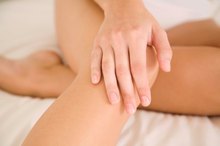
Muscle and connective tissue adhesions are tight bundles of tissues that are sensitive to pressure and can lead to joint and muscle stiffness. They are often caused by constant contraction in a muscle or joint and its surrounding tissues. Injuries and healing wounds can also contribute to adhesions in your calves that can inhibit your ability to move your ankles well, which can lead to foot, knee, hip and lower back pain when you run or walk, says physical therapist Chris Frederick, co-author of "Stretch to Win." Stretching your...
Your soleus plantar flexes, or points, your ankle; helps you maintain an upright posture; and stabilizes your body when you rise on your toes. To stretch the soleus, you must bend your knees. Otherwise, you are primarily stretc...
The muscles of your lower leg help you push off when running by placing tension on your Achilles tendon. Since your calf muscles, your soleus and gastrocnemius, are some of the most-used muscles in your body, stretching them ca...
Running, jumping and cutting are some of the most essential skills in sports. These movements require strenuous use of your calf muscles and sometimes lead to painful calf tightness. Your calves are made up of two muscles: the ...
The gastrocnemius sits on top of the soleus, the deeper muscle. Tight calf muscles "can affect the health of your feet, knees, hips, low back and even your shoulders," according to Evamarie Pilipuf, an ACE-certified personal tr...
Pain in your calf may be related to a strain or an injury that occurs during stretching. It can also be simply a result of overuse. Sometimes, calf pain could indicate a more serious condition. If your pain persists b
They work with the calves and other muscles in the foot and upper leg to move the foot and knee joint in different directions. Stretching the shin can improve ankle and knee mobility between each joint. The National Academy of ...
Calves play an important part in your everyday step and require stretching to function properly. You can stretch your calves barefoot or while wearing shoes, even Doc Martens. Doc Martens are a British brand of footwear that sp...
Your gastrocnemius and soleus, the two major muscles of your calf, power every walking and running step you take. Although having the strength and endurance to provide that power is important, calf flexibility also matters. If ...
Stretching the legs is a component of soccer training, but the way soccer players stretch is not the same as for other sports. Stretching is beneficial to improve flexibility, agility, range of motion and athletic performance, ...
You hold a stretch still without movement for a static stretch, or you move the muscles through a contraction and a release during a dynamic stretch. The calf walk is performed from a standing or facedown position to dynamicall...
These actions are known as dorsiflexion and inversion. Moving the foot in the opposite direction to point the toes stretches this muscle and strengthens the muscles on the rear of the calf. Hold these stretches for 30 seconds.
It also helps to prevent injury. The hamstring and calf muscles are major muscles that do a lot of the work during exercise. Stretches geared toward these muscles are an important part of your exercise routine.
When you're strength training your upper body, your calves help stabilize your body in every standing position. Spending your day at work on your feet increases your potential for calf-muscle tightness and pain. Stretching your...
You use your calves just about any time you move, whether you're walking, jogging or running. Calf strains are common, especially in athletes -- and they can cause pain and tenderness. Exercises to stretch and strengthen the c...
Stretching --- or a slow lengthening of your major muscles --- represents a proven method to prepare your body for exercise and ensure you have the flexibility to avoid injury. Stretching won't increase the size of your calf mu...
The calf muscles are found on the back of the lower leg, below the knee and above the ankle joint. Warming up and stretching these muscles before and after exercise helps prevent injury caused by strains and sprains. Stretching...
The calf muscles are targeted as you use the forward and the reverse mode of the cardio machine. To warm up before using the elliptical, you can do several simple stretches that prepare the calves for exercise.
Therefore, the lengthening affect of any calf stretch that is performed on a regular basis may help give your calf muscles a slimmer appearance. Regardless of the type of calf stretches you perform, stretching has its limitatio...
The muscles of the calves include the soleus and the gastrocnemius. A lack of stretching or incorrect stretching can cause a gradual tightening over a period of several months.
Being that your feet remain fixed on pedals, this form of exercise places little stress on your knee, back and hip joints. Before you step onto the machine to work out, it is a good idea to spend time stretching your muscles. T...
The Pro Stretch is a device that stretches your calf and is an alternative to using a slant board. Product claims include improving flexibility and performance and preventing injuries of the foot, ankle and lower leg. However, ...
Stretching first thing in the morning is one of the best tricks to get your blood flowing, increase energy and prepare your muscles to go to work, according to FitnessTipsforLife.com. Calf stretches are especially helpful becau...
Tight calf muscles are a common ailment that can limit an athlete's effectiveness on the field or court and lead to a variety of foot and ankle injuries. Stretching is the most common way to reduce the occurrence of tight calf ...
Stretching elongates your muscles and helps them to become more flexible, preventing injury and tightness. Exercise isn't the only cause of tight calves -- you can suffer from tight calf muscles due to everyday activities inclu...
They work when your walking around your home or when you are climbing the stairs. If you are doing just about any kind of exercise, your calf muscles will likely play an even greater role. As a result, calf stretches need to be...
Tight calves may cause lower back pain, foot problems and pain in the Achilles tendon --- the tendon that joins the heel to the calf. By incorporating calf stretches into your daily routine, you can improve your flexibility and...
Your gastrocnemius is the larger of the two muscles and is just under the back of the knee, making up the "ball" part of the calf. The soleus is the smaller muscle located beneath the gastrocnemius, which attaches to your Achil...
Keeping these muscles strong and stretched is important for sports, physical activity and daily functions. Always consult your doctor if you experience pain while completing stretches for your calf muscles.
It's good to regularly stretch your calf muscles, because you use them for many daily functions, especially walking, running and any activity that involves raising your heel. Tightness or cramping in your calves is common durin...
The smaller soleus muscle hidden beneath the gastrocnemius puts out the majority of the force when you point your toes with your knees bent. You can adapt most calf stretches to target either the gastrocnemius or soleus by stra...
Both work to extend your ankle in a movement called dorsiflexion. Both calf muscles can be prone to tightness and, if they become overly short, the function of both your knee and ankle can be affected. Make sure you warm up by ...
Your calf is actually a combination of strong muscles and tendons. The gastrocnemius muscle runs from the back of your knee to the back of your heel and is divided into the lateral and medial heads. The soleus muscle attaches t...
Your running stride is dependent upon the calves. Your calf helps propel you forward as you press off of your back foot and stabilizes you as you step your foot forward at the front of your stride. Strong calves can increase yo...
Runners are particularly vulnerable to lower leg injuries such as shin splints, Achilles tendonitis and plantar fasciitis. Before every run, follow a five-minute warm-up with a thorough stretching routine that includes calf str...
Regardless of the reason, tight calves are painful and benefit from stretching. If you exercise regularly, stretching is even more important. Tight calf muscles can increase your risk of developing shin splints, ankle injuries ...
If you participate in activities that use your calf muscles, stretching after a warm up and after heavy activity may be beneficial. If you are recovering from a calf injury, follow your physical therapist's recommendations for ...
The calf muscle allows you to walk, run, and point and flex your toes. This muscle is especially prone to cramping after exercising, so performing stretches as a part of your workout routine is essential for maintaining flexibi...
Stretching both the gastrocnemius and soleus muscles when recovering from a calf muscle strain is necessary, as either muscle can be become strained or injured. You can use active stretching ti apply a gentle stretch to the mus...
The gastrocnemius, the largest of the calf muscles, is the most visible from the outside. The peroneus longus runs down the outside of your lower leg and is most visually noticeable when you flex or point your foot. Yoga moves ...
The calf muscles can withstand a large amount of force and are responsible for much of the load incurred during walking, running and jumping. These two muscles can be prone to tightness due to excessive use, and several machine...
Stretching your calves and feet helps keep your muscles and tendons flexible and prevent sports-related injuries, such as shin splints and plantar fasciitis. Before every workout, warm up with at least five minutes of brisk wal...
Tight calf muscles can throw your spinal alignment off, increasing your risk of muscle tightness, muscle strains and ligament sprains throughout your body. Stretching your calf muscles can prevent such injuries, especially if y...
Calf injuries can range from micro tearing to a full rupture of the calf muscle. While recovery time depends largely on the extent of your injury, calf stretching and strengthening exercises can help return you to your normal a...
The muscles in your calves and shins constantly work against each other to produce force and balance when you stand or move. The ankle and hip joints must have full range of motion in order for these muscle groups to function p...
When you stretch your calves, you cannot isolate certain portions of it because all muscles and tissues are connected. Calf stretches can help you move your ankle better, which prevents knee injuries, according to Coach Mike Bo...
Stretching your calves and your feet keeps muscles supple, which can increase their range of motion and make movement easier. Don't push stretches beyond a feeling of mild tension, and hold them steadily for at least 30 seconds...
Your soleus muscle is smaller and lies beneath and below your gastrocnemius and crosses only your ankle joint. Both muscles work together to point your foot away from you in a movement called plantaflexion. There are a number o...
The gastrocnemius is the main force producer in your lower leg when your run or jump, while the soleus stabilizes your ankles and feet with the tendons and ligaments of your lower leg and foot and the tibialis muscles in your s...
You've probably never seen your soleus, since it's located deep to the gastrocnemius, but you might feel it tighten up from time to time. The best-known calf stretches target your gastrocnemius, but if you bend your knee you fo...
Stretching after a workout can reduce muscle soreness. Stretching your calves regularly is especially important because your calf muscles -- the gastrocnemius and soleus -- work every time your heel leaves the ground. Stiff, ti...
Many people experience tightness in their calves, the muscles at the back of their lower legs. The calf muscle is composed of two separate muscles called the gastrocnemius and the soleus. Stretching both muscles can prevent a...
But several lesser-known factors may also cause bunions on the big toe. These factors cause an imbalance of forces acting on the joints and tendons in the foot. In addition to bad shoes, this imbalance may be caused by poor foo...
Stretching your calves opens the door to a host of potential benefits. According to the American Council on Exercise, taking time to stretch before and after a workout helps loosen your calves, preparing them for the run to com...
The American Council on Exercise advises including stretching as part of your warm-up process before every workout, stretching after five to 10 minutes of brisk activity to get your blood flowing.
Stretching your calf muscle...
Both of these muscles attach to your heel bone via your Achilles tendon and are responsible for extending your ankle in a movement called "plantar flexion." Your calf muscles are important in walking, running and jumping, and n...
It’s no wonder they get tired and tight. Even while sitting or lying down, the calves can grow stiff as fluids pool in the feet and calves. Tightness can turn to spasms, cramps, and painful charley horses, especially if t...
Calf-stretching equipment helps you bend at your ankles, drawing your toes and your shin bone toward each other, elongating the two primary muscles at the back of your lower leg: your soleus and your gastrocnemius. The soleus l...
Some of devices are expensive, but many are cheap, easy to find and just as effective. The key is to find a device that releases both the gastrocnemius as well as the soleus and Achilles tendon. Make sure any device can be used...
Stretching will improve flexibility, increase circulation, and relieve stress, and it should be an important part of your regular workout routine, says the Mayo Clinic. Whether you are getting ready to run a 10k or play a pick-...
When performing dynamic stretching, you will move the designated muscle through motions that increase flexibility. The key to dynamic calf stretching is to perform each movement deliberately for at least one set of eight to 12 ...
The calf muscles are one of the most common places for people to experience muscle cramps due to overuse or inadequate stretching, according to the American Academy of Orthopaedic Surgeons. Stretching and strengthening the calf...
This can cause you to turn the toe out as you steps down, which puts more pressure onto the big toe instead of all the toes equally, says Kevin Colling, DC in his article, "How to Prevent Bunions." Colling works at the Vital He...
If you do not take the time to stretch your calf you can pull or strain this muscle. In addition, the calf muscle attaches to the Achilles tendon, which is another area prone to injury. By doing some simple stretches after each...