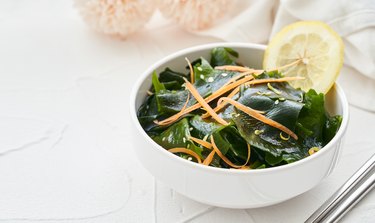
Kelp is a type of edible seaweed known for its high iodine content. It is commonly enjoyed sautéed, in salads or as a dried snack, and is also available as a dietary supplement that is often marketed as being good for the thyroid. However, you should use caution when taking kelp supplements, because the iodine they contain can cause adverse health and safety effects, including iodine overdose.
Read on to learn more about kelp benefits, safety and the seaweed's effects on iodine levels, hypothyroidism and other thyroid issues.
Video of the Day
Video of the Day
Kelp Sources
Dried and fresh kelp can be purchased online; the brown seaweed is also available in many grocery stores, Asian markets and health-food stores. Kelp is sometimes marketed as kombu or "sea vegetable." Kelp snacks can take the form of sheets, puffs and chips. Savory dishes can be made with kelp noodles, puree, whole fresh leaves, flakes and seasonings.
Kelp is dried for use in supplements that are available in tablet, capsule or powder form. Kelp supplements are often labeled as being "a natural source of iodine" that is used "for thyroid support." But many health experts actually warn against kelp supplementation, as the supplements' iodine content can be too high, even for those who don't have thyroid issues.
Kelp Safety
According to research published in the April 2021 issue of the European Thyroid Journal (ETJ), "Consuming seaweed alone or as a dietary supplement is unlikely to be harmful if taken occasionally (once or twice a week). However, regular intake of iodine-rich seaweeds such as kelps ... has the potential of exposure to excess iodine with possible adverse effects on thyroid function, particularly in those with pre-existing thyroid disorder, pregnant women and neonates."
An October 2019 article published by the Cleveland Clinic says that those with thyroid issues don't need to avoid kelp altogether, but also warns against taking it in supplement form. "People with thyroid issues should not have more than an average daily recommended intake of 158 to 175 micrograms of kelp per day," they say. "The concentration of iodine in foods is generally not enough to cause a problem, but a kelp capsule can contain as much as 500 micrograms."
Consult your doctor before taking kelp supplements — and read labels carefully.
Iodine and the Thyroid
As explained in an article published by the Mayo Clinic Health Center in March 2019, the thyroid is a butterfly-shaped endocrine gland found in the front of your neck. It produces a hormone that controls your metabolism. If your thyroid produces too little hormone, it results in a health problem called hypothyroidism. Symptoms include dry skin, weight gain and fatigue. If the thyroid starts producing too much hormone, it's a condition known as hyperthyroidism. Symptoms include weight loss, nervousness and rapid heart rate.
"Avoid [iodine] as a supplement whether you have hyperthyroidism or hypothyroidism," cautions the Cleveland Clinic. "The effect of iodine supplements can vary by person, causing the thyroid to produce either too much or too little hormone."
It's important to recognize that the high doses of iodine in kelp supplements and other dietary sources can throw your thyroid out of whack even if you don't currently have thyroid issues. "Excess iodine can ... lead to too much thyroid hormone production, causing hyperthyroidism," warns the Harvard T.H. Chan School of Public Health (HSPH). "Sometimes even just a slight increase in dietary iodine above the RDA can cause iodine-induced hyperthyroidism in sensitive individuals."
Warning
Iodine isn't the only culprit when it comes to toxicity, overdose, interactions and other adverse side effects of kelp supplements. As researchers at the University of Rochester Medical Center explain, "Kelp may contain harmful metals. These include cadmium, lead, aluminum and other heavy metals. This is more likely if you eat a lot of kelp from areas of contaminated ocean water." They recommend that pregnant or breastfeeding people, those being treated for thyroid issues and people on certain heart medicines all avoid kelp supplementation. Talk to your doctor if your kelp or iodine consumption is a concern for you.
Iodine Overdose
Iodine is an essential trace mineral; the body can't produce it, so it has to come from your diet. According to the HSPH, the recommended dietary iodine intake for adults aged 19 and up is 150 micrograms per day, "and 220 and 290 micrograms daily for pregnant and lactating women, respectively." Seaweeds such as kelp top their list of food sources high in iodine. However, iodized salt is probably the primary source of iodine in your diet.
"Both hyperthyroidism and hypothyroidism have been linked to too much kelp intake," note researchers at the University of Rochester Medical Center. "This is due to its high amount of iodine. Abnormal thyroid function has also been linked directly to too much use of kelp supplements."
In Japan, where high amounts of kelp and other seaweed are consumed, some people exhibit a type of thyroid blockage that causes a diet-induced goiter. An excess of iodine can also lead to Grave's disease, thyroid cancer and toxic levels of thyroid hormones. Symptoms of iodine poisoning include abdominal pain, diarrhea, fever, lack of urination, seizures, shortness of breath, thirst and vomiting, per the HSPH.
When it comes to eating kelp or taking kelp supplements, the iodine level that could cause overdose varies from person to person, depending on individual physiological factors and how much iodine is consumed via other iodine sources such as iodized salt. The thyroid uses a complex system to deal with excess iodine.
"Some authors have suggested that excessive seaweed consumption may itself result in chronic lymphocytic thyroiditis," observes the ETJ. "Even [a] small systematic increase in iodine supply can significantly increase the risk of thyroid disease. ... The mechanism through which seaweed or high iodine levels might promote thyroid cancer remains unclear."
Iodine Deficiency
Just as too much iodine can block the proper production of hormones in the thyroid gland, a deficiency of iodine can make the thyroid work harder. But iodine is a trace mineral, meaning that your body only needs a tiny amount of it in order to be healthy. And as the Journal of the European Economic Association explained in 2017, the serious effects of iodine deficiency became greatly reduced in the United States once iodine started being added to table salt nationwide in 1924. Today, iodine deficiency is rare in the United States, says the Cleveland Clinic.
For these reasons, taking kelp supplements specifically for their iodine content is considered unnecessary.
Related Reading
- European Thyroid Journal: "Iodine, Seaweed and the Thyroid"
- Cleveland Clinic: "Thyroid Issues? What You Should Know About Foods and Supplements to Avoid"
- Harvard T.H. Chan School of Public Health: "Iodine"
- University of Rochester Medical Center: "Kelp"
- Mayo Clinic Health Center: "Thyroid Disease: Symptoms and Thttps://www.mayoclinichealthsystem.org/hometown-health/speaking-of-health/thyroid-disease-symptoms-and-treatmentreatment"
- Journal of the European Economic Association: "The Cognitive Effects of Micronutrient Deficiency: Evidence from Salt Iodization in the United States"
- Cleveland Clinic: "Iodine Deficiency"