
What does fact checked mean?
At SportsRec, we strive to deliver objective content that is accurate and up-to-date. Our team periodically reviews articles in order to ensure content quality. The sources cited below consist of evidence from peer-reviewed journals, prominent medical organizations, academic associations, and government data.
The information contained on this site is for informational purposes only, and should not be used as a substitute for the advice of a professional health care provider. Please check with the appropriate physician regarding health questions and concerns. Although we strive to deliver accurate and up-to-date information, no guarantee to that effect is made.
Lunges Versus Stair Climbing
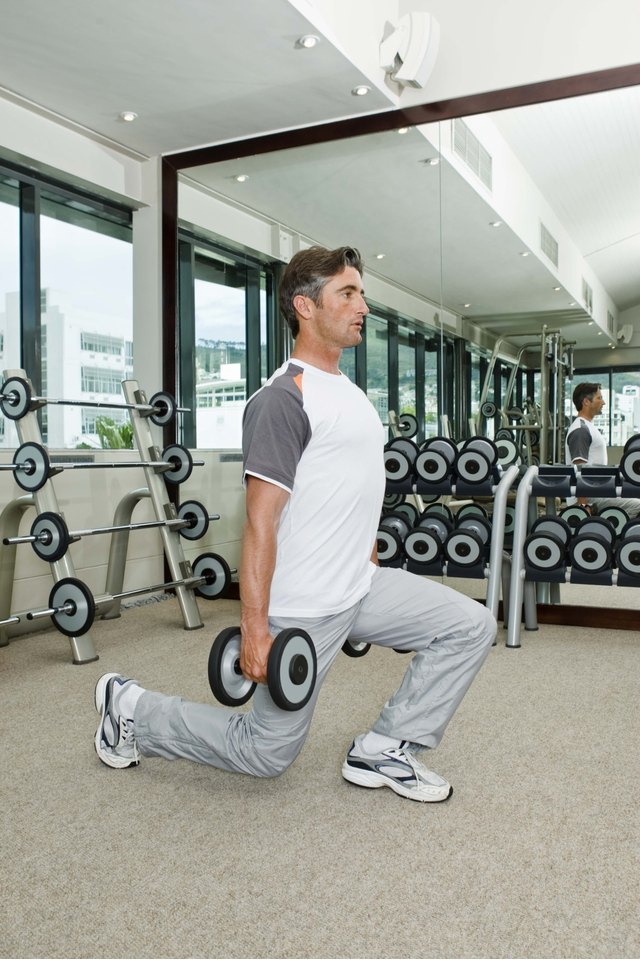
Lunges and climbing stairs share a number of similarities, including their techniques and the muscle groups that they target. While lunges can be performed in a variety of ways, all types of lunges and climbing stairs target the same major muscle groups in the legs. Because of this, you can select one to include in your workout or combine both into the same session if you’re interested in a workout of greater volume.
A Look at Lunges
The traditional lunge involves taking a large step forward with one leg so that you’re in a staggered stance and then bending your front knee to lower your body toward the floor. Continue until your back knee is about to touch the ground, and then extend your lead knee to rise up. Finish by bringing your lead foot back to meet your trailing one. On the next rep, switch legs. Other lunges include the back or reverse lunge, which is similar to the traditional lunge except that you step backward instead of forward; the walking lunge, which involves traveling forward while alternating legs with each rep; and the side lunge, which calls for a large step to the side, followed by bending of the knee to drop your hips toward the floor. You can increase the intensity of lunges by holding a weighted barbell on the back of your shoulders or gripping a pair of dumbbells by your sides.
Stair-Climbing Options
Stair climbing can be used as a challenging aerobic workout or strength-training exercise. If you have access to a staircase, you can continuously climb up and walk down the stairs for 10 to 30 minutes as a cardio workout for developing your cardiovascular system and burning calories. You can also use stairs or a plyo box to perform stepups, which utilize the same technique as climbing stairs, but you focus on overloading each leg to build strength. Set one foot atop the step or box. Drive off your lead leg to lift your body up onto the box. Keep your initial foot on the box as you lower your back foot back to the floor. Perform all reps on one leg and then switch. You can use a barbell or dumbbells to increase intensity.
Muscles Worked
Lunges and climbing stairs primarily work the same group of muscles in the hips and legs. The quadriceps, which are a collection of four muscles at the front of the thighs, extend your knees. Your gluteus maximus, in your buttocks, and adductor magnus extend your hips. The calf muscles handle movement at your ankle joints as you rise up out of the lunge or climb the step. According to ExRx.net, stepups and climbing stairs also require contribution from a number of muscles in your back and shoulders to keep your torso stabilized.
Considerations
Lunges can be performed anywhere and don’t necessarily require the use of additional weighted implements, while a staircase, plyo box or bench is needed for climbing stairs or performing stepups. Lunges require greater balance and coordination to perform with correct technique. When lunging, keep your torso erect and lower straight down toward the floor; keep your front knee from extending beyond the vertical line of your toes, which would place extreme stress on your knees. If you’re climbing stairs, you can skip a stair with each step, which mimics the movements involved in the lunge.
References
Writer Bio
Kim Nunley has been screenwriting and working as an online health and fitness writer since 2005. She’s had multiple short screenplays produced and her feature scripts have placed at the Austin Film Festival. Prior to writing full-time, she worked as a strength coach, athletic coach and college instructor. She holds a master's degree in kinesiology from California State University, Fullerton.