
Physical Therapy Exercises for Cervical Stenosis
Cervical spinal stenosis, also known as cervical stenosis, occurs when the spaces between or around your spine become narrower. This condition can be asymptomatic, but in other cases, it may become a serious issue. Cervical stenosis stretches and exercises can help manage symptoms.
What Is Cervical Spinal Stenosis?
Spinal stenosis is a condition that can affect various parts of the spine. However, the Mayo Clinic says that it's most likely to affect the lower back or neck. These types of stenosis are known as lumbar and cervical stenosis, respectively.
When cervical stenosis occurs, the spaces within your spine become narrower. Emory Healthcare says that stenosis can affect both your spinal canal, where your spinal cord is found, and the smaller openings around it. These are the spaces that your spinal nerves pass through.
According to an August 2015 study in the journal Spine, there are many causes of spinal stenosis. The Brigham Health Hub says that it's most commonly caused by the degeneration and herniation of your spine's disks. It can also be due to bone spurs or thickened ligaments.
Cervical stenosis can be congenital or due to age, genetics or a health condition like osteoarthritis or scoliosis. The Columbia University Department of Neurological Surgery says that a condition known as spondylitis, which is an age-related degenerative spine issue, can also lead to stenosis.
Cervical stenosis can also occur for various other reasons, like injuries. Damage to your spine can happen after an accident, like a car crash. A November 2014 study published in the journal Physical Medicine and Rehabilitation Clinics of North America indicates that cervical spine injuries can also occur from non-contact and contact sports, like football, wrestling, diving and skiing.
That being said, even just the normal wear and tear that happens with age can cause cervical stenosis. Most people with this issue are around 50 or older.
Cervical Stenosis Symptoms and Treatment
According to the Mayo Clinic, cervical stenosis can occur without causing any symptoms. However, people may also experience pain, tingling, numbness or weakness throughout their arms and hands. Symptoms in your legs and feet are only likely to arise in lumbar stenosis.
Clumsiness, jumpy reflexes, feeling that your limbs are heavy, and bowel or bladder dysfunction are also possible symptoms of cervical stenosis. Symptoms typically get worse over time.
Emory Healthcare says that these symptoms commonly due to myelopathy, which is when your spinal cord becomes compressed. They might also be caused by spinal nerve root compression (radiculopathy). Radiculopathy produces many of the same symptoms but is also likely to be very painful.
Treatment for cervical stenosis depends on the severity of your signs and symptoms. If your symptoms are severe, your doctor may recommend a surgical procedure. If mild to moderate, your doctor is likely to recommend pain relievers (anti-inflammatories or opioids) and steroids. He or she might also recommend antidepressants or anti-seizure drugs, which can help manage chronic pain and nerve pain.
If you have become less active due to your painful or unpleasant symptoms, physical therapy may also be recommended. Cervical spine exercises through physical therapy can help prevent pain from getting worse, which may result if your muscles weaken.
Cervical spinal stenosis exercises and stretches can also help maintain the flexibility and stability of the spine. However, you should be aware that physical therapy neck exercises and stretches won't work for everyone who has cervical stenosis.
Tips
People who have cervical stenosis with myelopathy will likely not benefit from physical therapy exercises on their own; they'll likely need spinal decompression, instead. Talk to your doctor or physical therapist to see if doing cervical spine exercises in physical therapy can help reduce or relieve some of your symptoms.
Cervical Stenosis Stretches
If your cervical stenosis symptoms are causing you serious pain or discomfort, your doctor or physical therapist will first recommend rest. Then, depending on your posture, range of motion and symptoms, he or she might recommend certain cervical stenosis stretches.
These exercises, recommended by the North American Spine Society, can help improve range of motion and flexibility.
Move 1: Supine Retraction
- Lie down so that you're on your back.
- Place your fingers on your chin.
- Push your fingers downward, so that your chin moves down toward your chest.
- Hold this position for one or two seconds. You should feel a stretch in the back of your neck.
- Repeat the stretch 10 times.
Tips
Stop immediately if you experience any pain as a result of doing this exercise.
Move 2: Sitting or Standing Neck Retraction
- Stand up straight or sit down in a chair, keeping your back straight.
- Place your fingers on your chin.
- Push your fingers downward, so that your chin moves down toward your chest. Don't let your neck bend backward; your face should remain facing forward.
- Hold this position for one or two seconds. You should feel a stretch in the back of your neck.
- Repeat this stretch 10 times.
Tips
If this exercise helps your pain, feel free to repeat it three or four times a day.
Don't stop once the pain is gone, though — you should continue doing cervical stenosis stretches several times a day for another two weeks to help prevent the pain from returning.
Cervical Spinal Stenosis Exercises
According to a Brigham Health Hub article featuring Dr. Yi Lu, MD, PhD, who is a spine surgeon and the Director of Neurosurgical Trauma at Brigham and Women's Hospital, core-strengthening exercises can also help manage spinal stenosis symptoms. They can take the pressure off the spine by strengthening the muscles that support your back.
Core exercises, like planks and crunches, can help reduce your symptoms if you do them regularly. According to Dr. Lu, this is because “exercises that strengthen the core slow down the wear and tear process.” The North American Spine Society also says that other isometric strengthening exercises can help.
Move 1: Prone Head Lifts
- Lie facedown on a firm surface.
- Rise up on your forearms with your elbows under your shoulders. Your weight should be on your shoulders, and your head, shoulders and chest should be above the mat.
- Let your head hang downward, with your chin on or near your chest.
- Bring your head into a neutral position; then lift your head upward. Gently bend your neck back, as if you were trying to look toward the ceiling. Hold this position for five seconds.
- Bring your head back to a neutral position; then allow it to hang downward toward your chest again.
- Do 5 reps once or twice a day.
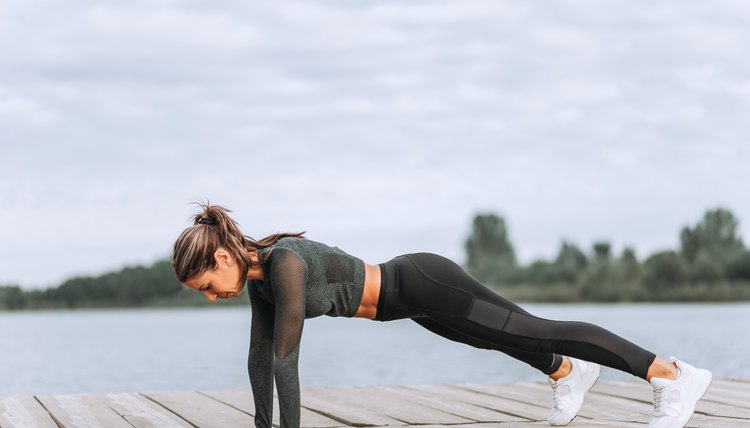
Move 2: Planks
- Lie facedown on a mat. Your body should form a straight line.
- Put your forearms on the mat, keeping your elbows under your shoulders. Put your legs together.
- Rise up so that you're balancing on your elbows and the balls of your feet. Keep your body straight and don't let your hips sag.
- Hold for 30 seconds. Rest and repeat a second time.
Tips
There are many ways to do a plank. However, this core exercise can be a bit strenuous if you're in a lot of pain or are still noticing debilitating symptoms. Try doing a plank while resting on bent knees, rather than on your feet, to make it easier.
References
- ExRx.net: "Front Plank"
- North American Spine Society: "Cervical Exercise: The Backbone of Spine Treatment"
- Physical Medicine and Rehabilitation Clinics of North America: "Return to Play Considerations for Cervical Spine Injuries in Athletes."
- Brigham Health Hub: "Spinal Stenosis: Cervical, Lumbar and Lumbosacral"
- Spine: "The Triangle Model of Congenital Cervical Stenosis"
- Mayo Clinic: "Spinal Stenosis"