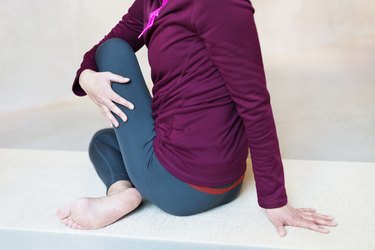
The sartorius muscle is the longest muscle in the body, attaching to two joints, so a pain or strain in this muscle can cause a lot of problems. If you experience sartorius muscle pain, you could feel it in the front of your hips or knees.
The sartorius muscle is something called a bi-articular muscle because it operates on two joints— the hip and the knee. It stretches from the anterior superior iliac spine (ASIS) to the medial knee. The sartorius is a hip flexor along with the rectus femoris, iliopsoas and tensor fasciae latae.
Video of the Day
Video of the Day
Causes of Sartorius Muscle Pain
If you have a relatively sedentary life that includes a lot of sitting, you could be at a higher risk of your sartorius muscle tightening, according to the Cleveland Clinic.
While tightness in itself is not exactly considered an injury, it is a dysfunction. However, sartorius muscle injuries are also commonly a result of chronic tightness, according to the American Academy of Orthopedic Surgeons (AAOS).
If you are feeling pain similar to a burning feeling on the front of your hip, this could be due to sartorius muscle strain or tissue damage. Strains like this can occur if you are an athlete who makes sharp twists and turns in your sport or if you experience a fall where you twist your leg, says the AAOS.
Strains typically occur where the muscles join connective tissue of the tendon, in the case of the sartorius muscle, this is the hip and the knee. A hip strain can occur when one of the muscles that support your hip joint, such as the sartorius muscle, is stretched or torn, according to the AAOS. These strains vary in severity from mild to severe.
Severe strains inhibit your movement and can be very painful. Strains can happen due to any action, but active people participating in sports are more likely to experience hip strains.
A December 2015 article published in the International Journal of Sports Physical Therapy says that lower extremity injuries can often be due to restricted hip flexor muscle length or tightness. Moreover, limited hip flexor muscle length can prevent your motor neurons from properly sending messages to the hip extensor musculature, increasing the risk of lower extremity injuries.
Read more: Glute Exercises That Fix Hip Tightness
Sartorius Pain Relief
According to the AAOS, many hip strains can be treated with simple methods at home, although more severe strains can require physiotherapy or treatment from your healthcare provider. Be sure to discuss any unusual or sudden pain with your doctor.
Home-based therapies recommended by the AAOS include the traditional RICE protocol of rest, icing the area for 20 minutes at a time a few times a day (never directly on the skin), compression using a bandage or compression garments and elevation, resting with your leg raised higher than your heart.
You may also take nonsteroidal anti-inflammatory drugs (NSAIDs) like ibuprofen to reduce pain and swelling for sartorius muscle strain.
Sartorius Muscle Stretches
Stretching can help keep your muscles flexible and healthy to maintain the range of motion in your joints and prevent muscle shortening and tightness, according to Harvard Health Publishing. Stretching can help combat a day spent sitting, which tightens the muscles and can put you at a higher risk of joint pain, strain and muscle damage.
The AAOS recommends the following hip rehabilitation exercises to improve flexibility and strength. Before performing the following stretches, warm up with five to 10 minutes of low-impact activity such as walking. Please note that none of these stretches should cause you pain. If you feel pain, discontinue, and speak to your doctor. Repeat the following sequence four times.
Move 1: Standing Iliotibial Band Stretch
- Standing next to a wall, cross the leg that is closest to the wall behind your other leg. Be sure not to lean forward or twist at your waist.
- Lean your hips toward the wall until you feel stretching on the outside of your hip and hold for 30 seconds.
- Repeat on the opposite side.
Move 2: Seated Rotation Stretch
- Sitting on the floor, cross one leg over the other with the bottom leg outstretched.
- Slowly twist toward your bent leg leaning on your hand, outstretched behind you for support.
- Use your opposite arm to help you twist by placing it on your bent thigh.
- Look over your shoulder, holding the stretch for 30 seconds, and then slowly return to the starting position. Be sure to keep your sit bones pressed into the floor through the entire stretch.
- Switch legs and repeat on the other side.
The American Council on Exercise (ACE) recommends the following stretch for opening up tight hips. This particular stretch, called the seated internal rotation, will target the sartorius muscle.
Move 3: Seated Internal Rotation
- Sit on the floor with your feet flat on the floor and your knees bent.
- Move to a modified pigeon stretch, with your left knee pointing out from the hip at a 45-degree angle.
- Roll back into the seated position you started in while keeping your feet flat on the floor and your knees wide. Sitting up tall, pull your hips toward your heels.
- Roll to the right side into a modified hurdler stretch with your right knee pointing out from the hip at a 45-degree angle.
- Dynamically move from side to side, holding each side for three to five seconds.
- Repeat for 10 to 15 repetitions.
Another sartorius stretch that is particularly good for runners comes from James Dunne, a sports rehabilitation specialist and coach. He combines hip extension, adduction and internal rotation to target the sartorius muscle.
- Folia Morphologica: "Anatomy of Sartorius Muscle"
- Cleveland Clinic: "No Joke: Your Desk Job Promotes ‘Dead Butt’ Syndrome"
- American Academy of Orthopaedic Surgeons: "Hip Strains"
- International Journal of Sports Physical Therapy: "Effect of Restricted Hip Flexor Muscle Length on Hip Extensor Muscle Activity and Lower Extremity Biomechanics in College‐Aged Female Soccer Players"
- Harvard Health Publishing: "The Importance of Stretching"
- American Council on Exercise: "3 Stretches for Opening Up Tight Hips"
- YouTube.com: "Sartorius Stretch for Runners [Ep25]"
Is this an emergency? If you are experiencing serious medical symptoms, please see the National Library of Medicine’s list of signs you need emergency medical attention or call 911.