
Most Devastating Wrestling Moves
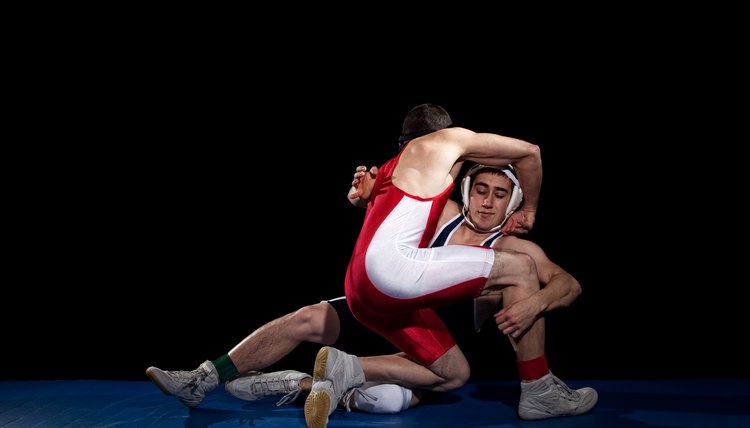
In wrestling, the word devastating does not mean causing immense physical harm or permanent injury. It instead refers to the moves that are most likely to score significant points or achieve a pin and immediate victory for the wrestler performing the technique. That might not seem as exciting as a bone-breaking arm bar, but it can quickly, and sometimes dramatically, end a match.
Cradle
The cradle is a devastating move in that it is likely to put an opponent on his back and hold him there long enough to get a pin. To execute a cradle, you wrap one arm around your opponent's head and neck, and the other around one or both of his legs. Clasp your hands together and maneuver him onto his back. Your grip on his head and legs can prevent him from escaping long enough for you to win the match.
Head and Arm
A head and arm is a pinning combination where one wrestler lies sideways on top of his opponent's chest and wraps the head and one arm in a tight grip. This traps the opponent on his back while putting enough weight on his chest to make breathing difficult, which can be uncomfortable and even frightening. Head-and-arm combinations are effective in high school competition, but college-level wrestlers are often too experienced for this move to work.
Spladle
The spladle is difficult to initially execute, but if you can trap your opponent in this move it's almost impossible for him or her to escape before you score the pin. To perform a spladle, you wrap up one of your opponent's arms in your legs and his other arm with your arms. Position his neck and head against your belly or side. His legs will be up in the air, making any kind of movement difficult. You secure the pin for this devastating move by pulling his head in tightly until his shoulders and back are against the mat.
Crossface
The crossface is a defense against a takedown. It's not a pinning combination, but it is devastating in that it can turn an opponent's momentary advantage into an opportunity for you to seize control. The process is much like punching your opponent in the jaw. Instead of actually striking him, you instead lay your fist against his face and rub your knuckles and wrist along the sensitive parts of his jaw and nose. This will push your opponent away and give you control of his head -- a situation you can convert into a takedown or pinning combination.
References
- NCAA Publications: 2010-11 Wrestling Rules
- Andy Brick; Wrestling Coach; Hillsboro, Oregon
- Jason Brick; Martial Arts Instructor; Browncoat Enterprises; Hillsboro, Oregon
Writer Bio
Jake Wayne has written professionally for more than 12 years, including assignments in business writing, national magazines and book-length projects. He has a psychology degree from the University of Oregon and black belts in three martial arts.