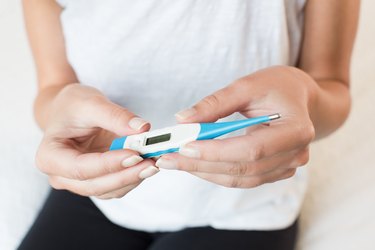
You've probably had it drilled into your head that your body temperature "should" be 98.6 degrees Fahrenheit and that a high or low body temperature signals something is wrong. But that's not quite true.
In general, normal body temperature differs among individuals and ranges from about 97 to 99 degrees Fahrenheit (36.1 to 37.2 degrees Celsius) when taken with an oral thermometer, per the U.S. National Library of Medicine (NLM).
Video of the Day
Video of the Day
Your average body temperature will increase or decrease depending on factors like your age, sex and the time of day — it can even be an effect of exercise. And you can have a low body temperature when you're sick or healthy.
What Does a Low Body Temperature Mean?
Here's the good news: A slightly lower-than-normal temperature is usually nothing to worry about.
In fact, research suggests that average human body temperature may be decreasing slightly, and that 97.5 degrees Fahrenheit (36.4 degrees Celsius) may be a "new normal" temperature, according to Harvard Health Publishing.
This may be due to the fact that we now spend much of our time in temperature-controlled settings, or perhaps because of a population-wide drop in metabolic rate or inflammation, per Stanford Medicine.
What temperature is too low for a person, then?
A consistently or very low body temperature that's lower than 95 degrees Fahrenheit (35 degrees Celsius) often signals accidental hypothermia or an underlying medical issue. That's because having a low body temperature that's less than 95 degrees Fahrenheit doesn't provide enough heat for your heart, nervous system and other organs to function, according to the Mayo Clinic.
Warning
Hypothermia is a medical emergency, so if your temperature is lower than 95 degrees Fahrenheit, you should seek care immediately, per the Cleveland Clinic.
In general, low body temperature occurs when the body loses heat faster than it's able to produce it, according to the Cleveland Clinic. Low body temperature can occur as a result of both external causes (like medication side effects, age or cold weather) and internal causes within the body, such as hormone and nervous system disorders.
Here are several of the other possible causes of low body temperature, along with when to see your doctor.
1. Hypothermia
Your body temperature reflects the balance between the heat your body generates versus how much it loses. Prolonged exposure to a cold environment can potentially lead to hypothermia because of excessive heat loss, according to the Mayo Clinic.
Infants and older adults are particularly susceptible to this condition, as their bodies don't regulate body temperature as well as those in other age groups.
Serious hypothermia is more likely to occur in extreme conditions like if your car breaks down in a blizzard, rather than if you spend a few hours bundled up at a football game on a cold day.
Still, if you plan to spend time outside in cool or cold weather, dress in warm clothing and avoid drinking alcohol, as it dilates your superficial blood vessels and increases loss of body heat, per the Mayo Clinic.
Seek medical attention as soon as possible if you're concerned hypothermia is already setting in. In the meantime, here's how to increase core body temperature:
- Get out of the cold
- Remove any wet clothing
- Bundle up in blankets
- Sip warm beverages
- Avoid applying direct heat, like hot water
2. Hypothyroidism
Hormones regulate many bodily functions, including body temperature maintenance, according to Rush University Medical Center. But per the Cleveland Clinic, if you have hormonal disorders such as hypothyroidism, it can mess with your temperature and make you feel too cold.
That's because reduced production of thyroid hormones can potentially lead to a lower-than-normal body temperature or intolerance to cold. In fact, a low body temperature sometimes serves as an important clue to a hormonal problem like hypothyroidism.
3. Nervous System Disorders
An area of your brain called the hypothalamus serves as the primary site of body temperature regulation, according to Rush University Medical Center. It sends messages to the rest of your body that result in either overall heat conservation or loss.
Nervous system disorders can disrupt this temperature regulation or your response to external sources of cold, leading to a low body temperature, according to an April 2016 review in Autonomic Neuroscience. Examples of these conditions include:
- Stroke
- Spinal cord injury
- Parkinson's disease
- Multiple sclerosis
- Poor circulation in the limbs, also known as peripheral artery disease, per the Mayo Clinic
4. Infection or Illness
Most people think a fever and infection go hand in hand — and they often do.
But you can also have a low body temperature when sick. For instance, a serious infection like pneumonia sometimes triggers a low body temperature, especially among older adults and people with weakened immune systems, according to the Mayo Clinic.
Hypothermia associated with a serious infection often indicates a complication called sepsis, which refers to an out-of-control inflammatory response to the infection leading to malfunction of body organs or systems, per the NLM.
Having a low body temperature but feeling hot may also be a sign of this condition if accompanied by other signs of sepsis (like rapid breathing, fast pulse and disorientation).
Warning
Seek medical treatment immediately if you have signs of sepsis, as developing a low body temperature when you have sepsis typically signals a potentially life-threatening situation, according to an October 2016 study in Critical Care.
5. Certain Medications
A slight decrease or subnormal temperature is a potential side effect of some medications, including certain drugs used to treat depression, bipolar disorder and schizophrenia, according to the Autonomic Neuroscience review.
6. Other Health Conditions
Additional possible, uncommon causes of low body temperature include:
- Anorexia nervosa, per the Autonomic Neuroscience review
- Chronic vitamin B1 deficiency, also known as Wernicke-Korsakoff syndrome, per the NLM
- Hypoglycemia, or low blood sugar, per the Cleveland Clinic
- Certain skin conditions, such as erythrodermic psoriasis, per the National Psoriasis Foundation
Is There a Link With High Blood Pressure and Low Body Temperature?
In general, blood pressure is higher when you're in cold temperatures and lower in warm temperatures. That's because cold prompts your blood vessels to narrow, so more pressure is needed to keep your blood pumping, according to the Mayo Clinic. Lower skin temperatures, a proxy for core body temperature used in some research settings, is associated with higher blood pressure, according to a May 2022 Hypertension study.
How to Take Your Temperature Correctly
Sometimes your body temperature can read lower on a thermometer because you took your temperature incorrectly. In order to get a proper reading, follow these steps, per the Mayo Clinic:
- Always use a digital thermometer: The different types include rectal, oral, temporal artery (which scans the outside of your forehead) and armpit or ear thermometers. Oral and rectal thermometers tend to be more accurate than the other types, which can be affected by the temperature of the environment you're in.
- Make sure the thermometer is touching skin.
- Hold the thermometer still while it's reading.
- Don't remove the thermometer until it has beeped or indicated that it's done reading.
- Take your temperature a few times to ensure the reading is correct.
Normal Body Temperature by Age (in Fahrenheit)
Children | Adults | Older Adults |
|---|---|---|
97.5 to 98.9 degrees | 97 to 99 degrees | 95.4 to 99.3 degrees |
When to See a Doctor
You don't need to run to the doctor every time your body temperature rises or dips a degree or two. A temperature as low as 97 degrees Fahrenheit (36 degrees Celsius) can be perfectly normal if you otherwise feel well.
But you should see your doctor if your body temperature is regularly less than 97 degrees Fahrenheit, especially if you experience other symptoms, according to the Cleveland Clinic.
Per the Mayo Clinic, call 911 if you or anyone you know experience any warning signs or symptoms of hypothermia or sepsis, including:
- Shivering
- Slurred speech or mumbling
- Slow, shallow breathing
- Weak pulse
- Lack of coordination
- Drowsiness
- Confusion
- Memory loss
- Loss of consciousness
- Bright red, cold skin (in babies)



- Critical Care: "Risk Factors, Host Response and Outcome of Hypothermic Sepsis"
- Harvard Health Publishing: "Time to redefine normal body temperature?"
- Cleveland Clinic: "What is a Normal Body Temperature?"
- U.S. National Library of Medicine: "Body temperature norms"
- Mayo Clinic: "Hypothermia"
- Stanford Medicine: "Human body temperature has decreased in United States, study finds"
- Rush University Medical Center: "How the Body Regulates Heat"
- Autonomic Neuroscience: "Thermoregulatory disorders and illness related to heat and cold stress"
- U.S. National Library of Medicine: "Sepsis"
- Mayo Clinic: "Pneumonia"
- U.S. National Library of Medicine: "Wernicke-Korsakoff syndrome"
- National Psoriasis Foundation: "Erythrodermic Psoriasis"
- Mayo Clinic: "Blood pressure: Is it affected by cold weather?"
- Johns Hopkins Medicine: "Fever"
- Harvard Health Publishing: "When Is Body Temperature too Low?"
- Mayo Clinic: "Peripheral Artery Disease"
- Cleveland Clinic: "Hypoglycemia"
- Mayo Clinic: "Fever: First Aid"
- Hypertension: "Inverse Association of Skin Temperature With Ambulatory Blood Pressure and the Mediation of Skin Temperature in Blood Pressure Responses to Ambient Temperature"
Is this an emergency? If you are experiencing serious medical symptoms, please see the National Library of Medicine’s list of signs you need emergency medical attention or call 911.