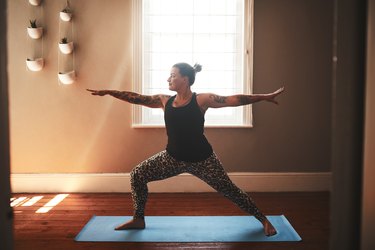
Starting a regular yoga practice might seem daunting at first, but over time, many yogis come to appreciate the physical, mental and emotional benefits so much, they never miss a day on the mat.
Even if you practice the same sequence day-in and day-out, you'll notice that your body never quite feels the same — and neither does your mind. Some days, yoga comes with ease, while other days, it can be a struggle to find the time or the quiet.
Ultimately, it's worth sticking with it — as these 13 convincing benefits of yoga prove.
Related Reading
1. Yoga Is Linked to Better Brain Health
In today's always-on-the-run world, your mind may be constantly spinning — thinking about what happened previously, what's currently going on and what's next on your to-do list. Yoga can help you stay in the present and clear your mind, says Jessica Ray, yoga teacher at Back Bay Yoga Studio in Boston.
Not only can a yoga practice help you think straight, it helps support a healthy brain. Indeed, yoga can have a positive effect on the structure and function of certain brain regions associated with age-related atrophy, according to a November 2019 systematic review in Brain Plasticity.
2. It May Ease Stress, Anxiety and Depression
Yoga has long been linked to better emotional wellbeing.
"Just the simple act of taking a few deep breaths can help ease the mind and reduce stress as your body moves through poses," Ray says. "As you incorporate breath into each movement, the muscles in the body begin to relax and the places we hold our stress and tension start to release."
The research supporting what many yogis experience themselves is still limited, however.
A regular yoga practice (in this case three times a week for four weeks) relieved stress and improved mood and overall wellbeing in a small group of women in a February 2018 study in the International Journal of Preventative Medicine, for example.
Practicing daily yoga and breathing exercises may decrease symptoms of anxiety and depressive feelings in the short- and long-term, according to a small November 2019 study in the Journal of Psychiatric Practice, but the study did not compare the effects of yoga to a non-yoga activity.
Similarly, a small January 2020 study in the Journal of Alternative and Complementary Medicine found that 90 minutes of Iyengar yoga led to an increase in gamma aminobutyric acid or GABA — a brain chemical that's often low in people with depression — and eased depression symptoms in people with the condition, but did not contrast the effects with a control group of participants who did no yoga.
More research is needed to truly understand how (and how much) yoga benefits mental health. In the meantime, it's important to remember it's no replacement for traditional treatment options.
In an August 2020 study in JAMA Psychiatry, adults with generalized anxiety disorder did experience an improvement in symptoms after following a regular yoga practice, but yoga wasn't as effective in the long term as cognitive behavioral therapy.
Related Reading
3. It's a Good Cross-Training Workout
Yoga complements plenty of other activities that work your muscles in different ways. "Many professional sports teams now include yoga as part of their practice," says Laura Burkhart, yoga teacher and founder of Yoga Reach International in San Francisco. "It helps them with the sporting activity in areas like balance, focus and endurance."
If you're already a fitness buff — be it a runner, cyclist, tennis player or weight-lifter — try taking a page from the pros and add some yoga to the mix.
4. Yoga May Help You Sleep Better
If you find yourself tossing and turning at night, yoga could deliver sound sleep. Practicing yoga regularly can help people with insomnia fall asleep faster and sleep for longer, according to the National Sleep Foundation.
Through breath and movement, yoga teaches you how to regulate your energy state.
"Mindful yoga practices can activate the parasympathetic nervous system to initiate the relaxation response, which in turn drains off excess nervous energy and lowers arousal levels," says Brendon Abram, author of Teaching Trauma-Sensitive Yoga and founder of Get Yoga in Ontario, Canada.
The result: When your head hits the pillow, your mind and body are properly prepped for slumber.
5. It Can Be Customized for All Fitness Levels
Yoga allows you to move at your own pace and push yourself as little or as much as you'd like. Most poses have several variations, from basic to advanced, and modifications suitable for a wide range of injuries or abilities.
"No matter your age, weight, strength or flexibility level, yoga is for anyone and everyone," Burkhart says. "It's an activity you can do even into old age."
Unlike many sports or workouts, in which the focus is on going farther or doing better, yoga respects — and celebrates — your physical strengths and limitations, so there's no need to be intimidated by anyone else in the class, Burkhart says. "It's a lot more kind to the body."
Related Reading
6. Yoga Improves Flexibility
For those who struggle to touch their toes, yoga may (gradually) help.
"Flexibility is something I have to consistently work on. It isn't something that comes naturally to me, so I fully understand the difficulty people have with this," Ray says, adding that the key to enhanced flexibility is practicing regularly.
And you don't even need to do it every day to see results: One small study found that a single yoga session a week for six weeks led to significant improvements in lumbar and hamstring flexibility, per the July 2014 issue of the Journal of Bodywork and Movement Therapies.
7. It Inspires Self-Confidence
Mastering new poses expands your confidence in your physical strength and your ability to learn something new.
"As the practice builds strength in our bodies and minds, we start to become more confident in ourselves and our decisions," Ray says. "The practice is a great reminder of how we are stronger than we think, both physically and mentally."
8. Yoga Teaches You How to Breathe Properly
Deep breathing can relax you and help you deal with stress better. And a large part of yoga centers on the breath. "Yoga teaches you to breathe not only when it's easy, but also when things are difficult," Burkhart says.
You may not realize it, but when you're constantly on the go or in stressful situations, you sometimes forget to breathe — at least productively. The slow, deep-breathing techniques you learn in yoga can help in tense circumstances when you might find yourself taking quick, shallow breaths.
"Just the simple act of taking a few deep breaths can help ease the mind and reduce stress as your body moves through poses."
9. It May Ease Joint Pain
Those with arthritis might find themselves especially inspired to take up yoga. Studies of people with various types of arthritis, including rheumatoid arthritis and osteoarthritis, indicate that practicing yoga regularly can help reduce joint pain, plus enhance joint flexibility and function, per the Arthritis Foundation.
Get the green light from your doctor first, then speak with a yoga instructor about modifications that will work for you.
10. It Helps Support Strong Bones
A regularly yoga practice may also protect against bone loss that could otherwise lead to osteoporosis.
In an April 2016 study in Topics of Geriatric Rehabilitation of more than 200 people who practiced yoga more than every other day, the researchers found notable improvements in bone mineral density (a measure of bone health) in their spines and femurs, even in people who had bone density loss indicative of osteopenia or osteoporosis.
Worth nothing: While the participants spent just 12 minutes per day on a 12-pose flow, they maintained their regular yoga practice for years.
11. Yoga Builds Better Balance
As you age, being steady on your feet is particularly important to help prevent serious falls. For older adults, yoga can lead to important improvements in balance and mobility, according to a January 2016 systemic review and meta-analysis in Age and Aging.
Good balance depends upon proprioception, Abram says, "the ability to sense where our body is in space, whether we are moving or standing still."
Yoga not only builds better body awareness, but it also strengthens and tones the muscles that support and stabilize you.
Related Reading
12. It Improves Your Posture
Anyone who has ever felt stiff after spending all day hunched over a laptop or weeding flowerbeds knows carrying your body incorrectly can cause pain, injuries and other health issues.
Poor posture is linked to a host of concerns, including musculoskeletal, digestive and respiratory problems, according to the National Institutes of Health (NIH).
But an active yoga practice can prevent you from falling prey to poor posture, per the NIH. Not only does it help you develop the body awareness to recognize when you're slouching and correct your posture, it also strengthens your core — all the stabilizing muscles around your back, abdomen and pelvis that work together to you hold your body in proper alignment.
13. There's a Type for Everyone
You can find a number of different types of yoga at varying levels of difficulty. From toasty warm Bikram and hot yoga to more traditional Ashtanga and Iyengar to the trendy Vinyasa and power yoga, there are many styles to explore.
Plus, even once you find a type you like, every yoga teacher brings their own style to a class — and as you progress, you'll explore increasingly difficult poses to keep you feeling challenged.
For example, with Vinyasa yoga, there are hundreds of poses and variations that can be combined into a 60- or 90-minute class, so you're never doing the same flow twice.