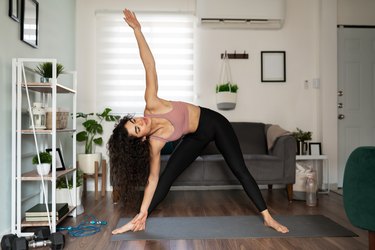
If the different styles of yoga are layers, Hatha yoga is the base. The meditative, stress-busting practice hones in on many of the basic yoga postures, making it a perfect introduction for beginners and experienced yogis alike.
Here's everything you need to know about the benefits of Hatha yoga, what to expect and how to get started.
What Is Hatha Yoga?
Hatha yoga is an umbrella term for all physical yoga practices. In Sanskrit, the word "hatha" refers to the union of two opposites: sun (ha) and (moon) in Sanskrit. This form of yoga is filled with a series of postures, or asanas, that both strengthen the body and improve flexibility. Other types of yoga, such as Ashtanga and Vinyasa, are actually forms of Hatha yoga.
The practice also allows yogis to find both mind and body balance, Candy Glover, a yoga instructor based in Oxon Hill, Maryland, tells LIVESTRONG.com. It does this through the emphasis of eight limbs, or principles:
- Yama (restraint)
- Niyama (observance)
- Asana (posture)
- Pranayama (breath control)
- Pratyahara (withdrawal of the senses from their objects)
- Dharana (concentration)
- Dhyana (meditation)
- Samadhi (contemplation)
"Balance is so hard to come by in our fast-paced culture," says Brandie Regaldo, a San Antonio-based yoga instructor and co-founder of SAY OM SA. "From my personal experience of practicing and observing as a teacher, a Hatha class is often the first opportunity some people have to actually slow down and tune into their body and mind while reinvigorating themselves at the same time."
Related Reading
5 Benefits of Hatha Yoga
1. Stronger Muscles
Each pose is its own strength and endurance exercise. After 12 weeks of Hatha yoga, a group of 154 middle-aged Chinese adults had better muscle strength and endurance, according to a June 2015 study in Evidence-Based Complementary Medicine.
2. More Flexibility and Mobility
As your muscles work, they also stretch and move through their full range of motion. This can help with muscle flexibility and joint mobility, according to the American Osteopathic Association.
This is particularly helpful for people with stiff joints and athletes who want to get better in their sport.
3. Better Posture and Alignment
Over time, you'll also develop good posture. And, by working on your posture, you can do more than ease back pain, you can actually improve your lung health, according to the American Osteopathic Association.
"Through my Hatha yoga practice, I have developed better air flow and breathing practices," Glover says.
4. Better Stress Management
One of the things you'll learn quickly in Hatha yoga is that your breath helps you not only transition between the poses, but mindful breathing also helps you try new and difficult poses. This can easily be translated to life off the mat. When you're going through stressful moments, focusing on your breathing can help put your mind at ease.
"No matter where I am, how I'm feeling or what's going on, if I really take the time to check in with myself, there's always a way to bring more comfort, joy and acceptance into the moment," Regaldo says.
5. A Healthy Body Weight
Regaldo also credits her routine with helping her lose weight. "There are so many benefits to practicing Hatha yoga regularly, but the most dramatic benefit I've experienced was an 85-pound weight loss over the course of four years, which I have been able to keep off for 12 years," she says.
According to Harvard Health Publishing, just 30 minutes of Hatha yoga can burn between 120 and 178 calories, depending on your weight. Take a look at how much you can expect to burn:
Calories Burned During 30 Minutes of Hatha Yoga
Weight | 125 lbs | 155 lbs | 185 lbs |
Calories | 120 calories | 144 calories | 168 calories |
Yoga won't burn too many calories, but you can boost the weight-loss benefits by flowing more quickly from posture to posture. Eating in a calorie deficit (when you burn more than you eat) and incorporating other forms of movement in your routine will help, too.
What to Expect at Your First Hatha Yoga Class
Whether a Hatha yoga class is slower-paced or more intense is up to the instructor, but the most important thing is to breathe through the transitions of the poses and to move at your own pace.
Some Hatha yoga poses you can expect to do include Downward-Facing Dog, Cat-Cow, Child's pose and Mountain pose. These are great basic poses for beginners to learn, but they also help more advanced yogis return to simplicity when they needs to.
While the instructor will give you a general time frame for staying in a pose, you can expect to hold poses for five to 10 breaths. If you're not able to do certain poses, don't be shy about asking for a modification.
Regaldo also suggests letting go of all expectations and encourages students to not be concerned with setting strict goals, such as working hard through the hour-long classes or trying to nail down all the poses.
"I invite you to use your time on the mat for self-exploration and inquiry in place of judgements and rules," she says. "Even five minutes of mindful movements and breathing can do wonders."
How to Find a Hatha Yoga Class Near You
Since Hatha is arguably the most popular form of yoga, many fitness studios and gyms offer classes.
To find a studio or class near you, check out Yoga Alliance and ClassPass. You can also find on-demand classes at Yoga Greenbook, Daily Burn, Peloton and Alo Moves. If you have a gym membership, ask if the facility offers Hatha specifically.
Want to get started at home? This gentle yoga flow is perfect for beginners and takes just 13 minutes.