
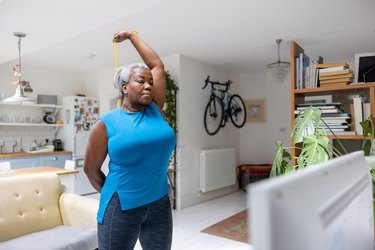
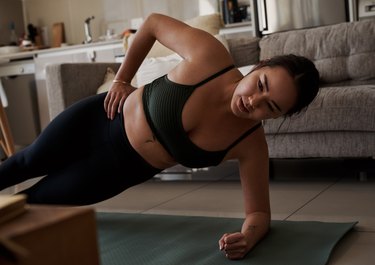
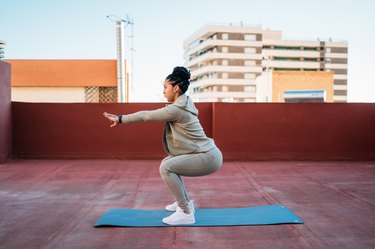
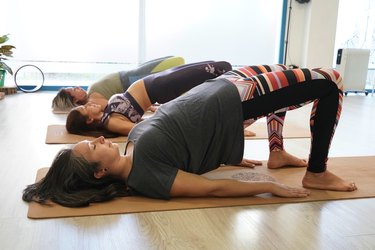
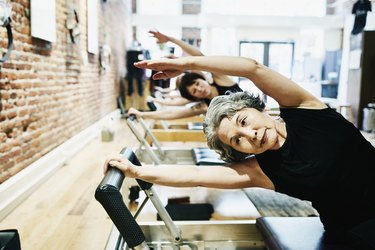
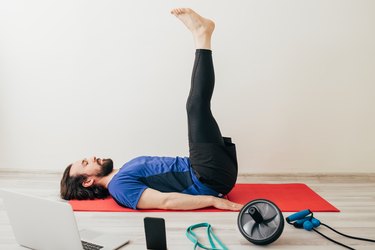
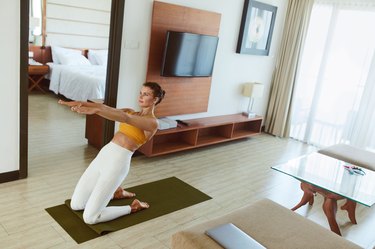
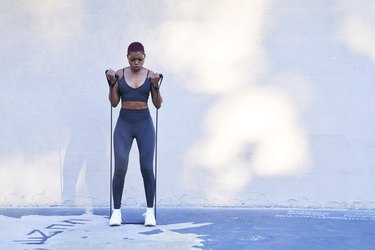

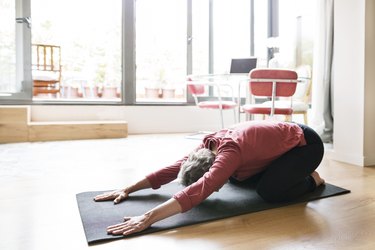
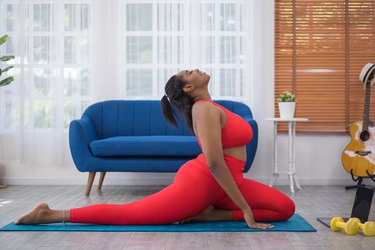
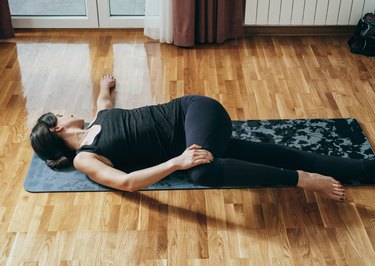

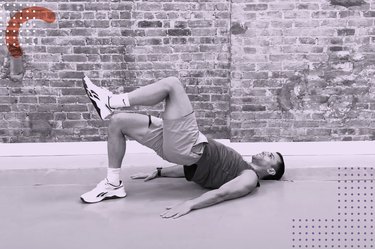

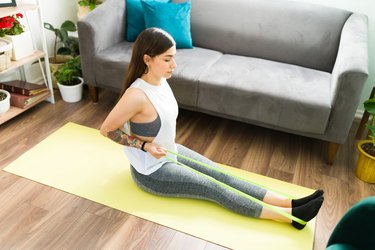
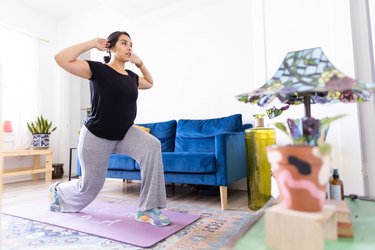

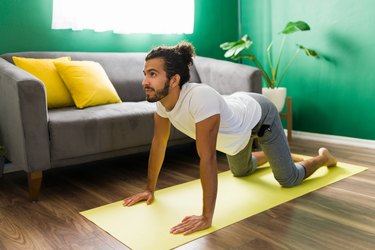

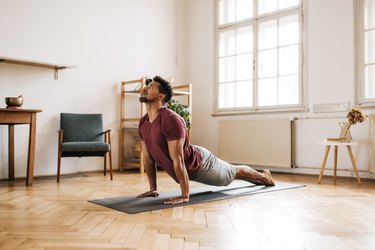
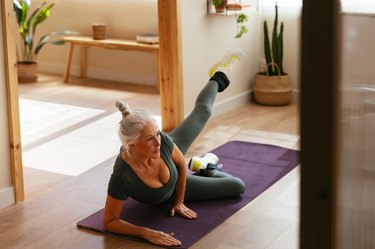
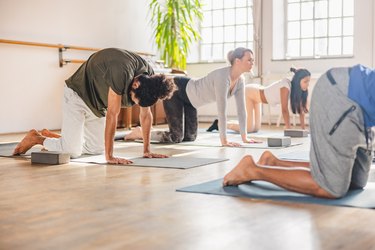

Everyone from athletes to arthritis sufferers can experience hip pain when their muscles become tight or imbalanced. Whether your hip pain is caused by inactivity, overuse or inflammation from a chronic disease, Pilates stretches can help rebalance your musculature and ease your hip pain. Check with your doctor to assess the causes of your hip pain before starting any new exercise program. Once you get your physician's approval, perform all four Pilates stretches in this series on your right leg before switching to your left leg.
Supported Leg Circles
This movement spreads synovial fluid throughout your hip joint, which can ease arthritis pain. Lie on your back with your knees bent and your feet flat. Loop a strap over your right foot and extend your leg toward the sky. Pull gently on the strap ends to drop the weight of your leg into your hip socket. Use the strap to draw a circle with your leg, rotating the top of your thighbone in the hip socket. Draw five to eight circles in one direction, and then reverse directions.
IT-band Stretch
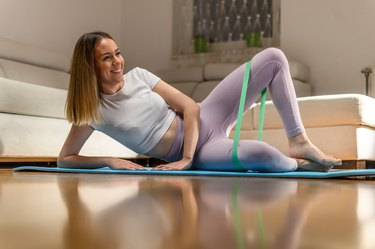
Tightness in your iliotibial band, which runs from the outside of your knee to the side of your hip, can cause an aching sensation anywhere along the band. Lie on your back with a strap looped over your right foot. Extend your leg toward the sky. Use the strap to tilt your leg 6 to 8 inches across the mid-line of your body, creating a tug along the outside of your leg. Breathe in this position for one to three minutes. If you stop feeling a stretching sensation, move your leg farther across the mid-line, but do not raise your hip off your mat.
Groin Stretch
A tight groin can throw off your walking gait, causing hip pain. Lie on your back with a strap looped over your right foot. Reach your left arm out to the side and bend your left knee, pressing your foot into the floor. Extend your strap leg toward the sky and hold both strap ends in your right hand. Lower your strap leg out to the right. Support the weight of the leg with the strap and do not allow your hips to rock. Breathe in this position for one to three minutes. If this position is uncomfortable, place a large pillow next to you to support the weight of your leg.
Figure Four
If you have difficulty crossing your legs, you may have a tight piriformis muscle, which can cause hip pain deep in your seat. Lie with your legs extended up a wall. Place your right heel above your left knee and drop your right knee out to the side, creating a figure-four shape with your legs. Slide your foot down the wall and bend your knee until you feel a stretch in your right hip. Allow your right thighbone to rotate outward. Breathe in this position for one to three minutes.
References
- "The Official Body Control Pilates Manual"; Lynne Robinson, et al.; 2000
- "Trail Guide to the Body: A Hands-On Guide to Locating Muscles, Bones, and More"; Andrew Biel and Robin Dorn; 2010


