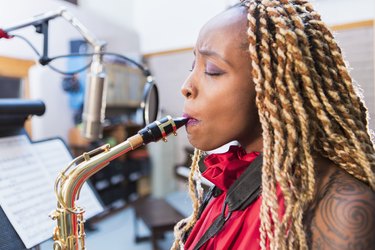
Feel yourself getting winded too soon after you start working out or even just climbing a set of stairs? There are things you can do to increase lung capacity using the same strategies as people who need their maximum lung capacity for their livelihood or avocation, like athletes and musicians.
Read more: The Effects of Exercise on Lung Capacity
Video of the Day
Video of the Day
How Athletes Strengthen Their Lung Capacity
Exercise itself has a huge impact on the lung capacity of athletes, and it comes from practice and hard work, says Jessica S. Wang Memoli, MD, director of bronchoscopy and interventional pulmonary at MedStar Washington Hospital Center in Washington, D.C.
"Exercise increases the volume of air that you inhale with each breath," she says. "That opens up more air sacs, which in turn allows more air to enter the lungs and brings in more oxygen. High-level exercise, such as in professional athletes, is exercise for the lungs as well. This leads to more lung being used routinely and thus more lung available routinely for the exchange of oxygen."
According to the National Academy of Sports Medicine (NASM), how you breathe while training can impact your performance. For example, you can:
- Count reps out loud during workouts to teach yourself to breathe in a steady, repetitive pattern.
- Try timing exhalations on every left footfall to create a rhythm when breathing or side stitches become an issue while running.
- Stand tall with your hands behind your head to catch your breath rather than bend over with your hands on your knees if you run out of breath while exercising.
- Place your hands on your ribs when breathing to feel the expansion.
- Take slow, deep breaths when cooling down after a workout.
NASM notes that people with lung disease can usually exercise comfortably at 40 to 60 percent of peak capacity, three to five days per week for 20 to 45 minutes. If you have asthma or COPD, for instance, it encourages these tips on breathing control and taking frequent rest breaks.
NASM says a "talk test" can be a good way to gauge exercise intensity:
- With vigorous, high-intensity exercise, you can't talk a lot while exercising.
- If you're exercising at a low to moderate rate, you can hold a conversation while exercising.
One strategy in particular that seems to be effective for athletes, says NASM, is respiratory muscle training (RMT). This type of breathing exercise is designed to build the muscles involved in respiration, and studies have shown that it improves sports performance. Because it often involves using a breathing device, you'll want to get guidance from an expert, like a strength and conditioning coach.
How Musicians Strengthen Their Lungs
According to the American Lung Association (ALA), wind musicians in particular need to work on lung capacity to blow enough air into their instruments, but their approach may differ from athletes' training. The ALA notes that performing simple breathing exercises, such as pursed lip breathing, can be helpful. To do this, simply inhale through your nose, then breathe out for at least twice as long while pursing your lips.
Another technique is belly, or diaphragmatic, breathing:
- Breathe in slowly through your nose with a hand on your belly, so you can feel it filling with air.
- Next, breathe out slowly through the nose, relaxing your shoulders and neck as you let the diaphragm do most of the work.
This type of controlled breathing allows musicians to produce steady, prolonged sounds from their instruments or voices. "Musicians have trained their lungs to take in more air to help them with singing," Dr. Memoli says. "This intake of air is the same as the increased volumes that athletes inhale, with the same beneficial effects."
Increase Your Own Lung Capacity
The increased lung capacity that athletes and musicians work to develop is available to just about everyone — even those with COPD and asthma.
"For the average person, and especially for those with lung disease, respiratory exercises as well as general exercise can have the same effect," Dr. Memoli says. "The lungs, like another muscle, get weaker and lazy, and air sacs collapse out of disuse. The only way to reverse that trend is to start an exercise regimen to exercise the lungs in the same way other muscles in the body need to be exercised."
Read more: Benefits of Deep Breathing
- Jessica S. Wang Memoli, MD, director of bronchoscopy and interventional pulmonary, MedStar Washington Hospital Center, Washington, D.C.
- National Academy of Sports Medicine: “The Right Way to Breathe During Exercise”
- American Lung Association: “Breathing Exercises”
- American Lung Association: “Inhale Air, Exhale Music”
Is this an emergency? If you are experiencing serious medical symptoms, please see the National Library of Medicine’s list of signs you need emergency medical attention or call 911.