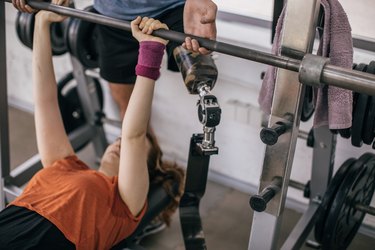
The bench press is a multi-joint movement and key strength development exercise for the pectoral (chest) muscles, shoulders and triceps.
This movement is a determining factor in many athletic and sports events, such as the NFL combine, where NFL coaches ask prospective NFL players to test their bench press as a marker of fitness.
Video of the Day
Video of the Day
Read more: 9 Essential Strength Benchmarks for Men
This exercise will help develop pure upper body strength, endurance and power. While many factors come into play in determining your bench press, such as training level, bodyweight, age and gender, there are certain benchmarks athletes should try to achieve when training their bench press.
Tip
Your bench press to bodyweight ratio depends on many factors, including gender, current fitness level and your weight.
Bodyweight-to-Bench-Press Ratio
Your bodyweight-to-bench-press ratio is dependent on your gender, weight and level of fitness. For example, bench press standards for a man who weighs 165 pounds who is untrained 120 pounds, while an elite athlete at the same weight has a goal of 320 pounds. A male performing at an intermediate level should lift 185 pounds.
Standards for an untrained woman who weighs 165 pounds is 80 pounds, while an elite athlete at the same weight would shoot for 185 pounds. An intermediate level female should lift 115 pounds.
Read more: Major Muscle Groups Used in Bench Press
Bench Press Technique
A study published by the American Council on Exercise in 2012 determined that the barbell bench press had the highest amount of muscle recruitment in the pectoral muscles compared to other chest exercises.
The barbell bench press is performed by lying on your back on a bench. Grab the barbell in your hands with your hands shoulder-width apart. Take a deep breath in and take the bar off of the rack or, if not using a rack, push the bar up toward the ceiling.
Contract your abs as you lower the bar down with control so it lightly touches your chest. Once the barbell touches your chest, push the bar up and away from your body until your elbows lock out as you breathe out.
Read more: Alternative Exercises for Bench Pressing
Additional Chest-Strengthening Exercises
While it is important to train the bench press to increase your one-rep max bench press, there are also additional exercises that can help increase your bench press.
The standing cable press, where you stand up and use a cable to press outward similar to a bench press, is an effective way to improve your one-rep max bench press. The internal obliques and latissimus dorsi are improved by training the single-arm standing cable press. In addition, the standing band press activates ancillary muscles that will help with support.
A supplementary exercise that is beneficial to the bench press is the push-up. As the push-up activates the same pectoral pushing muscles while also activating your core, mimicking the same movement as the bench press. For added resistance, place a weight on your back while performing the push-up. Complementary exercises also include cable crossovers or a pec deck.
Was this article helpful?
150 Characters Max
0/150
Thank you for sharing!
Thank you for your feedback!