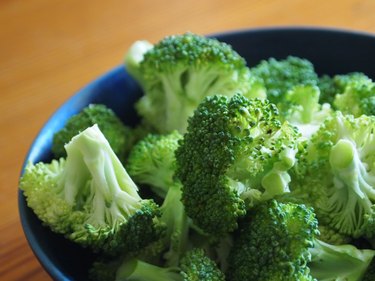
According to the National Digestive Diseases Information Clearinghouse, 42 million Americans, or 15 percent of the population, have been afflicted with constipation, making it one of the most common gastrointestinal disorders. Chances are you have experienced constipation at some point and you know just how uncomfortable it can be. If you have chronic constipation, speak with your physician about changes in diet. High-fiber foods, such as broccoli, can help alleviate this condition.
What Is Constipation?
Video of the Day
Constipation is an uncomfortable and sometimes painful condition. You're not necessarily constipated if you don't have a bowel movement every day. The National Digestive Diseases Information Clearinghouse defines this condition as three bowel movements a week or less with small, hard, difficult-to-pass stools. Constipation is not usually dangerous, but it can be painful and cause you to experience cramping and bloating.
Video of the Day
Causes of Constipation
Stool travels through your colon before it exits your body. When it stays in your colon too long, your colon absorbs water from the stool making it tough and dry and harder for your muscles to pass through. The NDDIC cites a diet lacking in fiber as the most common cause of constipation. Fiber keeps your stool running smoothly through your colon. Specifically, insoluble fiber allows food to move quickly through your digestive tract to alleviate constipation according to Medline Plus.
Fiber in Broccoli
The Institute of Medicine recommends that females 19 to 50 years should consume 25 grams of fiber daily, while men in the same age range should consume 38 grams. One serving of broccoli, which is 148 grams or about 1 1/2 cups, contains 3.8 grams of fiber, which is 15 percent of the recommended intake for women and 10 percent for men. The fiber in broccoli is half soluble and half insoluble. For a high-fiber diet, Harvard University Health Services recommends 6 to 8 grams of fiber at every meal and 3 to 4 grams of fiber at every snack.
Increasing Broccoli in Your Diet
You can easily add cooked broccoli to soups, stews and salads. Or, chop raw broccoli and enjoy it for a snack with a low-fat dip or hummus. Increase your broccoli intake slowly because Medline plus states adding too much fiber to your diet all at once can lead to gas, bloating and cramping. Incorporate it gradually over 2 to 3 weeks. Drink plenty of water, because it will make the fiber in broccoli more efficient in preventing constipation.
- National Digestive Diseases Informaton Clearinghouse: Constipation
- Medline Plus: Fiber
- Institute of Medicine: Dietary Reference Intake: Macronutrients
- USDA National Nutrient Database for Standard Reference: Basic Report: 11090, Broccoli, Raw
- Harvard University Health Services: Fiber Content of Foods in Common Portions
- Medline Plus: Dietary Fiber
Is this an emergency? If you are experiencing serious medical symptoms, please see the National Library of Medicine’s list of signs you need emergency medical attention or call 911.