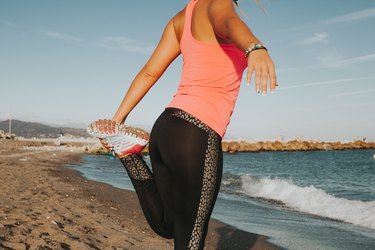
The human body is a tricky thing—though you might be feeling pain in your lower back or struggling with your hips, the actual cause could be the tight muscles in your quadriceps. Both those who are too sedentary or overly active are vulnerable to tight quadriceps, which create imbalanced muscle tension at the hips. If left unaddressed, too-tight quadriceps can effect posture and body mechanics, leading to back pain and increasing your risk of hip and knee injuries.
Read More: Quadriceps Stretches
Video of the Day
Video of the Day
Quadriceps Muscles
Located at the front of your thigh, the rectus femoris, vastus lateralis, vastus medialis and sartorius comprise the four muscles of your quadriceps, and all four muscles influence movement at the knee. The rectus femoris, the largest of the four, crosses over the hip and works with the iliopsoas muscle, located in the pelvic floor, to produce hip flexion.
When quadriceps muscles are overworked from athletic movements such as jumping, running or weight training, they can become tight and inelastic and exert imbalanced tension at the joints. Standing with the knees hyper-extended, as well as spending long times sitting, can also produce tightness in the quadriceps. When tight quadriceps are accompanied by weak hamstrings, you have all the ingredients for an ACL injury.
Hip Flexor Tightness
Your skeleton is a kinetic chain, meaning that the position of a single joint can affect the position of its neighbor. Therefore, when one joint is out of alignment, it can have a domino effect on other joints. Your quads rest right next to your hip flexors, so when the quads become too tight, they pull on the hip flexors.
When this happens, the hip flexors exert force on the pelvis, causing it to tilt forward and throwing the hips out of alignment. An anterior pelvic tilt increases the curve of the low back, compressing the vertebrae and hyperextending the knees. Tight hip flexors can lead to back and knee pain, and can promote inefficient movement during sports that can lead to injury.
Read More: How to Get Rid of Hip Flexor Pain
Patellar Alignment
Tight quadriceps can also lead to misalignment of the patella, or kneecap, causing a painful condition known as patello femoral pain syndrome. In addition to overuse during sports, aggravating factors include as prolonged sitting, squatting, stair climbing and running. PFPS is often caused by imbalanced muscle tension at the knee joint that forces the patella to be pulled off-track. Typically, the rectus femoris and the vastus lateralis exert lateral forces on the knee cap that need to be offset by strengthening the vastus medialis and stretching the tighter muscles.
Restoring Balance
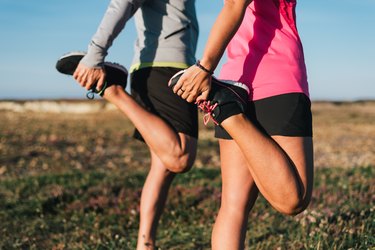
Improve muscle balance at the hip and knee by stretching your quadriceps daily and work on strengthening opposing muscles, especially the hamstrings and gluteal muscles. Start by using simple stretches such as the classic quad stretch:
- Stand next to a wall or chair. Using one arm to balance, grasp the ankle of the outside leg and pull the heel to your buttocks.
- Point your knee straight down to the floor and fully extend your hip.
- Hold your stretch for 30 to 60 seconds.
Is this an emergency? If you are experiencing serious medical symptoms, please see the National Library of Medicine’s list of signs you need emergency medical attention or call 911.