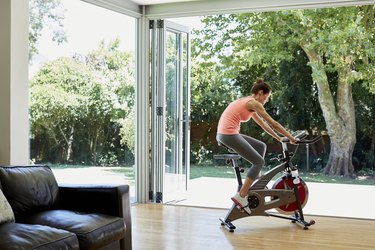
You might be surprised to learn that biking does not increase the size of your leg muscles in proportion to the amount of hours you spend cycling and the effort you exert. That's because of the lack of resistance generated by cycling.
However, resistance from your body weight, gravity and increased gear settings can help you somewhat build your upper and lower leg muscles during your rides. The muscles that get worked the most are the quads.
Video of the Day
Video of the Day
Bicycling suggests that you perform off-bike exercises for your hamstrings, so as not to get that unbalanced look that some hard-core cyclists sport in their legs.
Ride Up Hills
Ride up hills to force yourself to use more leg muscle as you deal with the forces of gravity. Just as setting the incline on a treadmill higher forces you to push harder with your legs, so does going up a hill on a bicycle. Riding uphill requires that you push your body's weight and your bike weight with your quadriceps and hamstrings — and your gluteus maximus if you are riding in a sitting position.
Stand Up to Pedal
Stand while pedaling to add more weight to your down-stroke pedaling, your resistance on the upstroke and to use different muscles than you use while seated. Cycling uses predominantly the quadriceps, calves and glutes during the seated pedal on the down stroke.
On the upstroke, says Harvard Health Publishing, you're using your hamstrings and hip flexor muscles. Raising your heels while standing will require you to use more calf muscle. Do this by pointing your toes downward if you are clipped in. Practice this at a slow pace to make sure you can do it safely at higher speeds and under more stress.
Slow Your Pedaling Down
Pedal slower to use more muscle, rather than benefiting from the momentum of the pedal and chain. Pedaling slower makes you do more of the work, with less assistance from the bike's mechanical apparatus. This is best done on an even grade or a slight incline rather than up a steep hill, which could lead to fatigue and exhaustion much sooner.
Shift Into High
Shift to higher gears to provide more resistance on level surfaces or slight downhill grades. The more resistance your muscles face from the pedals, either by gravity acting on your body and the bike weight or by your legs' efforts against the chain, the more you will stress muscle tissue — which will need to repair and recover, leading to muscle growth.
Sprint for Muscles
Sprint to build leg muscles. The chosen gear should be high enough for you to maintain a sprint for at least thirty seconds with adequate resistance. Spinning the pedals on a low gear with no resistance will not help build leg muscle.
Sprints should be done on a straight-away and can be used as part of high-intensity interval training on the bike. Sprints can be done seated or standing and a good combination of both will help develop leg muscles.
ACE Fitness reports that doing intervals will increase the production of muscle-building hormones; but also warns against the risk of muscle strain.